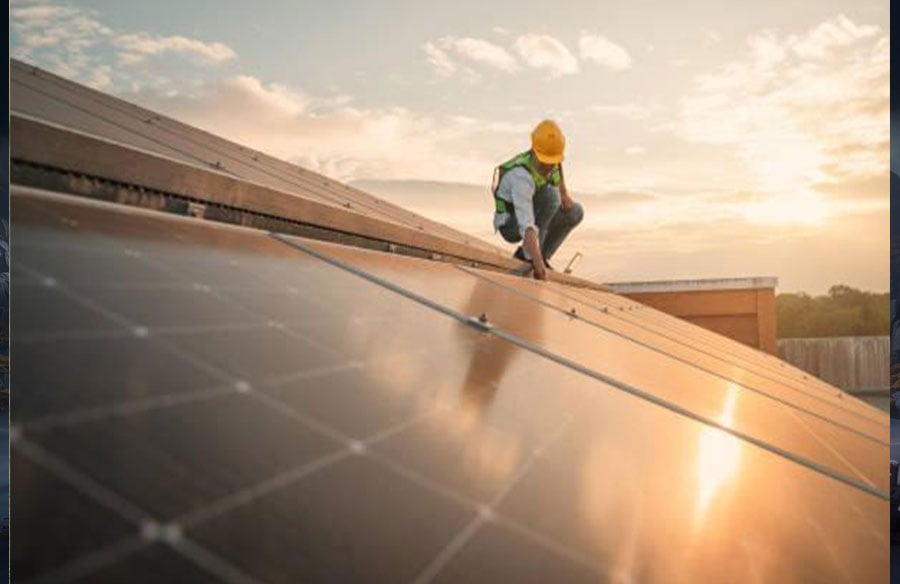
For years, many homeowners and businesses saw solar panels as bulky, unattractive, and expensive due to high upfront costs and awkward rooftop installations.
Today, architects are reimagining solar as part of the building itself—integrating panels into roofs, façades, and even public spaces. Additionally, with prices dropping—from about $40,000 in 2010 to roughly $26,880 today—solar demand is steadily rising.
The result is a seamless blend of affordability, sustainability, and modern design.
Creative Ways Architects Are Integrating Solar Panels
Let’s look at some of the creative ways architects are integrating solar panels:
#1. Roof Integration: From Shingles to Skylights
The days when solar panels simply sat on top of buildings are gone. Now, they are being designed as building materials, and solar shingles and solar skylights are two popular options.
For instance, Google’s Bay View Campus in Mountain View, California features a roof built with solar shingles that produces nearly half of the site’s energy needs.
On the other hand, a standout example of solar skylights is Bell Works in Holmdel, New Jersey. It features the largest photovoltaic skylight in the United States, spanning 60,000 square feet. The installation floods the building with light while offsetting around 60 tons of annual CO₂ emissions.
#2. Façade Integration: Turning Walls into Energy Producers
Instead of being confined to rooftops, solar panels can be embedded directly into walls. In dense urban environments, where rooftops are often crowded or shaded, this approach transforms façades into valuable energy-generating surfaces.
Also, façade integration introduces striking visual possibilities. Panels can be arranged in geometric patterns, tinted, or made semi-transparent to double as windows. In Lausanne, Switzerland, the SwissTech Convention Center shows how façade integration can become art, with colored photovoltaic panels that transform with the changing light.
#3. Solar Canopies and Shading Structures
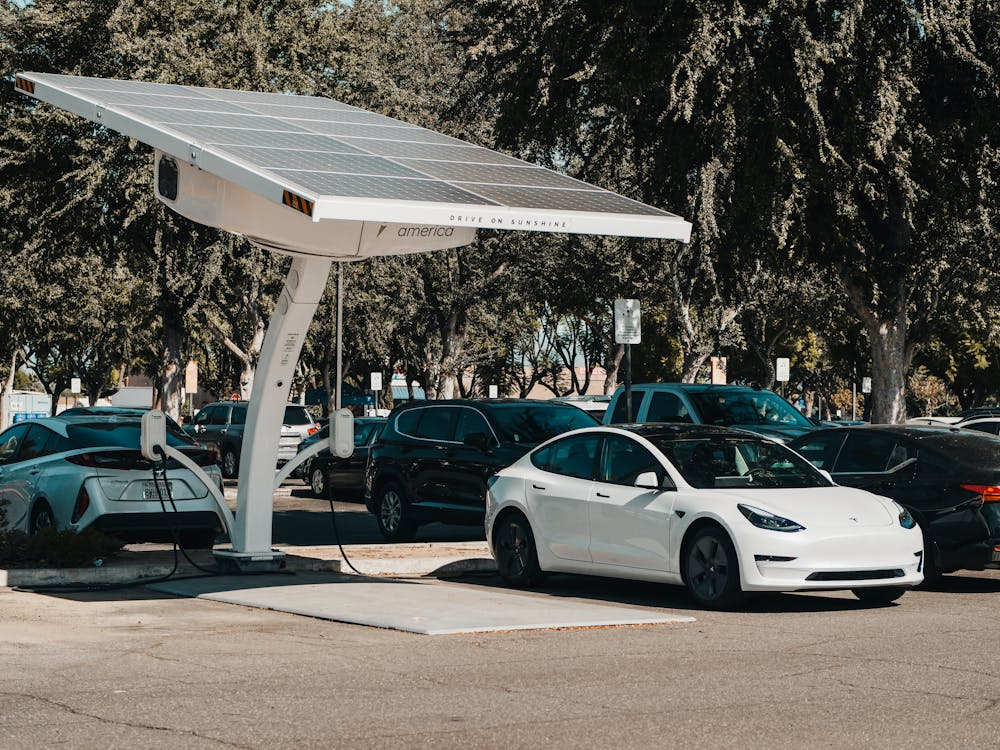 Solar panels are increasingly being used as canopies and shading devices, offering both comfort and clean energy. Carports, pergolas, and walkways can be topped with photovoltaic panels that generate power while providing shade. This makes them especially valuable in sunny regions, where they also help reduce cooling costs.
If you have been to Indianapolis International Airport, you may have parked beneath one of the largest solar canopies in the United States. It provides shade for travelers while producing enough electricity to support airport operations and offset millions of pounds of CO₂ emissions each year.
#4. Artistic and Sculptural Solar Installations
Architects and artists have found creative ways to weave photovoltaics into sculptures, monuments, and public installations as well.
One iconic example is the “Sonic Bloom” installation in Seattle, Washington. It includes five towering flower sculptures equipped with solar panels that power LED lights, creating a mesmerizing light display after dark. By doubling as art, it reshapes the way people interact with solar technology.
In Houston, the upcoming “Arch of Time” sculpture in Mason Park will incorporate over 60,000 solar photovoltaic cells into its exterior, which will generate roughly 400,000 kilowatt-hours of clean electricity annually. Furthermore, the arch will provide shaded space for community gatherings and performances, merging art, technology, and sustainability.
#5. Innovative Materials: Flexible, Transparent, and Colored Panels
Today’s solar technology allows for colored panels that blend into building designs, transparent panes that double as windows, and flexible sheets that wrap around curves.
At Copenhagen International School (CIS), for instance, more than 12,000 blue-green panels cover the façade and transform the campus into a glistening landmark while supplying much of its energy.
Closer to home, in Santa Barbara, NEXT Energy Technologies has turned its headquarters into a showcase for transparent solar windows that generate electricity and integrate seamlessly with the building’s design.
Flexible solar panels have also been applied in functional building designs, allowing architects to cover curved or unconventional surfaces. For example, at the University of Utah, the “Solar Ivy” project used leaf-shaped photovoltaic panels on building façades.
Future Trends in Solar Architecture
The market for building-integrated photovoltaics (BIPV) in the U.S. is set to reach nearly $14.8 billion by 2030. This reflects a shift toward making solar a seamless part of design. One of the most exciting areas is transparent solar panels, a market expected to grow more than 20% annually as architects turn windows and skylights into energy generators.
Solar panels are also moving beyond buildings and into transportation. Buses, trains, and electric vehicles are beginning to incorporate photovoltaic systems to supplement energy use. In New York City, a pilot project is deploying solar-powered electric school buses, while the Rhode Island Public Transit Authority has equipped buses with solar panels to power auxiliary systems.
Pilot projects like SunTrain and Sun-Ways are testing solar panels on trains and between railway tracks, and on the EV front, Aptera Motors in California has developed a solar-powered car that can generate up to 40 miles of range per day.
Final Thoughts
From Google’s Bay View Campus solar shingles to the photovoltaic façade at Copenhagen International School (CIS), creative solar integration is transforming buildings into energy-producing works of art.
As technology advances and costs continue to drop, the future promises even more inventive ways to combine solar panels with eye-catching architecture, making sustainability, energy efficiency, and aesthetics a standard part of how we build.