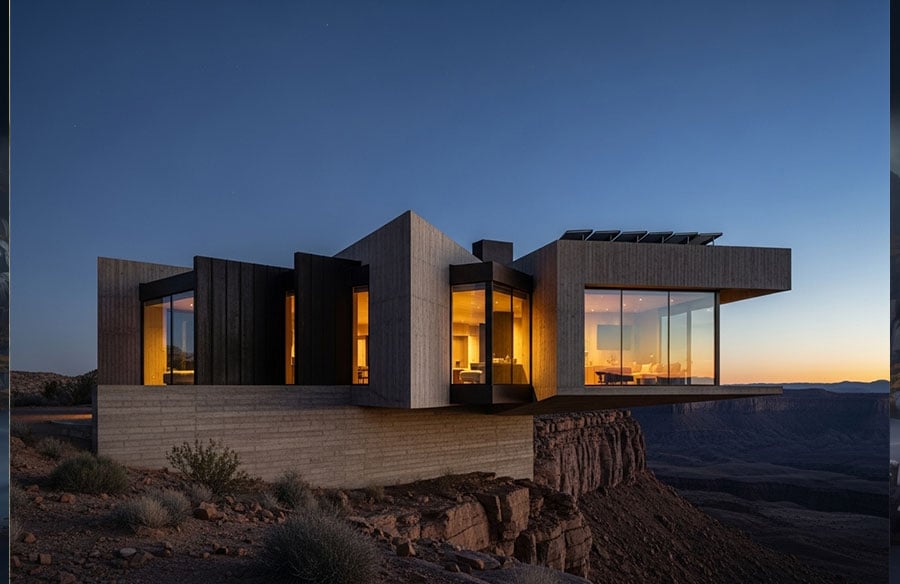
The concept of off-grid living is undergoing a luxurious transformation, representing the pinnacle of sustainable innovation and architectural excellence. Today’s most inspiring designs prove that self-sufficiency doesn’t mean sacrificing comfort or style. Instead, it can mean resilience, independence, and a deeper connection with nature.
As homeowners increasingly seek independence and environmental stewardship, designers craft self-sufficient sanctuaries that offer every modern convenience without relying on public utilities. From tropical islands to snowy mountains, these homes prove that disconnecting from the grid can be the ultimate form of connection—to nature, design, and a smarter way of living.
Kūpono Hale, Maui, Hawaii
Winner of the 2025 AIA Honolulu Design Award for Excellence, Kūpono Hale is a benchmark in regenerative architecture. Entirely off-grid for power and water, the home generates enough solar energy to support its residents and their electric vehicles. Its defining innovation uses Surf Block, a low-carbon building material made from recycled EPS foam. It reduces environmental impact while ensuring durability. By seamlessly blending indoor and outdoor living—a hallmark of Hawaiian architecture—Kūpono Hale demonstrates how sustainability and luxury can thrive together.
Solstice Home, Colorado
Perched high in the Colorado mountains, the Solstice Home demonstrates that energy independence and architectural elegance can go hand in hand. Designed as a Net Zero residence, it produces more energy than it consumes through a carefully engineered solar photovoltaic array paired with battery storage. A propane generator provides backup power, ensuring resilience during extended absences or extreme weather. The home’s design draws on passive solar strategies—such as skylights and shading devices—that flood the interior with daylight while maintaining comfort throughout the year. Though it does not feature every modern amenity, its commitment to self-sufficiency and renewable systems makes it one of Colorado’s most forward-looking examples of sustainable mountain living.
Horizon House, Syros, Greece
On the windswept island of Syros, Horizon House by ONUS Architecture Studio is a striking example of architecture embedded in its landscape. It nearly disappears into the hillside, partially underground and built from stone excavated directly from the site. The home achieves energy autonomy through micro wind turbines, geothermal systems, and rainwater harvesting. It shows that off-grid living can be as much about ecological restoration as independence.
Lib Earth House, Kumamoto, Japan
Japan is pushing the limits of sustainable design with the Lib Earth House, a fully off-grid residence created with 3D-printed soil-based walls instead of conventional concrete. Solar panels and Tesla Powerwall batteries supply the home’s energy, while its curved, earth-formed design blends into the terrain. This project offers a vision of future homes built directly from the ground beneath them, minimizing waste, cost, and environmental impact.
Ecocapsule Box, Slovakia
The Ecocapsule Box offers a 26-foot prefabricated pod with solar panels, rainwater collection, and smart waste management for those seeking modular independence. Its panoramic windows immerse residents in the surrounding landscape, while its modular design allows owners to expand living space by adding units. Compact yet forward-looking, it shows that off-grid living doesn’t have to be large-scale to be transformative.
The Carbon-Negative Beach Shack, Australia
On the New South Wales coast, a modest 1950s shack has been transformed into the Cake House, a climate-resilient renovation by Alexander Symes Architect. The project was shortlisted in the 2025 Houses Awards for Sustainability for its innovative heritage preservation and performance approach. By retaining the original footprint, integrating a high-performance building envelope, and adding rooftop solar with battery storage, the all-electric home now generates more energy than it consumes across its lifespan. A life-cycle analysis confirmed that the design achieves carbon-negative status, while reclaimed timber, masonry, and cladding drastically reduce embodied carbon. This project demonstrates that retrofitting existing homes can be just as impactful—if not more—than building new ones.
The Transformed Cabin, Svalbard, Norway
Located in the remote Arctic archipelago of Svalbard, a 40-year-old off-grid cabin—accessible only by snowmobile in winter or boat in summer—has undergone a heartfelt transformation. Throughout 2025, homeowners documented their renovation journey through videos and social media, revealing how simple updates like painting, lighter furnishings, and thoughtful redesign made the space feel so cozy while retaining its charming rustic character. The updates notably softened the interior, making it feel brighter, more inviting, and distinctly like home.
This renovation offers a genuine, intimate glimpse into how even the most remote and basic structures can be adapted for modern, sustainable off-grid living, enhancing comfort and resilience without compromising the space’s original spirit.
What Defines an Off-Grid Masterpiece?
To be considered a true architectural masterpiece, an off-grid home must embody more than utility independence.
- Innovative Self-Sufficiency: Advanced systems for power, water, and waste.
- Architectural Significance: Visually stunning designs that respect the environment.
- Sustainable Materials: Local, recycled, or low-impact building choices.
- Durability: Engineering that withstands extreme climates and remote conditions.
Future-proofing these systems requires both vision and expertise. When it comes to critical infrastructure like septic design, the right licensed professionals can help ensure your waste management system remains reliable, environmentally compliant, and built to last in even the most remote settings.
The Future of Off-Grid Living
From the lush valleys of Hawaii to the rocky islands of Greece and the icy expanses of Norway, these architectural marvels demonstrate that beauty, sustainability, and independence can coexist. As technology and design converge, off-grid living is no longer a niche—it is becoming the aspirational standard for resilient, luxurious, and environmentally respectful homes worldwide.