The idea of a city without a center—decentralized, endlessly extendable, and structurally democratic—has long shaped architectural imagination, from Archizoom’s provocative No-Stop City to present-day inquiries into networked, adaptable urbanism. These theoretical explorations challenge top-down zoning, instead envisioning a civic space shaped by participation, sharing, and flexible infrastructure. Zhaoxiong Han’s recent works, No-stop Sharing (2024) and Urbanism (2025), extend this lineage into contemporary practice—recasting the abstract notion of infinite cities into grounded, expressive spatial systems.
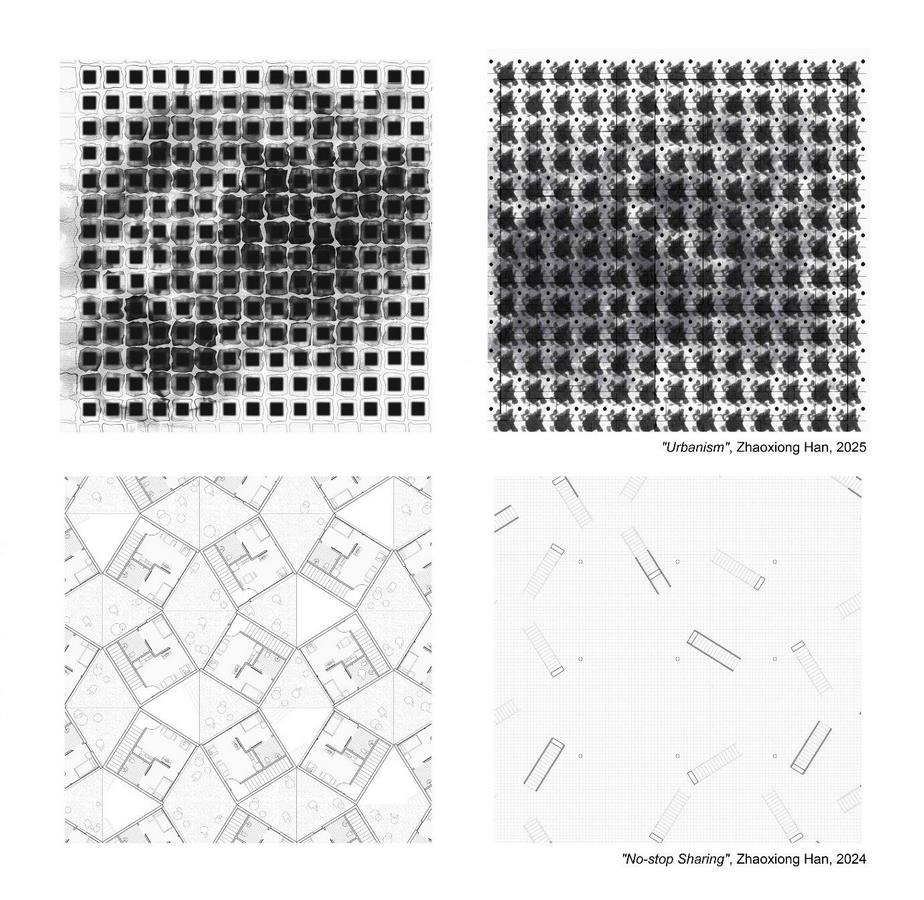 Both projects explore the concept of the city as a field—an open, extendable framework rather than a closed masterplan. They question the necessity of symbolic centers and boundaries, proposing instead that meaningful urban experience arises from distributed structures, modular logic, and the merging of collective order with individual identity.
No-stop Sharing establishes a modular system of civic micro-units arranged in a gridded field. Each unit is open to multiple uses—residential, infrastructural, public—offering a continuous and inclusive urban space unconstrained by programmatic fixity. The system encourages long-term adaptability and sharing, aligning with a vision of the city as a dynamic platform for cohabitation and reinvention. It transforms the rigid repetition of No-Stop City into something socially generous and ecologically responsive.
By contrast, Urbanism takes a more abstract, diagrammatic approach. It visualizes the urban fabric as an array of repeated modules—identical at first glance, yet subtly varied at the edges. These variations express the friction between collective order and personal narrative, suggesting a city where individuals occupy shared systems without surrendering uniqueness. Density is modulated through patterns, not boundaries; urban identity emerges through distributed intensity, not central monuments. In this sense, Urbanism becomes a meditation on how form, repetition, and rhythm can yield a city that is both orderly and intimate.
Together, the two projects advance a unified vision: cities without centers, but full of possibilities. Rather than enforcing order, they enable evolution. Rather than prescribing identity, they invite participation. Han’s reinterpretation of the No-Stop City is not a dystopian field of consumption, but a civic field of potential—where adaptability, sustainability, and individuality coexist within shared frameworks.
Both projects have been recognized through international exhibitions and critical dialogue, including The Order of Chaos in Los Angeles and Fractured Horizons in New York. These platforms have helped situate the work within an emerging discourse around decentralized urban form and open-ended inhabitation. In an era where cities must grapple with ecological limits and social fluidity, Han’s work offers a compelling alternative: not cities built from control, but cities built from continuity, difference, and collective imagination.