
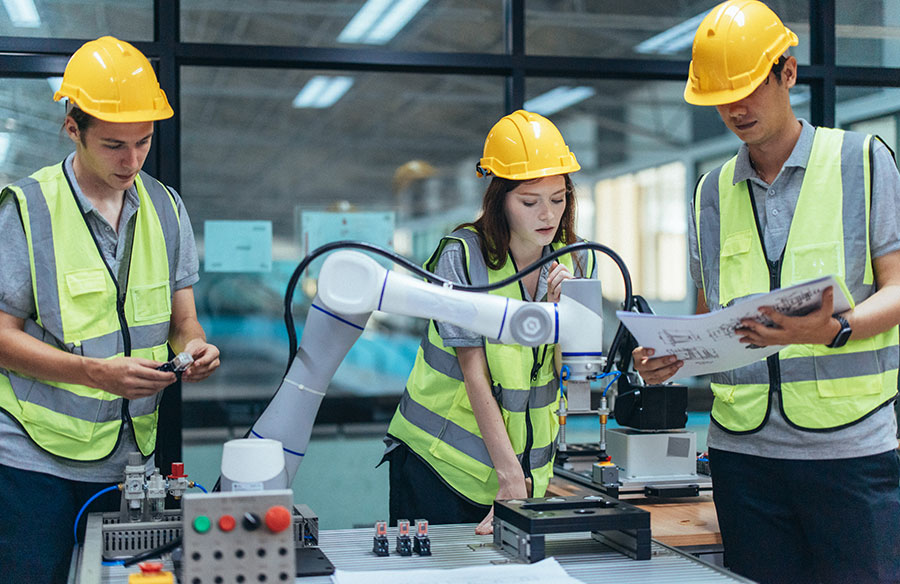
When examining various industries, it becomes clear that AI is significantly impacting how workplaces conduct their operations, from site inductions to presentation and preparation of work. Whilst AI is mainly taking over typical desk jobs, the construction industry is also being affected by the rise of AI.
AI is transforming the construction industry in powerful and practical ways, improving productivity, safety, decision-making, and sustainability. Here, we will examine how the construction industry is being affected by AI and how this can have both positive and negative impacts on the industry.
Design & Planning
In the construction industry, design & planning are pivotal to the business, as failing to prepare is preparing to fail. With the help of AI, companies can use algorithms to generate multiple building layout options based on specific constraints such as budget or energy use. Architects and engineers can work alongside AI to explore optimal designs, making the most of their resources and capabilities.
AI can also be used for Building Information Modelling (BIM), which is incredibly essential for designing and planning. This enables material optimisation, project forecasting and real-time clash detection to be performed, a tool that is helpful for designers and engineers.
Digital twins of buildings can also be produced by AI, which are real-time replicas of buildings, enabling simulation of environmental effects, energy usage and maintenance needs before construction even starts!
Safety & Risk Management
AI can not only help with designing and planning projects, but it can also be used for safety and management issues, such as computer vision. Cameras and AI can work together to detect unsafe behaviour, missing PPE or structural risks in real time, allowing management teams to keep on top of their site.
There can also be predictive safety models which AI can use to determine potential accidents by analysing data from previous incidents and site conditions, ensuring that your site remains safe. The devices can also track worker fatigue, heart rate and proximity to danger zones.
Sustainability & Energy Efficiency
AI models help minimise energy use through better building orientation and materials, ensuring that site managers are getting the most out of their tools and resources. AI can also be used to predict lifecycle emissions and suggest renewable integration, ensuring that your site is the best it can be. With integration suggestions such as solar and geothermal energy sources, AI could help you make the most of energy from renewable sources.
Inspection & Quality Control
AI compares blueprints to completed work to detect discrepancies, ensuring that all of your products and plans are controlled and safe, whilst image recognition can inspect welds, concrete cracks or paint finishes, cutting manual effort and human error.
Pairing AI with quality control teams is the perfect way to make sure that everything about construction sites is incredibly safe and secure, whilst ensuring that all work is done to a proper standard.
Project Management & Optimisation
AI can forecast project delays, cost overruns and supply chain risks based on real-time inputs and historical data. Tools like ALICE Technologies use AI to simulate thousands of scheduling scenarios to find the most efficient path forward, and it can also optimise the use of materials, equipment and labour across multiple projects.
Downsides of AI
Whilst there are many ways that AI can be implemented into construction sites, construction still requires humans for projects to work, as machines will need to be built and plans will be made by humans to ensure that there are no mistakes throughout AI operations.
Another downside to AI is the fact that it will take away jobs throughout the market, as some companies will implement AI solely. The best way to implement AI is to utilise it to enhance the performance of contractors and workers, rather than replacing them.
AI can also come with high initial costs, as implementing relevant tools like drones, robots, or advanced sensors requires significant upfront investment in hardware, software and training. Smaller contractors might find it hard to afford or justify these costs.
There can also be some data privacy and security risks when applying AI. AI often requires collecting large amounts of data, and this can raise concerns about privacy, cyber-attacks and misuse of sensitive information.