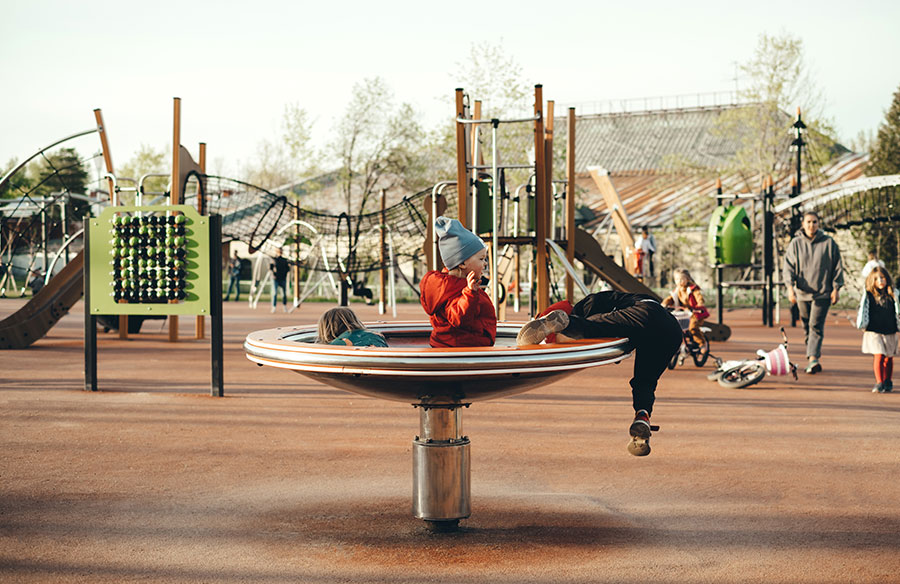
Playgrounds are important for all children, but even more so to those in urban cities where green grass and backyards are harder to come by. Having the space to play freely, explore, and interact with others is essential for children’s physical and cognitive development.
For contractors and designers, building an inclusive playground can be more challenging in cities due to numerous factors. First, it can be harder to locate an area for a playground, and finding ample space may be competitive with other developers with infrastructure plans and needs. Second, a city playground can be much more expensive based on land cost. As a result, designers may have smaller budgets in the design aspects based solely on the price point for the plot of land. Lastly, designers may also be constrained by different zoning laws, permits, and even utility compliances that those in suburban areas may be able to avoid.
Even so, contractors who overcome these hurdles may be curious about incorporating inclusive designs within smaller areas. Here are three considerations to help inform the design while also keeping inclusivity top of mind.
1. Accessibility
When it comes to urban design, accessibility is key. Large metropolitan areas don’t have the luxury of space, meaning any type of construction project needs to be built with accessibility in mind. If a park, for instance, is secluded in a more isolated section of town, families will be less motivated to go. The playground, no matter how beautiful it is, won’t see as much foot traffic if it were stationed in a more public, easier-to-access area.
Besides the physical location, inclusive playgrounds are inherently made for all children to enjoy. Adding ramps, adaptable surfacing, and constructing large, clear pathways helps ensure that children with all mobility levels can get to the playground. Commercial playground equipment such as wheelchair-accessible ramps, inclusive swings, together glides, and turnabout spinners are all great examples of inclusive equipment.
When planning out the final layout and design, it’s also important to consider the surrounding area. Loose materials like pea gravel and sand may look appealing, but aren’t often compliant with the Americans with Disabilities Act, or ADA. Instead, choose surfacing that’s more suitable for wheelchairs, such as rubber matting, which is firm and slip-resistant. Ensure all walkways are clear of obstacles and that there is enough room for children with various mobility constraints to easily enter.
2. Sensory Integration
When you think of playing on a playground, you may first think of a child running, climbing, jumping, and skipping. While these are all examples of play, sensory play is another core component that adds an educational aspect as well. For any child, whether they’re limited by their mobility or not, playgrounds incorporating sensory elements can be engaging and entertaining.
Activating the senses during recreational time is another chance to improve cognition. In a classroom setting, it can be challenging for all children to stay on task and interested. Children with autism or ADHD, for instance, may have trouble concentrating. However, during a set break, such as recess, children may be more attuned to learning when it involves play. Adding sensory elements to a park or playground gives children the opportunity to learn on their terms.
Playground designers can be creative and bring in numerous types of fun elements for each of the five senses. Sandboxes and sand elements are one classic example of a tactical sensory experience, while tactile surfaces are another popular option. Musical instruments and soundscapes stimulate hearing, and bright, vivid pops of color are great for visual stimulation. Smell and taste may be harder senses to incorporate, but a nearby planter full of herbs, fruits, and veggies can help solve that challenge. Planter and container gardens are a good option for metropolitan areas where nature isn’t plentiful and space is limited.
Related to the senses, having a quiet area designated for children who need a break can also be beneficial to kids with certain needs. It’s easy for children with autism, ADHD, or other sensory processing disorders to become overstimulated when playing with other children. A dedicated space, such as a park bench or picnic table, away from the commotion for children and guardians, can be used for those who need a retreat due to sensory overload.
3. Safety
For any playground design, safety should be of the utmost importance. This is especially the case in urban areas where crime rates tend to be higher. For children and families to feel comfortable at a park, you want to ensure that all safety precautions have been thought of.
Make sure the playground is well-lit, especially during dusk when lingering children may still be playing. Installing lighting in and around the playground will help families feel safer. Also, consider installing a fence around the playground. Not only does this carol children into a predetermined area, but it is another way to prevent unwelcome passersby from visiting. To take it a step further, you may also want to add video surveillance cameras to discourage vandalism.
Additionally, it’s also important to encourage parental or guardian supervision. Adding park benches and shaded areas for parents to sit and visit with one another is one way to entice caregivers to stay. Also, posting signage with “Adult Supervision Required” can discourage parents from just letting their kids run free without them there.
Final Considerations
There may be challenges to building an urban inclusive playground, but the reward certainly pays off. Having a dedicated space for city kids to be kids, while interacting and playing with their peers, can be a valuable addition to the city. Contractors and designers should be considerate of accessibility, sensory integration, and safety precautions to ensure the space is well-used and maintained by all children and families.