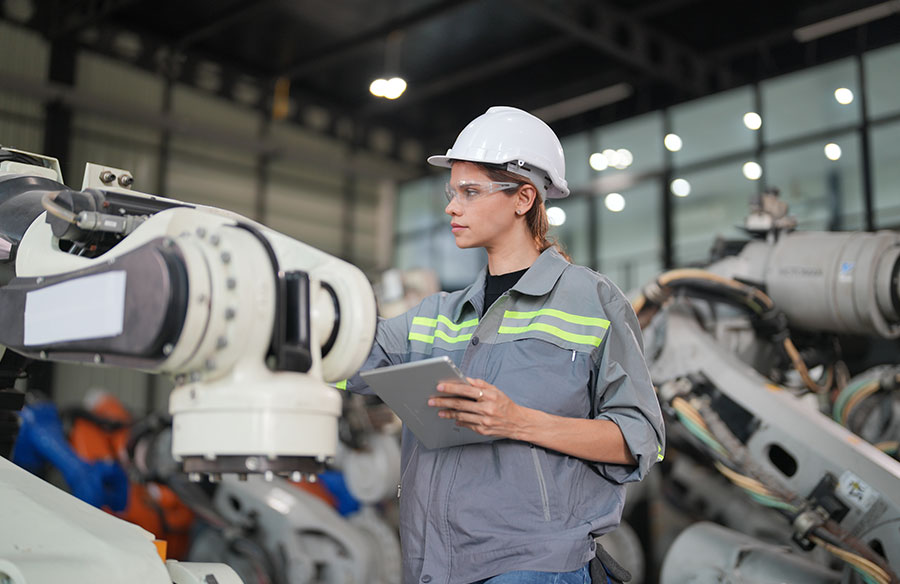
Factories today face a big challenge: staying efficient while keeping up with constant demand. Machines break down, sensors fail, and operators struggle to predict problems before they happen. This can mean wasted time, higher costs, and missed deadlines. Here’s the good news: technology is stepping in to help. Sensors now do more than just measure force or tension; they collaborate with AI to make smarter decisions instantly. Together, these tools are reshaping how industries function and making processes faster and more reliable. In this blog, we’ll examine how sensors and AI power modern industrial control systems. You’ll learn about trends shaping automation and key applications across sectors like manufacturing and robotics.
Ready to dive in? Keep reading!
The Role of Sensors in Industrial Control
Sensors serve as the observation and listening tools of industrial control systems. They gather accurate data to maintain a steady and efficient operation.
Force Sensors
Force sensors measure applied force in machines or structures. These components play a crucial role in industrial automation by detecting pressure, weight, or physical stress. Their precision helps improve safety and efficiency in robotic arms, conveyor systems, and assembly lines. Force measurement ensures that machines respond with accuracy every time. Manufacturers use these sensors to monitor production processes and avoid costly breakdowns. For example, they prevent overloads on machinery during automated tasks. With advancements like smaller designs, they now fit into compact spaces while delivering dependable performance.
Tension Sensors
Tension sensors measure the force exerted on a material or object to monitor stress levels. These sensors are essential in various industries, especially manufacturing and packaging. They help maintain consistent tension in conveyor belts, wires, or fabrics during operations. Accurate control minimizes wear and tear on materials and enhances efficiency. These devices are important for industrial IoT applications. By collecting real-time data, they assist advanced control systems and intelligent automation processes. Combining AI algorithms with these sensors enables predictive maintenance, reducing downtime and improving production dependability.
Torque Sensors
Torque sensors measure rotational force in systems such as engines or robotic arms. They help monitor machinery performance by detecting twists, turns, and strain during operation. This ensures precise control of industrial automation processes. These sensors play a significant role in robotics and smart manufacturing. For example, they assist robot joints in applying the appropriate amount of force for delicate tasks like assembling electronics. Their incorporation supports more efficient operations across various industries.
Load Cells
Load cells measure weight or force with high precision. These sensors convert mechanical force into electrical signals, assisting businesses in monitoring loads in real time. Industries apply them in weighing systems, material testing, and automation processes to enhance productivity. “Without exact measurement tools like load cells, industrial control would still rely on estimation.”
AI and Its Integration in Industrial Control
AI reshapes industrial control by analyzing data faster than humans ever could.
AI-Powered Predictive Maintenance
AI algorithms predict when machines will fail by analyzing past performance data. They detect patterns not easily noticed by the human eye, reducing downtime and expensive repairs. Sensors gather real-time information like temperature, vibration, and pressure from equipment. This data feeds into AI systems that assess machine health constantly. Industrial IoT connects devices, enabling fast communication across factories. Machine learning improves predictions over time, helping to identify issues earlier. A faulty motor might show slight irregularities in vibrations before breaking down completely.
Businesses save millions by fixing problems during scheduled maintenance instead of reacting after failures occur. To support such systems, companies often rely on managed services like IT support by Nortec for monitoring infrastructure and ensuring uninterrupted performance. Real-time processing ensures smooth operations for maximum efficiency across industries, like manufacturing or agriculture, that rely on precision machinery.
Real-Time Data Processing with AI
AI processes sensor data immediately to identify patterns or irregularities. Factories apply it to oversee production lines and spot product defects within moments. Machine learning models anticipate equipment failures ahead of time. This decreases downtime and prolongs machinery longevity. AI systems enhance Industrial IoT by providing quick, precise insights for informed manufacturing decisions.
Key Technology Trends in Industrial Control
Technology in industrial control is shifting gears, combining AI with more intelligent, compact sensors and wireless systems.
Miniaturization and Sensor Integration
Smaller sensors now fit into compact spaces, allowing machines to operate with greater efficiency. Industrial automation systems use these tiny components to monitor processes in tighter environments without sacrificing accuracy. For example, advanced load cells manage weight measurements in conveyor belts while taking up minimal room. Sensor integration combines multiple functions into one device, reducing equipment costs and maintenance needs. AI algorithms process data from merged sensors faster than ever before, improving decision-making in smart manufacturing setups. This approach supports smooth communication between robotics and other control systems for precision tasks.
AI and Sensor Fusion
AI combines data from multiple sensors to provide more precise results in industrial control. For example, AI algorithms can analyze information from gyroscopes, accelerometers, and load cells simultaneously. This allows systems to detect errors or inefficiencies faster than traditional methods. Machine learning models process this data in real time to make quick adjustments during operations. Businesses benefit from reduced downtime and better output predictability. Sensor fusion improves the accuracy of decision-making by removing noise and inconsistencies in data streams. Robots equipped with combined sensors can adapt to changing conditions like surface irregularities or weight changes instantly. Industrial Internet of Things (IoT) networks bring together these advanced control systems for smarter manufacturing processes. Wireless connectivity further simplifies setup without compromising efficiency or reliability.
Wireless Connectivity and IoT
Wireless connectivity links machines, sensors, and systems without physical cables. It substitutes conventional wiring with quicker and more adaptable alternatives. Technologies like Wi-Fi, Bluetooth, and 5G networks improve communication between devices in industrial automation. To maintain this performance, companies may turn to providers offering services like IT support in Wentzville to manage connectivity, troubleshoot IoT deployments, and optimize system reliability. The Internet of Things (IoT) supports smart manufacturing through connected devices that exchange real-time data. Sensors gather information from machinery to track performance or identify errors early. This provides opportunities for predictive maintenance and minimizes expensive downtime.
Applications Across Industries
Industries now demand smarter control systems to handle complex tasks. AI and sensors together have turned impossible ideas into everyday solutions.
Manufacturing Automation
Factories use robotics and AI algorithms to increase production efficiency. Automated systems reduce human errors, saving time and money. Advanced manufacturing uses sensors for accuracy at every step. For instance, industrial IoT connects machines to track operations in real time. Machine learning processes data instantly to adjust workflows as needed. Digital twins replicate workflows before implementation, minimizing risks. Cyber-physical systems connect physical machines with digital control systems for smooth performance in complex tasks like assembly lines or quality checks.
Agricultural Machinery
Automation in manufacturing has created the basis for progress across other sectors. In agriculture, machinery equipped with advanced control systems is changing traditional farming practices. Smart tractors now rely on sensors and AI algorithms to monitor soil conditions, crop health, and equipment performance in real time. Machines like combine harvesters use industrial IoT connectivity to sync data between devices. Precision planting systems use force sensors and load cells for accurate seed placement. These technologies save fuel, reduce waste, and improve yield predictability. AI-powered predictive maintenance ensures fewer breakdowns during critical harvesting periods.
Medical Robotics
Medical robotics incorporates sophisticated robotics and AI to enhance healthcare precision. Robotic surgical systems, like the da Vinci Surgical System, improve human dexterity in minimally invasive procedures. These machines decrease errors and accelerate recovery times for patients. AI algorithms in medical robots analyze large volumes of real-time data during surgeries or diagnostics. Industrial control systems enable accurate movements and decisions, fostering safer operating environments in hospitals. The use of industrial IoT ensures smooth integration between robotic devices and broader healthcare networks.
Conclusion
Sensors and AI are reshaping how industries work. They blend precision with intelligence, turning raw data into smart decisions. From factories to farms, these tools enhance efficiency and reliability. The future of industrial control isn’t just bright; it’s already here, driving change at every turn. Are you ready to stay ahead?