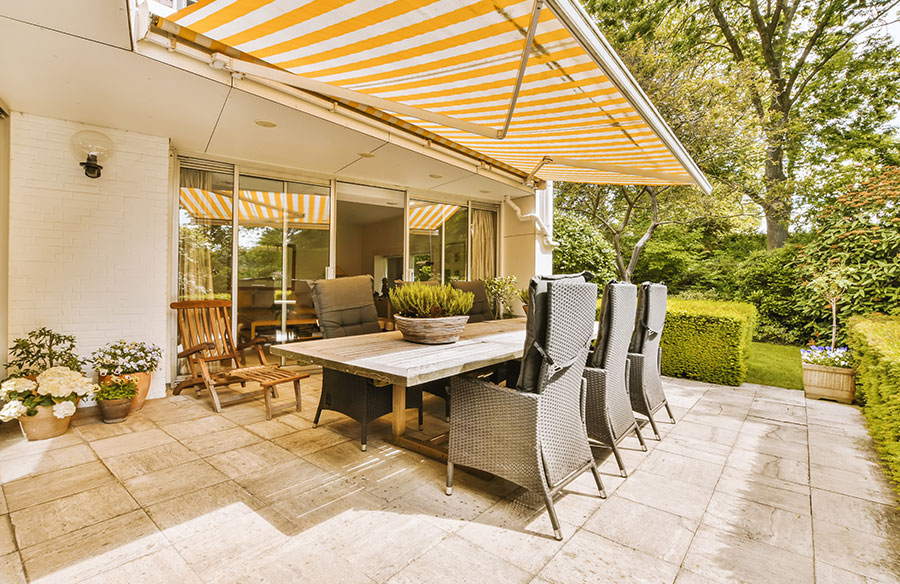
While not always the case, in the majority of cases, retractable awnings are going to cost more than fixed awnings, usually around 20% more.
Motorized retractable awnings are even more expensive and can be anywhere from 30-50% more expensive than regular awnings.
Retractable awnings also tend to be less durable and require more maintenance, which begs the question: Why would anyone choose a retractable awning, and is it really worth it?
That’s what we’re going to be going through today, starting with the costs.
Retractable Awnings vs Fixed Awnings Cost
To assess whether retractable awnings are worth the price, we need to first know how much they cost.
There are two main types of retractable awnings—manual and motorised ones.
You can expect to pay anywhere from $800-2,500 USD for a manual retractable awning and $2,000-6,000 USD for a motorised one in America.
A manual retractable awning in Singapore typically costs $1,200-2,800 SGD, and a motorised one $2,500-6,500 SGD.
For Australia, manual retractable awnings are usually between $1,000 and $2,500 AUD, and motorised ones between $2,000 and $5,500 AUD.
So retractable awning prices tend to be roughly the same around the world when converted into the same currency.
There are also more technologically advanced motorised awnings that are equipped with sensors and detectors for the wind, sun, and rain. These are less often seen, but to install one for your home, it’ll usually set you back anywhere between $5,000 and $12,000 USD.
These are overall final prices, which means labor and installation are all accounted for already.
The exact amount you pay in the given range will depend on a few things: size, material quality, frame material, customisation, and installation costs.
In comparison, here’s how much fixed awnings typically cost based on the material you choose:
- Aluminium: $400-1,200
- Polycarbonate: $600-1,500
- Steel: $1,000-3,000
- Glass: $2,000-6,000
As you can see, retractable awnings can cost quite a bit more than stationary ones.
And it’s not just the installation. Due to the complexity of the retractable awning mechanism, whenever any of the parts malfunction or spoil, repairs can be quite costly.
These repairs are usually required more often too, as with fixed awnings, as long as you properly clean and maintain them on your own, there shouldn’t be any repairs needed for the lifespan of the awning.
Now that you have a good idea of how much more retractable awnings cost, let’s go over why you might choose a retractable awning nonetheless.
Why Choose Retractable Awnings Over Fixed Ones?
It goes without saying that the main difference between stationary and retractable awnings is that retractable awnings can be extended and retracted as needed.
So what you’re really asking is “How important is being able to retract and extend your awning, and what benefits do they bring?”.
1. Comfort
One of the biggest reasons why people ultimately still opt for retractable awnings despite their price is the comfort that they get.
While both fixed and retractable awnings shield you from the sun and rain, the key difference is that with retractable awnings, you can retract them on cooler days when the sun isn’t as bright.
This could be during autumn or even during summer on more cloudy days. At times like these, an awning can actually make your space feel too dim, and you’ll wish you could retract it.
This is especially true with window awnings, as even on just slightly less sunny days, an extended awning can make the indoors quite dark.
2. Weather Protection
Another huge reason to choose retractable awnings over stationary ones is weather protection.
During violent storms, strong gusts of wind and hail can damage or stress your awning and even damage its supporting structure.
Even during normal storms, strong gusts of wind can put pressure on your awning and its supporting structure.
Over time, this can accumulate and damage your awning or even cause its supporting structure to buckle and break.
With retractable awnings, you can retract the awning during storms when you’re not using them. You can even equip your motorised awning with wind and rain sensors that will detect when winds have gone past a certain threshold and automatically retract your awning.
This keeps your retractable awning protected and perfectly safe from harsh weather even when you’re not at home to manually retract it.
It’s not just during inclement weather either. Even when the sun is up, you can keep your awning retracted so that it doesn’t get worn out by UV ways, which can cause discoloration and fading.
So while retractable awnings may require more maintenance and aren’t as sturdy as fixed ones, they’re much better protected from inclement weather and wear and tear, which can actually end up helping it last even longer than stationary awnings.
3. Aesthetics
In some cases, your awning can boost your space’s aesthetics, eg a sleek glass awning or a bright, bold fabric awning.
However, in most cases, eg ACP awnings, metal awnings, etc, they don’t do much to help your aesthetics.
As such, many homeowners actually prefer to keep their awnings retracted until they need them so that their home’s overall aesthetics is more clean and less affected by the awning.
Drawbacks Of Retractable Awnings
The most obvious drawback is that they cost more, but that’s not the only one.
With more moving parts, more maintenance needs to be done, and when things go wrong, repairs are usually more expensive due to the complexity of the mechanism.
Being fabric, retractable awnings are also less sturdy than stationary awnings. In other words, during more intense storms, you need to retract them, and they won’t be able to protect you like a stationary awning would.
Finally, motorised units are also dependent on power, so during power outages or if there’s an issue with the wires, you won’t be able to operate them.
Verdict: Are They Worth It?
At the end of the day, both fixed and stationary awnings have their flaws, so it boils down to what you need and want.
Retractable awnings may be less sturdy and require more maintenance, but you also get more flexibility with them, they’re much better protected from wear and tear and harsh weather, and they won’t affect your aesthetics.
So consider if aesthetics and flexibility matter more to you and you’re willing to pay more for it, or if more sturdy protection and lesser maintenance appeal more to you.