Why resilience is no longer optional
The IPCC projects that we are likely to breach the 1.5 °C threshold this decade, bringing more frequent heatwaves, floods and lightning strikes to every region. Buildings that rely on historic weather files or rules‑of‑thumb are increasingly exposed to events they were never engineered to withstand. Lightning risk assessment and other hazard forecasts are therefore becoming core inputs for architects who must satisfy tightening insurance and regulatory requirements.
A new design palette: high‑resolution climate‑risk & lightning‑strike data
Environmental platforms that were once the domain of climate scientists are now packaged for the AEC sector:
| Data Service | Key Variables for Architects | Typical Use‑Cases |
| ClimRR (US) | Future hourly extremes of temperature, precipitation, wind, humidity, lightning strike data | Sizing HVAC & envelope components for 2080 conditions; preliminary lightning risk assessment for buildings |
| ClimateData.ca – Buildings module | Cooling/heating degree days, freeze‑thaw cycles, 1‑day max rainfall, sea‑level rise projections | Overheating analysis, foundation design in permafrost zones, drainage sizing |
| Typical & Extreme Weather Datasets | Hourly files for 15 global cities under 12 climate scenarios | Early‑stage energy modelling and structural load checks |
These open (or low‑cost) datasets arrive pre‑processed and geo‑located, so architects can import them directly into BIM or analysis software—instead of relying on coarse climate “normals.”
Integrating AI‑powered lightning risk management
While floods and wind loads have long been modelled, AI‑powered lightning risk management solutions can now analyse decades of cloud‑to‑ground strike density, soil resistivity and topography to create location‑specific lightning risk assessment with AI. A typical workflow looks like this:
- Import regional lightning strike data (e.g., from ENTLN or GLD360) into a dedicated lightning risk software plugin.
- The model calculates strike probability and peak current values for the building footprint and its tallest architectural features.
- Results feed directly into generative design loops that optimise roof geometry, conductor paths and equipotential bonding layouts, ensuring the structure meets IEC 62305 or NFPA 780 without costly over‑engineering.
The outcome: faster compliance reviews, lower material use on air‑termination systems, and measurably safer occupants.
Turning raw data into resilient design options with AI
1. Real‑time environmental simulation
- Autodesk Forma streams wind, solar‑gain, daylight and embodied‑carbon analyses in seconds while you iterate massing or façade options.
- Forma’s new AI‑based embodied‑carbon engine (built with EHDD) predicts the emissions impact of structural systems early enough to pivot to lower‑carbon, more durable materials.
2. Generative & parametric design
Machine‑learning agents evaluate thousands of layout variations against multi‑objective fitness scores—think “minimise flood depth, maximise daylight, ensure compliance with the latest lightning risk assessment for buildings standard, and keep embodied carbon below X kg CO₂e/m².”
3. Operational feedback loops
AI does not stop at ribbon‑cutting. In a 32‑storey Manhattan office tower, BrainBox AI digests live sensor data (temperature, sun angle, wind, occupancy) plus weather forecasts, then pushes thousands of HVAC set‑point changes every five minutes. The building cut HVAC energy 15.8 %, saving $42 k and 37 t CO₂e in 11 months while maintaining comfort—proof that AI can harden existing stock against heatwaves and lightning‑induced power anomalies without capital‑intensive retrofits.
Workflow snapshot: from climate file to drawing set
- Choose scenario & horizon – Select SSP2‑4.5 @ 2050 or client‑mandated target along with a probabilistic lightning risk assessment dataset.
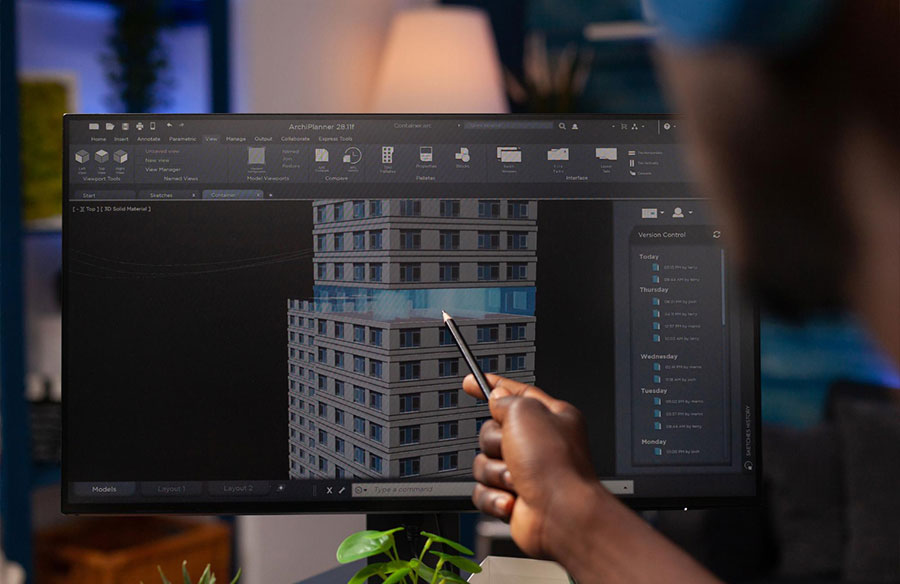
- Import to BIM/analysis tool – Tools like Forma, ClimateStudio, Ladybug or specialist lightning risk software read the JSON/EPW and strike‑density rasters directly.
- AI‑assisted optimisation – Envelope tuning for peak wind loads, wet‑bulb temps and lightning‑induced surge levels.
- Review & iterate with the team – Dashboards show cost, carbon, flood depth and lightning‑strike probability scores side‑by‑side.
- Document resilient assemblies – Drawings reference climate‑rated cladding, surge‑protected electrical risers and passive cooling paths.
Best‑practice checklist for architects
- Use future climate files and local lightning databases, not historic averages.
- Run “stress‑tests.” Simulate your design under the 5 % hottest, wettest and most lightning‑active hours.
- Balance embodied vs. operational carbon. Swapping steel for timber may cut emissions but increase moisture or conductivity risk; AI helps quantify both.
- Specify adaptive systems (modular façades, reversible ventilation, surge protection) so the building can evolve with the climate curve.
- Collaborate early with structural, MEP and lightning‑protection engineers; integrated AI platforms allow shared optimisation targets.
Barriers & ethical watch‑outs
- Data gaps in the Global South can bias AI outputs toward regions with better monitoring networks—including under‑reported lightning activity.
- Model opacity. Architects must document assumptions to avoid “black‑box” liabilities.
- Energy cost of AI itself. Training large models has a carbon footprint; choose vendors that disclose and offset compute emissions.
Looking ahead
By 2030, RIBA anticipates that adaptation—rather than mitigation alone—will dominate practice workflows. AI that ingests granular climate data, city‑scale sensor feeds, circular‑economy databases and real‑time lightning strike data will turn resilience into a quantifiable design deliverable. Early adopters already win bids where climate‑risk disclosure is mandatory; soon it will be table stakes.
Bottom line: Marrying AI with trustworthy environmental and lightning datasets lets architects move from reactive code‑compliance to proactive climate stewardship—delivering buildings that protect occupants, preserve investments and push the industry toward a safer, low‑carbon future.