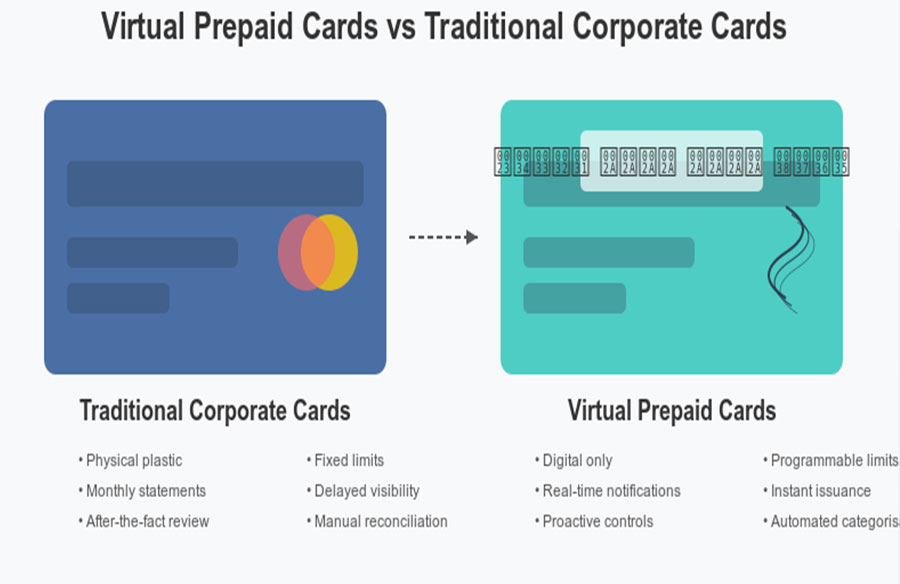
In the rapidly evolving landscape of corporate finance, payment methodologies have undergone significant transformation. Australian businesses are increasingly faced with choosing between conventional corporate card solutions and emerging alternatives that promise greater control and flexibility. The virtual prepaid card represents one of the most compelling innovations in this space, offering businesses a fundamentally different approach to managing expenses compared to traditional plastic corporate cards.
The Fundamental Difference
Traditional corporate cards operate essentially as credit instruments issued by financial institutions, providing employees with predetermined spending limits tied to company accounts. Meanwhile, virtual prepaid cards function on a fundamentally different principle—they’re digital payment instruments that can be loaded with specific amounts before use, eliminating the open-ended spending potential that characterises conventional corporate cards.
This distinction creates cascading differences in how these payment solutions serve business needs, particularly around control, visibility, and financial management.
Real-Time Control vs. After-the-Fact Management
One of the most striking contrasts between these payment methodologies lies in the timing of financial control:
Traditional Corporate Cards:
- Spending limits set broadly at account level
- Transactions reviewed after they occur
- Rules enforced through policy rather than technology
- Changes to spending permissions require administrative processes
- Limited ability to prevent unauthorised purchases
Virtual Prepaid Cards:
- Precise loading of exact amounts needed
- Preset spending parameters enforced at transaction level
- Real-time denial of non-compliant purchases
- Instant adjustment of permissions or cancellation
- Expiration dates that can align with project timelines
This shift from reactive to proactive expense management represents perhaps the most valuable aspect of virtual cards for organisations struggling with budget adherence. Rather than discovering policy violations after money has been spent, businesses can architecturally prevent unauthorised expenditures from occurring.
Issuance and Distribution Efficiency
The logistical differences between traditional and virtual payment methods create significant operational contrasts:
Traditional Corporate Cards:
- Physical production and shipping requirements
- Typical wait times of 5-10 business days
- Centralised tracking of physical cards
- Replacement processes for lost or stolen cards
- Limited number of cards due to administrative burden
Virtual Prepaid Cards:
- Instant digital creation
- Immediate availability for use
- No physical distribution requirements
- Instantaneous replacement capabilities
- Unlimited unique cards for specific purposes
For organisations with distributed teams, temporary contractors, or urgent purchasing needs, these efficiency differences can dramatically impact operational agility. The ability to provision payment methods on demand rather than through predetermined procurement cycles allows businesses to adapt to changing circumstances without payment friction.
Expense Visibility and Reconciliation
Perhaps nowhere is the contrast between traditional and virtual payment methods more evident than in the realm of expense visibility:
Traditional Corporate Cards:
- Monthly statement cycles
- Batch processing of transactions
- Manual receipt collection and matching
- Retrospective categorisation of expenses
- Limited data capture at the transaction point
Virtual Prepaid Cards:
- Real-time transaction notifications
- Individual cards are mapped to specific budget categories
- Digital receipt capture integrated with transactions
- Pre-categorised expenses based on card purpose
- Rich merchant data collection at the point of sale
These differences fundamentally transform the finance team’s experience from one of retrospective detective work to proactive financial management. The granular visibility provided by purpose-specific virtual cards eliminates much of the reconciliation burden that characterises traditional expense management.
Security Architecture and Risk Exposure
The security models of these payment methodologies reflect fundamentally different approaches to risk management:
Traditional Corporate Cards:
- Single card number used across multiple transactions
- Exposure of primary account details with each use
- Cancellation affects all company transactions
- Broader potential damage from compromised cards
- Limited usage parameter controls
Virtual Prepaid Cards:
- Unique card numbers for specific purposes
- Limited exposure based on loaded amounts
- Isolation of risk to individual virtual cards
- Ability to create single-use cards for high-risk vendors
- Advanced fraud detection through pattern analysis
For organisations operating in increasingly complex digital environments, the reduced attack surface offered by virtual cards represents a significant security advancement. The ability to limit potential damage through architectural constraints rather than reactive measures aligns with modern security principles.
Cost Structure Differences
The financial models underlying these payment solutions reveal important distinctions:
Traditional Corporate Cards:
- Annual fees per physical card
- Revenue model based on interchange fees
- Interest charges on revolving balances
- Late payment penalties
- Foreign transaction fees
Virtual Prepaid Cards:
- Platform subscription models
- Loading or issuance fees
- Reduced or eliminated annual charges
- No interest components
- Potentially lower international transaction costs
For many organisations, the shift from transaction-based to platform-based pricing provides more predictable expense management costs and the elimination of unexpected penalty fees that often accompany traditional card programs.
Implementation Considerations
Despite the advantages of virtual prepaid cards, several factors influence the adoption decision:
- Integration requirements with existing accounting systems
- Employee adaptation to new payment workflows
- Banking relationship implications and potential resistance
- Cash flow considerations with prepaid vs. credit models
- Industry-specific compliance requirements
Organisations must carefully evaluate these factors against the potential benefits when determining their payment technology strategy.
Conclusion: A Complementary Approach
Rather than viewing the choice between virtual prepaid cards and traditional corporate cards as binary, forward-thinking Australian businesses are increasingly adopting hybrid approaches. Critical, high-volume vendors may remain on traditional payment rails while discretionary, project-based, or online spending migrates to virtual cards.
This strategic combination allows organisations to leverage the control and visibility benefits of virtual cards while maintaining established vendor relationships through traditional methods. As virtual card technology continues to mature and gain acceptance, the balance will likely shift further toward these programmable payment instruments.
The most successful implementations recognise that payment technology selection isn’t merely a financial decision—it represents a fundamental choice about how an organisation approaches expense management, financial control, and operational efficiency. In this context, virtual cards aren’t simply a different payment method but rather a different payment philosophy.