

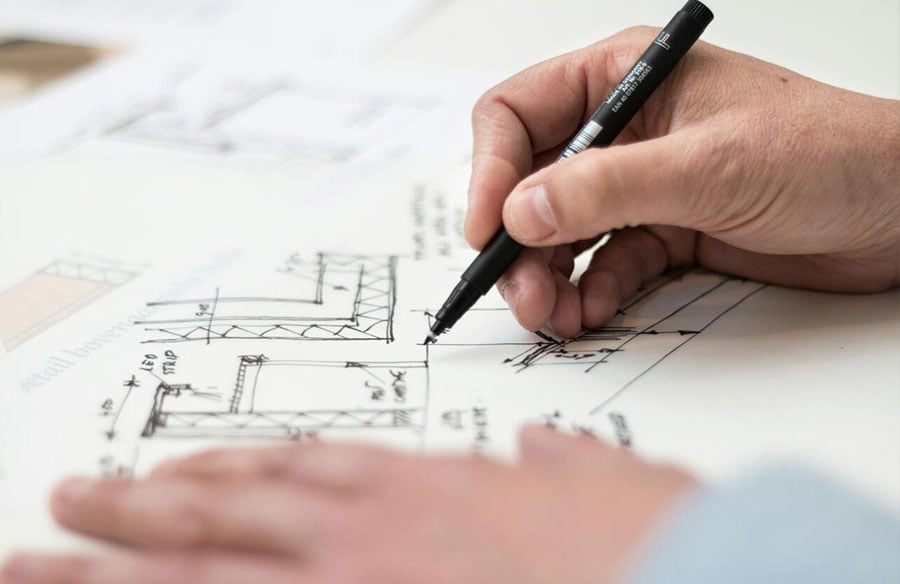
The architectural industry is going through some changes as it benefits from both native and peripheral advances in tech. Traditional design has transformed into a mostly digital experience, but even the most unlikely of tools are proving to help workers in the field – from voice notes and language learning models to borrowing new engineering tools.
Voice Notes: Not What They Used To Be
The integration of voice technology with architectural design software is a good place to start, because the two are seemingly an odd match on the surface. But, ultimately, it’s a giant leap in how architects capture and develop their own ideas, from mind to paper; or mouth to screen.
Modern voice recognition systems can easily and accurately transcribe audio to text. This helps create fluency in the design process, allowing architects to document their thoughts and observations while on the move. This is highly applicable to the environment of the job, which is often walking around building sites or talking to clients.
This technology has become particularly valuable in the context of Building Information Modeling (BIM), too, where voice commands and notes can be directly integrated into digital models. Architects can now walk through sites or client meetings, recording detailed observations that are automatically transcribed and organized within their project documentation. This turns the very chaotic and fragmented audio files into streamlined, indexable text within the right folders.
The advancement in natural language processing has now made it possible for these systems to understand complex architectural terminology and technical specifications with high accuracy. This is particularly useful when being interpreted by non-technical workers, too. This capability extends to multiple languages, facilitating collaboration during international projects.
These voice-enabled tools are particularly powerful when combined with cloud-based platforms. Multiple voice inputs can streamline into a single, shared text document. There are a lot of productivity advantages too when speeding up the transition of notes-to-desktop, and AI summary models can easily dig through masses of transcripts to either find data or provide summaries.
Generative Design with Climate Analysis
Generative design technology has become more than it ever intended, with the ability to incorporate climate analysis tools. With the environment becoming increasingly important to projects and proposals, it has transformed how architects approach environmental considerations in their projects.
Modern systems can now perform real-time environmental impact simulations and solar path optimization. This makes it easier to make data-driven decisions about building orientation and energy efficiency. For a simple example, tracking the sun to maximize where window placement should be, which should minimize how much the occupant will need to heat the home. This is important when future-proofing design, too, to meet regulatory changes.
OpenSite+ is a new platform in this space that uses generative AI to analyze site conditions and local requirements. This results in a rapid and automated solution, and a system that can evaluate multiple design alternatives simultaneously – each considering environmental factors and local building codes.
The integration of climate analysis tools allows architects to assess and optimize building performance from the earliest design stages. This kind means that projects which are inherently not viable (or optimal) can be found out earlier on, minimizing the time wasted on early design stages of projects that will not get the go-ahead.
These tools can generate detailed analysis of wind patterns, solar exposure, energy consumption, and more to help architects create more sustainable buildings. The technology also facilitates compliance with LEED certification requirements.
Digital Twin Technology
Digital twin technology is perhaps the most incredible breakthrough advancement within the architectural practice. This tech allows architects to create virtual replicas of physical buildings, each with real-time monitoring and optimization. These digital counterparts can track building performance metrics and facilitate predictive maintenance scheduling. This is a win for simulation-led design.
The integration of IoT sensors with digital twins is a new development that allows for more comprehensive monitoring of building systems. For example, energy consumption and space utilization. This can be taken on an existing building that is being used as an example for a future project. Building managers can make data-driven decisions about facility operations and maintenance schedules, but if the data is shared, it can be a source of design inspiration too.
The implementation of digital twins has shown promising results in sustainability efforts, with some projects achieving up to 20% reduction in material waste through improved resource management and end-of-life planning.
Final Word
The architectural industry stands at the cusp of more transformative changes, particularly through AI, either with design analysis or simply gains in office productivity. Predictive analytics and machine learning algorithms are the key to more sophisticated approaches to structural analysis and building optimization, particularly because they can spot patterns that humans cannot. Parametric architecture and generative design suggests a future where buildings will become increasingly responsive to the environment and occupants, with simulated designs and fast prototyping.







