

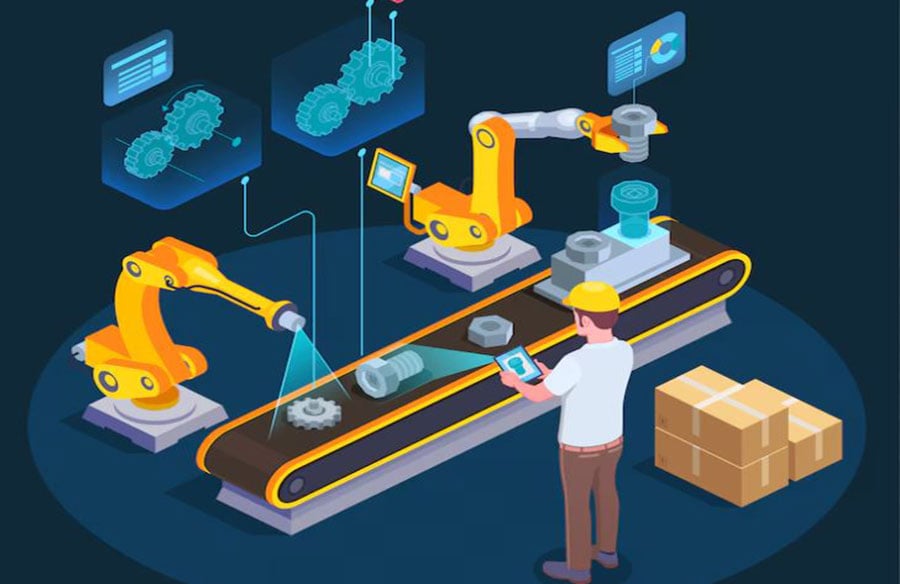
IoT devices seem like the ideal instrument for industrial automation. Is that always the case, though? Smart management systems and the Internet of Things (IoT) can be affordable ways to control the interaction of your employees, your industrial machinery, and their IoT gadgets. IoT and its digitally native approach to business have several benefits.
IoT Applications in Industry: 2025 and Beyond
According to Grand View Research, the industrial Internet of Things (IoT) market was valued at $394.0 billion globally in 2023 and is expected to expand at a rate of 23.2% per year until 2030.

It is crucial to emphasize that although industry will continue to become more automated, humans will still work in the workplace. The biggest advantage of IoT is that it enhances human productivity rather than replaces it. Business executives must ensure their employees can still function well in these new, automated settings, though, as the roles in an industrial workforce will alter.
What is Industry 4.0?
It is the fourth industrial revolution, or Industry 4.0. It is characterized by big data tactics, cloud computing, and manufacturing. All those technology capabilities are integrated into the processes of businesses that adopt the Industry 4.0 approach. Workers and their equipment and management systems can connect more closely.
Machine Learning and AI
Intelligent IoT devices collect information that AI and machine learning algorithms can use to identify patterns and possibilities that human workers would overlook. Based on user and IoT device input, these services can also enhance their operations. The secret to getting better is this:
- Operations related to warehousing
- Monitoring assets
- Management of inventories
- Monitoring of the supply chain
- Forecasting supply and demand
Predictive Maintenance
Businesses may better care for their production machines, mobile devices, and IoT endpoint devices by combining IoT and AI. You can detect maintenance support concerns before they become problems by combining IoT and AI management solutions.
Downtime is greatly decreased by this proactive maintenance strategy. AI and IoT technology also make it simpler to analyze performance patterns. This influences future procurement strategies and helps you fine-tune maintenance schedules.
Anticipated Results from the Collaboration of Industrial Automation and IoT
Even if you start with modest IoT investments, integrating smart technologies into industrial workflows yields several benefits. Companies can experience major benefits without committing to a full-scale transition up front. Here are five main benefits:
1. Increased Productivity
The speed at which automated systems work is significantly faster than that of manual labor. They work around the clock, cutting down on downtime and all but eliminating vacations, holidays, and sick days. Even with a restricted workforce, operations continue as usual.
Furthermore, fluid shift changes are made possible, enabling employees to quickly switch mobile devices between shifts and guaranteeing that business as usual is conducted around the clock.
2. Reduced Errors
Compared to human labor, automated methods are significantly more accurate. Humans are prone to fatigue, production errors, and data entry errors. These issues do not affect electronic systems.
Compared to manual techniques, IoT systems are also capable of capturing a substantially greater amount of data in greater detail. Better decision-making is made possible by the abundance of data, which allows for more in-depth and detailed assessments.
3. Regulatory Compliance Made Easier
By reducing manufacturing errors, IoT-driven industrial automation assures compliance in sectors with stringent regulatory and quality standards. Without the possibility of human error, automated systems’ accuracy and consistency make it simpler to follow industry-specific regulations and satisfy quality standards.
4. Better Working Conditions
Businesses can reduce workplace accidents by removing the most physically taxing and hazardous jobs from human workers through the use of automation and the Internet of Things. In addition to reducing workers’ compensation claims, this also lessens production delays and management and employee stress.
In hazardous or difficult-to-reach locations, such as autonomous guided vehicles (AGVs) for safe material handling or process automation in hazardous zones, wireless IoT solutions are particularly beneficial.
5. Cost Savings
IoT systems may seem like a big initial expenditure, but long-term savings more than makeup for it. Fast returns on investment are a result of lower labor expenses and more efficient operations. Businesses can use insights to further optimize workflows and reduce operating expenses as the system collects data.
For example, intelligent asset management systems aid in preventing inventory shrinkage and lowering losses. When equipment is not returned on schedule, they send out real-time warnings, allowing supervisors to take prompt action and retrieve lost goods. Even more money can be saved by identifying patterns in asset utilization or mismanagement early on, which can avert more serious issues later.
Challenges to Take Care in Industrial IoT Solutions
Some businesses attempt to launch end-to-end revolutionary IoT implementations without fully accounting for the difficulties they may encounter. Their IoT and industrial automation rollouts may be halted or delayed if they take on too much too fast.
These are the three most frequent issues that you should account for in your deployment plan, regardless of the system you’re installing for the use case:
1. Hidden Up-Front Expenses
The deployment of IoT solutions still requires a large upfront capital expenditure, even though they provide significant cost reductions over the medium and long term. To avoid delays and additional costs during deployment, careful planning is necessary.
A lot of people are concerned that they will have to go through a complicated project management procedure, but this is rarely the case. IoT implementations may frequently be streamlined by gathering operational staff insights and involving all stakeholders to ensure everyone is on the same page.
2. IT and Physical Security
Many pieces of industrial equipment that were previously offline are now making their initial internet connections thanks to the installation of recently integrated IoT sensors. As a result, business networks are exposed to a variety of new security risks and instability.
IoT devices are vulnerable to both internal and external theft due to their intrinsic value. Determining which devices are most susceptible is crucial. In order to prevent loss, theft, and misuse, mobile electronics—which are essential to the shift to Industry 4.0—need strict security measures and cautious handling.
3. Management and Integration
Even while automated systems replace many of the jobs that were previously performed by human workers, they still need to be properly maintained and managed.
As part of their IoT automation efforts, businesses wishing to provide mobile electronics to their employees frequently need to focus more on the amount of administration needed to keep an inventory of these devices. Without a well-thought-out device management plan, you run the risk of unintentionally giving your staff members even more manual labor rather than less.
Employees will need to receive training to become accustomed to the new tools and procedures when automated management systems are implemented. As IoT technology changes the way we perform daily tasks, traditional operating procedures can become outdated. The operational effectiveness and general performance of your IoT app development company may suffer if you fail to sufficiently train your staff for the changes resulting from Industry 4.0.
Conclusion
IoT and other smart technologies are the way of the future for industry. It is not a question of whether it makes sense to grow your IoT and industrial automation systems. It all comes down to how best to achieve the desired outcomes. The problem of controlling how your employees and mobile IoT devices must cooperate can be resolved with smart storage solutions.







