

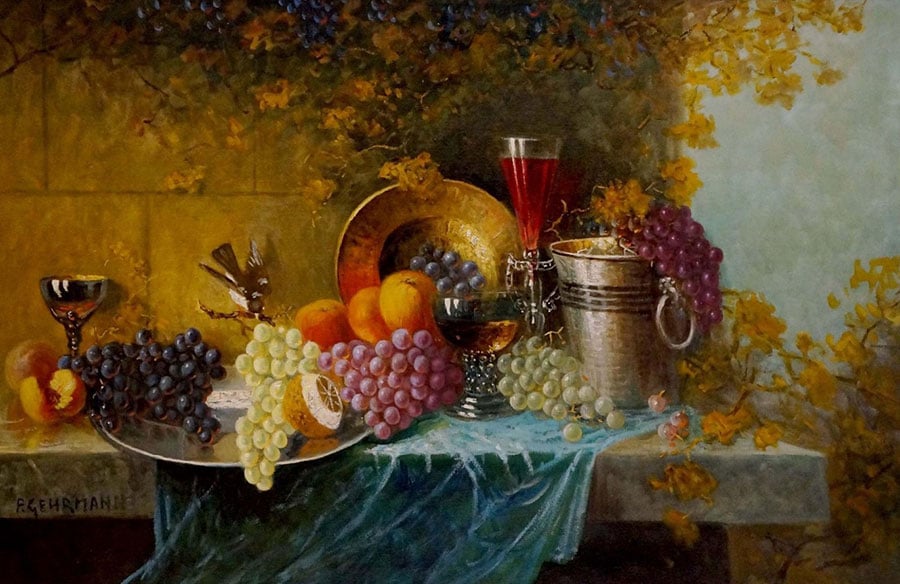
When a person hears the word “still life”, first of all, they associate it with a bouquet of non-living flowers, but this genre also has other elements that can be depicted on canvas. And first, let’s approach the issue of still life painting from the other side – this is one of the most expressive genres of art, which at first glance may seem simple, but hides deep symbols and subtle craftsmanship. Depicting everyday objects – from fruits and flowers to books and dishes – still life artists are able to convey not only their beauty, but also create compositions that tell entire stories. As an independent genre of painting, it has deep roots and interesting development, so, the first images of objects appeared in ancient times, and an independent direction in art was formed only in the late 16th – early 17th centuries. Now let’s take a closer look at the history of the emergence of still life in painting and understand why this genre is considered difficult for artists.
Painting experts helped write this material and for more details on this topic can be found here: https://ukrainianvintage.com/colle ctions/still-life
The first images of inanimate objects can be seen in ancient cultures and civilizations, for example, in Ancient Egypt, artists depicted scenes with food, animals and utensils on the walls of tombs, since these elements were considered an important part of preparation for the afterlife. The authors did not strive for the accuracy of the transfer of volumes or light, and the works, although far from ideal, can already be considered the harbingers of still life. In Ancient Greece and Rome, there are also images of objects, for example, fruits, vases, decorations on frescoes and mosaics. However, all these elements were rather decorative, which serve as a background for the main scenes, such as mythological and historical events.
Moving on to the Middle Ages, paintings of any genre fell under the influence of a religious worldview, and art was focused on spiritual subjects, and the image of inanimate objects was extremely limited. And yet, in religious compositions of that time – you can already find images of symbolic objects, such as: flowers, candles, fruits. Flowers were often depicted by artists in religious scenes – lilies – meant as a symbol of the purity and innocence of the Virgin Mary, and the rose was associated with the martyrdom or blood of Christ. Candles – symbolized the light of faith and divine illumination, and lit candles in church compositions meant the presence of God and holiness. Fruits were depicted to a lesser extent in the Middle Ages, but the favorite was apples – a symbol of original sin and temptation, as a reminder of the fall of Adam and Eve, and grapes symbolized the blood of Christ, which is associated with the Eucharist. Flowers, candles, fruits – these elements served primarily as “hints” for the viewer so that they could correctly interpret religious scenes. Medieval art played an important role in preparing the ground for the development of the still life genre, and despite the fact that the images of objects remained subordinate to religious themes, artistic techniques began to form during this period that would later influence the creation of still life genres. Let’s consider three key elements that developed in the Middle Ages and became the basis for still life:
1) Accuracy of rendering textures and shapes of objects.
2) Using objects to express symbolic meanings.
3) Interest in decorative elements and attention to detail.

The Renaissance – a big boost to development
With the beginning of the Renaissance in the 14th-15th centuries, art began to actively develop and change, new genres and techniques appeared – this revived interest in ancient culture, its rationalism, and the precision of attention to detail. Artists sought to convey the smallest details, such as the texture of objects, the play of light and shadow – and this became an important basis for the future flourishing of still life painting; the Renaissance is famous for its connection with the humanistic worldview, which put man and his place in the world at the center of attention, so, for example, artists began to pay more attention to the material and physical side of life. This was reflected in the depiction of not only human figures in painting, but also objects of the surrounding world, for example, we will highlight three main objects:
1) Books – symbolized the intellect and education of a person, showing that in front of you there may be a scientist or an aristocrat.
2) Musical instruments – symbolize people’s connection with culture and art, indicating their refined tastes.
3) Flowers and fruits have moved from religious motifs, and are becoming more like part of the decor in the painting.
Among other things, artists began to include such items as dishes, vessels or weapons, which emphasized the status and role of the person depicted in society. By the way, this became the basis for the subsequent development of “Vanitas” – still lifes that remind us of the transience of life. The Renaissance was a time of great technical advances in art, which also influenced the development of still lifes; one of these innovations was the development and use of linear perspective, which allowed artists to create the illusion of depth and space – this made it possible to more accurately depict objects in a three-dimensional environment.


The Golden Age of Still Life in the 17th Century
It is believed that the true birth of still life painting as an independent genre occurred in the 17th century in Europe, especially in the Netherlands and Flanders. At this time, society was undergoing significant changes – the rise of the bourgeoisie, the development of trade, the discovery of new lands and goods; as well as the Protestant Reformation, which changed the approach to religious and secular issues. In this cultural context, still life perfectly corresponded to these changes and became a popular genre that allowed artists to demonstrate mastery in the transfer of textures, light, compositions.

1) Food – bread, cheese, fruit, fish, meat.
2) Household items – glass goblets, jugs, silver and copper utensils
3) Flowers – both individually and in bouquets – they became a symbol of beauty and the ephemerality of life.
Artists primarily sought to convey on canvas the accuracy and realism of the depiction of details, achieving the effect of maximum similarity to reality, and special attention was paid to the transfer of textures of various materials, such as glass, metal, fabric and food. Masters masterfully used light and shadow to create the effect of volume and depth, as well as to emphasize the naturalness of objects as they are in life.

1) Skulls – as a symbol of death and a reminder of the inevitability of the end.
2) Burning candles or smoldering coals – as a symbol of the fading of life.
3) Withering flowers – as an allegory of the brevity of beauty.
4) Hourglass – a symbol of time and its fleetingness.
If you think about it in our modern world, such paintings can cause an ambiguous reaction from viewers, some will like it, and some will not. But in the 17th century – “Vanitas” had a moral and edifying character and often served only as a reminder of the vanity of wealth and material goods, as well as the need for spiritual purification and preparation for the afterlife.
Still life painting in the Flemish schools
Speaking of Flanders, like the Netherlands – also became the center of the heyday of still life painting in the 17th century, but the Flemish tradition was distinguished by greater splendor and luxury in paintings. Unlike the more restrained Dutch still lifes, Flemish masters paid more attention to spectacular and rich compositions depicting exotic objects and goods, which reflected the wealth and success of their customers.

1) tropical fruits;
2) exotic flowers;
3) rare luxury items such as spices, rare shells and textiles.
These objects became frequent elements of Flemish still lifes and their inclusion in paintings signified – prestige, wealth, as well as a connection with distant lands and cultural diversity. Examples of such works were the artists Jan Brueghel the Elder and Frans Snyders – they created lush and detailed floral still lifes, depicting hunting, and an abundance of food on the table.
It is safe to say that the 17th century became the “golden age” of still life painting for both Dutch and Flemish artists. The genre still life – moved from being secondary elements in paintings to an independent art form that not only demonstrated high skill in conveying details, textures, and light; but also served as an expression of the philosophical and religious ideas of the 17th century. The difference between Dutch restraint and Flemish splendor became a striking example of both the diversity of the still life genre and the manifestation of the cultural characteristics of these regions; the works of artists of that time remain important monuments of European art, which inspire a new generation of artists and simply connoisseurs of paintings.
Still life Painting – Through The Ages
The genre of still life painting is an excellent example of what a long and thorny path can be to the development of an independent art form, developing in different cultural and historical contexts – from small to large. In the 17th century, still life became an independent genre thanks not only to Holland and Flanders, but also to Italy, Spain, France – where each acquired its own unique features, for example, in Italy and Spain – still life is closely associated with religious symbolism and asceticism – paintings emphasized the spiritual values of these two countries. In France, still life in painting began to develop later, however, it was distinguished by its sophistication and lightness, which demonstrated not drama and luxury, but calmness and harmony in the depiction of simple everyday objects in paintings.
With the transition to the 19th century, still life in painting underwent significant changes due to the influence of realism and impressionism, and such famous artists as Gustave Courbet and Edouard Manet began to experiment more freely with the depiction of objects, playing with such aspects as light, color, form. This became the basis for further experiments with the genre within modernism and the avant-garde in the 20th century, when cubists such as Pablo Picasso and Georges Braque radically changed the perception of still life, focusing on form and structure, and one cannot fail to mention the surrealist Salvador Dali – he added fantastic and psychological elements to still life, which simply expanded the boundaries of the genre. Still life in modern art not only continues the tradition of experimentation, but continues to add new technologies to artists (media, which includes photography and digital art), which allows exploring the genre from different angles. The main thing to understand is that still life remains an important and living genre – it reflects not only the skill of artists in depicting inanimate objects, but also leaves the necessary emotions for the viewer. Let’s quote: “Brilliant artists make the viewer admire copies of simple things, the originals of which a person in everyday life does not pay any attention to.” For example, you can look at the painting by the artist Anatoly Tarabanov called “Tabletop Elegance” – see a mixture of art nouveau and still life.

Still Life Painting – Subgenres that reveal reality
There are seven key trends in still life painting that clearly demonstrate evolution and reflect not only the artistic tastes of each era, but also cultural, social, and philosophical ideas. Let’s take a closer look at each of the subgenres to understand how artists used still life to convey complex and multifaceted meanings:
1) Floral still life in painting – were not just a demonstration of the beauty of nature, but also a symbol of fleeting life, as flowers fade over time. In such works, you could often find luxurious, lush bouquets of various flowers, often exotic ones, in which the details of the petals were skillfully conveyed. For example, you can see the work of the modern artist Olga Artim called “Asters and chrysanthemums”.


7) Still life “Trompe-l’œil” in painting – artists created the illusion of reality for viewers – painted objects seemed so lifelike that they were difficult to distinguish from real ones. Artists used technical methods to create three-dimensional effects on a flat surface – these paintings played with the viewer’s perception, making him doubt the reality of the depicted.

Life Still Painting – Amazing Works
For example, we will analyze three paintings by famous artists, and each of them depicts everyday objects in their own way, which causes special admiration when viewed.
The first painting by the artist Tamara Kapkanets, titled “Still life with flowers and fruits,” is a classic example of a flower still life with fruits. In the center of the composition is a bouquet of bright orange rowan berries placed in a glass vase; the flowers occupy the central place in the painting and stand out with their rich warm color against the background of white fabric. In the lower part of the painting are various fruits: pomegranates, persimmons, lemon – located both on a plate and on a towel – these elements add a sense of fullness and completeness to the composition, and also emphasizes the connection with traditional still lifes, in which food items are often depicted. Each fruit is depicted with detailed elaboration, which allows the viewer to feel their texture and weight, as if it were right in your room.

The second painting by the artist Vasily Korkishko, entitled “Still life with pink peonies”, belongs to the classic genre of still life – the central place is occupied by pink peonies placed in a glass vase. The peonies look fresh and alive, their petals are voluminous and soft, conveying a feeling of lightness and grace; on the table, next to the peonies, are several old books – often symbolizing knowledge, wisdom and spiritual development. In the context of the painting, the artist emphasizes the idea – beauty and intelligence go hand in hand, and that knowledge also has its value and durability in comparison with the transience of living nature.

The third painting by artist Alexey Vlasov, titled “Still life with apple”, belongs to the still life genre, which focuses on the depiction of simple objects in a calm and harmonious composition. The artist uses a minimalist approach in his work – this makes the painting expressive due to the play of light, shadow and simplicity of objects. The painting depicts three main objects – a metal coffee pot, a ceramic vase and a wicker basket with red apples; in the upper part of the painting, a dark oval element is visible – an antique mirror in a massive frame. Each object in the painting has its own texture, and the artist focuses on the differences in these textures – shiny metal, smooth ceramics and basket weaving – all this creates visual interest for the viewer and adds depth to the composition. In the foreground of the painting, a white cloth is depicted lying on the table – although the object is simple, it gives the composition softness and adds a sense of coziness to the viewer. It is a contrast to the metal coffee pot and wicker basket; the background of the painting is minimalistic and allows the viewer to focus on the objects on the table.

Here we come to the end and we can say that still lifes are a truly difficult genre to depict on canvases of the correct composition, from which the viewer should get the emotions he needs from such things as flowers, fruits, cutlery and much more. When in real life – they only perform aesthetic or other functions for each of us, and not noticing their true beauty.
All examples of photographs and artists are kindly provided by the Ukrainian Vintage Co.







