Museums have long positioned themselves as inclusive civic institutions—places meant to educate, inspire, and welcome diverse publics. Over the past several decades, accessibility has become a visible part of this mission, often articulated through policy statements, architectural guidelines, and compliance with regulatory standards. Yet for many visitors, particularly those with visual impairments or sensory differences, meaningful access to museums remains incomplete. While physical entry may be technically possible, full participation in the cultural experience frequently is not.
This disconnect points to a deeper issue within contemporary museum design: accessibility is too often treated as a logistical obligation rather than a spatial and experiential one. Ramps, elevators, handrails, and prescribed circulation clearances are essential, but they are rarely integrated into the conceptual framework of a museum. Instead, they are added onto environments that otherwise remain unchanged. As a result, inclusion becomes peripheral—an accommodation layered onto a space designed primarily for a narrow range of users—rather than a core driver of how museums are conceived and experienced.
The Visual Bias of Museum Spaces
At the heart of this problem lies the visual orientation of museums themselves. Modern exhibition design has long prioritized sight as the dominant mode of engagement. White walls, controlled lighting, clear sightlines, and strict viewing protocols reinforce the idea that art is meant to be observed from a distance rather than physically or sensorially encountered. Touch is frequently prohibited, sound is minimized, and bodily movement is carefully regulated to preserve objects and maintain curatorial clarity.
While these conventions serve important conservation and interpretive purposes, they also establish a sensory hierarchy in which vision is privileged above all other forms of perception. Visitors who do not primarily experience space visually are often pushed to the margins of the museum experience. Those with visual impairments may rely on verbal descriptions or assistive technologies that operate outside the main spatial narrative. Neurodivergent visitors may find highly controlled visual environments disorienting or overwhelming. Even able-bodied, sighted visitors are encouraged into a largely passive mode of engagement that limits embodied interaction.
Conventional accessibility frameworks rarely address this imbalance directly. By focusing on circulation and physical access, they leave untouched the deeper question of how space itself communicates meaning. A museum may meet every regulatory requirement and still fail to offer equitable cultural access. If museums are to function as truly inclusive public institutions, they must confront not only how people move through space, but how that space is perceived, understood, and felt.
Moving Beyond Compliance
Addressing this challenge requires a shift in design thinking—one that moves beyond compliance-driven accessibility toward a more inclusive spatial logic. Rather than treating accessibility as a set of specialized accommodations for specific users, designers must recognize sensory diversity as a fundamental condition of human experience. This means questioning the assumption that there is a single, “normal” way to perceive and navigate space.
One approach that responds to this need is sensory decentralization. As a design strategy, sensory decentralization redistributes cultural engagement away from a single dominant sensory mode and toward a network of parallel, equally valued experiences. Instead of concentrating meaning at discrete visual focal points—such as objects, vitrines, or prescribed viewing positions—this approach disperses engagement across circulation paths, thresholds, and peripheral zones.
In a sensory-decentralized environment, visitors encounter space through touch, movement, sound, atmosphere, and social interaction, as well as sight. Accessibility is no longer limited to designated routes or tools; it becomes embedded in the spatial structure of the museum itself. The goal is not to replace visual experience, but to situate it alongside other sensory modes, allowing different bodies and perceptual orientations to engage with the same space in meaningful ways.
Designing for Sensory Variability
Central to sensory decentralization is the idea of designing for variability rather than for an imagined average user. People move at different speeds, occupy space in different postures, and rely on different sensory cues to orient themselves. Designing with this variability in mind requires environments that support multiple ways of navigating and interpreting space.
Tactile pathways, for example, can function as more than navigational aids. When thoughtfully integrated, they become narrative devices that guide visitors through a sequence of spatial experiences. Changes in texture underfoot can signal transitions between zones, while tactile surfaces at hand height can offer information about proximity, scale, or direction. Similarly, atmospheric elements such as mist, temperature gradients, or acoustic shifts can communicate boundaries and thresholds without relying on visual signage.
Importantly, sensory decentralization extends beyond gallery interiors. Exterior and transitional spaces—plazas, courtyards, entry sequences—play a crucial role in shaping how visitors orient themselves and prepare for the museum experience. By embedding sensory cues into these areas, museums can dissolve rigid boundaries between inside and outside, allowing visitors to acclimate gradually and intuitively. Social gathering zones integrated into these sensory networks further support inclusion by encouraging collective and informal forms of participation.
A Research-Based Application: Pathways of Inclusion
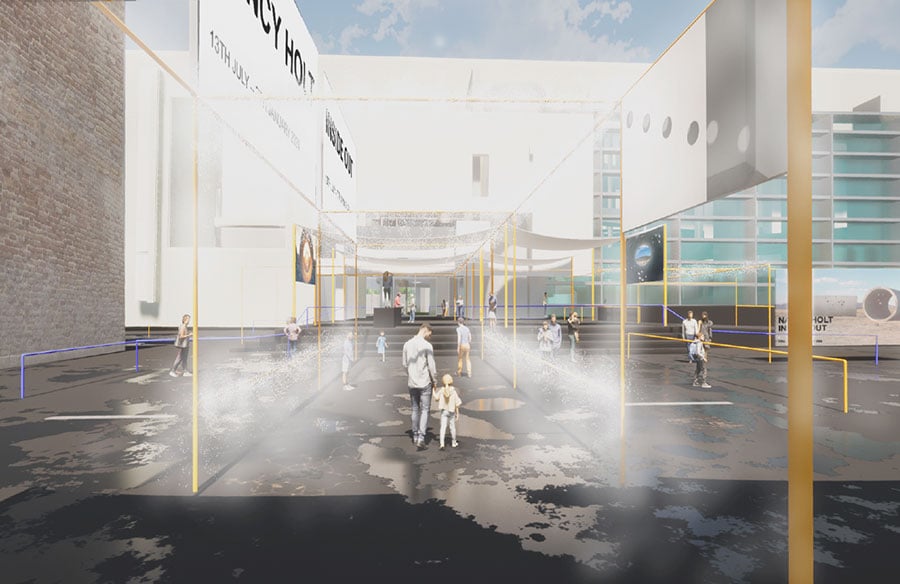
These principles are demonstrated through Pathways of Inclusion: Sensory Decentralization in Museum Design, an international design research project developed by Min Joo across institutions in the United States and Europe. This design research project demonstrates how museums can be reimagined as inclusive cultural environments by redistributing sensory engagement across both interior and exterior spaces. Using the RISD Museum as a primary reference and the Museum of Contemporary Art of Barcelona (MACBA) as a comparative context, the project proposes a transferable framework in which tactile and atmospheric interventions support equitable participation while enriching the experience for all visitors.
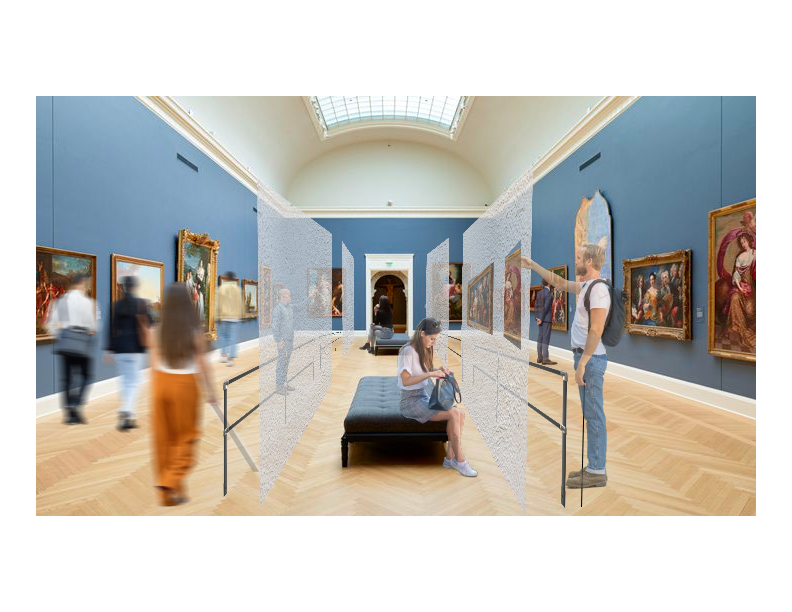 Tactile Exhibition developed at the RISD Museum, enabling visually impaired and sighted visitors to share a unified, immersive spatial experience.
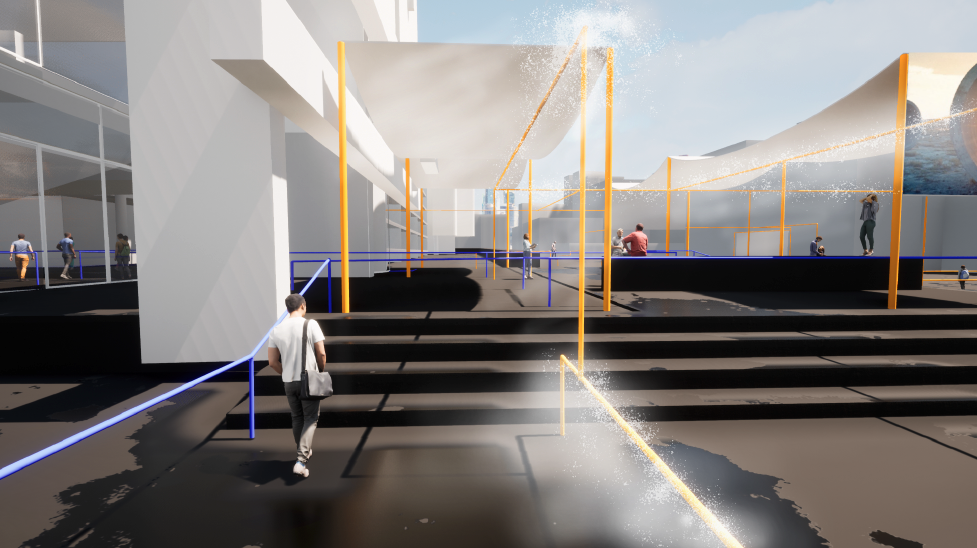 At the core of the project is a reverse-branching circulation system that replaces visually dominant wayfinding with a sequence of sensory cues. Exterior pathways are defined by mist railings that operate simultaneously as tactile guides, spatial boundaries, and atmospheric markers. These elements allow visitors to navigate through bodily proximity and touch, rather than through signage or distant visual landmarks. Social gathering areas are embedded along these paths, transforming circulation from a neutral passage into an active, communal experience.
Inside the museum, sensory decentralization continues through tactile and sculptural interventions inspired by Nancy Holt’s Inside Out. Selected spatial qualities of the exhibition are translated into three-dimensional, touch-responsive forms that invite physical engagement. Visitors can experience scale, orientation, and spatial relationships through contact and movement, rather than observation alone. Crucially, this approach does not create parallel experiences for different users; visually impaired and sighted visitors share the same spatial narrative, eliminating segregation while expanding access.
By applying the same sensory framework to both the RISD Museum and MACBA, Pathways of Inclusion demonstrates the adaptability of sensory decentralization across distinct cultural and architectural contexts. Rather than presenting a fixed solution, the project establishes a flexible methodology grounded in bodily experience, spatial agency, and sensory equity.
Implications for Contemporary Design Practice
The implications of sensory decentralization extend beyond museums. As public institutions increasingly emphasize inclusion, designers are challenged to translate institutional values into spatial reality. Sensory-inclusive strategies reframe accessibility from a constraint into a generative design tool, encouraging more nuanced relationships between visitors and space.
For interior and exhibition design, this shift opens new expressive possibilities. Tactile surfaces, atmospheric gradients, and embodied wayfinding can become primary design elements rather than secondary additions. Such approaches support intuitive, participatory engagement while accommodating a wider range of users without fragmenting the visitor experience.
These strategies are particularly relevant in the context of demographic and cultural change. Aging populations, growing awareness of neurodiversity, and evolving expectations around public access demand environments that respond to sensory variability as a norm rather than an exception. Museums, as highly visible civic spaces, are uniquely positioned to model these values and influence broader design standards across libraries, educational facilities, and other public interiors.
Toward More Inclusive Cultural Spaces
Accessibility in museums is often framed as a matter of regulation rather than experience. Yet inclusion cannot be achieved through compliance alone. Reimagining museums through sensory decentralization offers a way to move beyond visually exclusive models toward environments that recognize sensory diversity as a fundamental condition of public life. When spatial meaning is distributed across touch, movement, atmosphere, and social interaction, accessibility becomes inseparable from design quality itself. In this framework, inclusive museums do not serve a subset of users—they expand the cultural experience for everyone, pointing toward a more participatory and humane future for public spaces.
Min Joo Jung
Min Joo Jung is an interior designer and design researcher whose work focuses on inclusive spatial systems, sensory design, and accessibility beyond regulatory compliance. Her research explores how interior environments can support diverse bodies and modes of perception through shared, non-segregated spatial experiences.