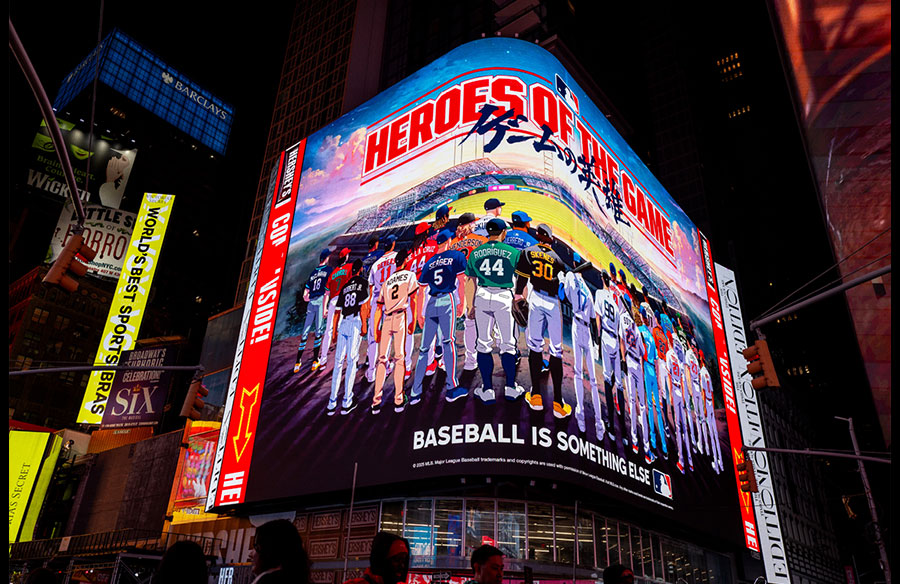
Art Director Shaoyang Chen occupies a rare position in contemporary commercial design: an creative at Wieden+Kennedy whose portfolio already spans the MLB 2025 World Series global campaign, HP’s worldwide ink cartridge rebrand, the 2025 Nike Shanghai Marathon campaign, collaborations with McDonald’s Shanghai, and the visual identity for the short film *Boxed*, alongside cultural projects with ADCOLOR and Asiancy. Recognized by Print Magazine’s “15 Under 30 New Visual Artists,” honored with the A’ Design Award, exhibited at the Penn Museum, and an AIGA member since 2022, she has assembled résumé few designers achieve in twice the time. What distinguishes her is breadth — mass-market production and culturally inflected exhibition work, held together by a coherent vision.
A Sensibility Forged at Intersections
Chen traces her visual instincts to a thirteen-year-old’s encounter with Wong Kar-wai’s *Ashes of Time* — a film whose saturated palettes, fragmented temporality, and atmospheres of longing read as structuring principles in her own work. She describes herself as a “visual storyteller seeking to bridge cultures and give voice to those who have long been unseen and unheard,” and her third-culture upbringing is not a marketing posture but a working method. The geography of her career corroborates it: reporting at NPR and NBC affiliates in Missouri, production on *The Amazing Race* in Tokyo, design across New York, San Francisco, Portland, Chicago, and Las Vegas. That cosmopolitanism shows up in her work as a default assumption that an image will travel — that it will be read across visual literacies that do not align. It is a creative position, and a rare one.
Commercial Mastery at Global Scale
The MLB 2025 World Series campaign is a tour de force of art direction. Chen led an international team coordinating MLB’s New York marketing group, a Portland editing studio, a London sound design house, a Singaporean storyboard illustrator, a French coloring studio, and a Japanese animation team under unforgiving deadlines. The work ran nationally on ESPN, aired on Fox, and was installed in Times Square, Mexico City, London, and Tokyo’s Shibuya Crossing, drawing coverage in *Adweek*, *Ad Age*, and *Crunchyroll*. Her collaboration with legendary anime film director Hiroshi Shimizu, whose work shaped touchstones like *Naruto*, *Ghost in the Shell*, and Studio Ghibli films, placed her as a peer-level partner on a campaign that courted anime visual language for a Western sports property — a bet that fails badly without genuine cultural fluency, and one this campaign handled with assurance.
Her work for Nike confirms the pattern at a different register. The 2025 Nike Shanghai Marathon campaign, part of Nike’s broader global marathon platform, demonstrates a sophisticated grasp of movement, identity, and urban culture that’s tailored to Shanghai city. Rather than defaulting to conventional sports advertising, Chen helped construct a visual narrative that captured the emotional intensity and collective energy of Shanghai’s running culture, positioning Nike as both a performance brand and a cultural force within the city’s creative landscape. The Nike China Kenna running documentary extended this sensibility, combining cinematic framing with documentary realism to produce work that reads as emotionally authentic rather than commercially manufactured. Her collaborations with McDonald’s Shanghai operate on adjacent terrain — dynamic commercial films and stylized visual campaigns that have transformed product launches into culturally visible moments and reshaped the brand’s relationship with younger audiences.
The HP global ink cartridge redesign, a system intended to run until 2039, demonstrates a different and arguably harder discipline: the capacity to design infrastructure that will be experienced billions of times by people who never consciously register it as designed. Restraint, legibility under degraded conditions, neutrality to local retail environments — Chen delivered all of it, modernizing a legacy brand at global scale while enhancing recognition and sustainability. That she can produce credible work in both registers — the expressive and the infrastructural — is genuinely uncommon.
A Provisional Verdict
Chen’s cultural projects, including her Penn Museum exhibition selected from 335 international submissions, demonstrate something the commercial work cannot fully show: an individual voice already capable of holding complexity without retreating into either decorative shorthand or art-school opacity. Her stated principle that “truly powerful art can still be felt, even without full understanding” is, in practice, a working aesthetic — designs built for partial reading, in which a viewer catches the emotional register without decoding every reference.
Across MLB, Nike, McDonald’s, HP, and her independent cultural projects, Chen has consistently delivered work that holds its shape under different commercial pressures — campaigns that translate strategic branding into something more legible and more emotionally precise than the category usually permits. The combination of formal range, comfort at global production scale, and a coherent cultural position is uncommon, and the body of work to date establishes her as a serious practitioner whose trajectory warrants attention.
This article is authored by Christine Taylor who is a writer covering design, branding, contemporary culture, and emerging creative talent. Their work explores the intersection of commercial storytelling, visual identity, and global creative industries.