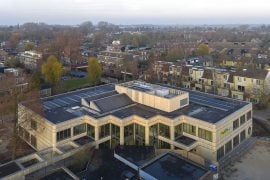
Chang Chun, as a typical old industrial city of Northeast China, still has endless possibilities for the diversified development and contemporary vitality. Real-estate Sales Center, as a special architectural typology in China, also needs to be thought its value of reutilization. When we first came to the site, facing the glass box among wild weeds in front of us, we started to think how to bring it back to life through proper renovation and provide diverse gathering spaces for people living in the nearby community.
Project Name: Time Cube Community Center
Studio Name: STEPS Architecture
Location: Mexico
Status: built
Image Credits: CreatAR Images

The client hopes to transform this abandoned sales center into a community swimming fitness center: the first floor is for parent-child swimming and playing, the second floor is for commercial rental, and the third and fourth floors are adult swimming pool and gym. We are impressed by their bold idea: a four-story reinforced concrete frame structure will contain three pools with different function and scale. We began to ask ourselves: water, as the core element, what does it mean to the building and users.
In the past, people living in northeast China would go to the public bath because there were no showering facilities in most families. The winter of the northeast is cold and long, so people usually stayed in the warm public bath very long. It gradually became the most relaxing and popular social place for people. Now, “gym” gradually took the place of “public bath”, and has become people, especially young people’s popular social and recreational place: it has water, people can swim and shower, and it is healthier and more fashionable. Therefore, “water” is not simply a symbol of the collective memory of Northeast China. It is the medium that can connect and heal.

After multiple rounds of communication and discussion with the client, we determined the basic renovation strategy: embedding flexible and diverse geometrical system into the homogeneous frame structure, which allows spatial and visual connection between “water” and other functional areas, giving vital form and content to the architectural interior.
Reset the Boundary: to Permeate Spaces and Stimulate Activities
Since the swimming pools and other areas need dry and wet separation, how to properly design the “boundary” naturally becomes the key point of design. We attempted to introduce multiple geometrical systems to create flexible, continuous, and changing “boundary”, which allows permeation from spaces on both sides of the boundary and simulation of events across the boundary.

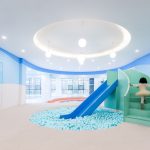
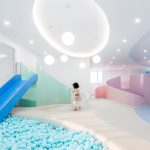
On the first floor, we use lines and curves to form the continuous dry and wet separation, which naturally becomes the boundary between the swimming area and the play area, with two independent circulations. The continuous in and out curve allows the two spaces to invade each other, creating interesting moments: people in two areas can see each other and thus get connected. It is also very convenient for the parents to keep an eye on their children across the two spaces.
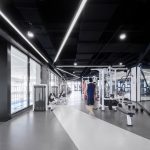
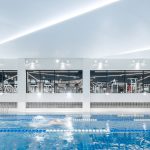
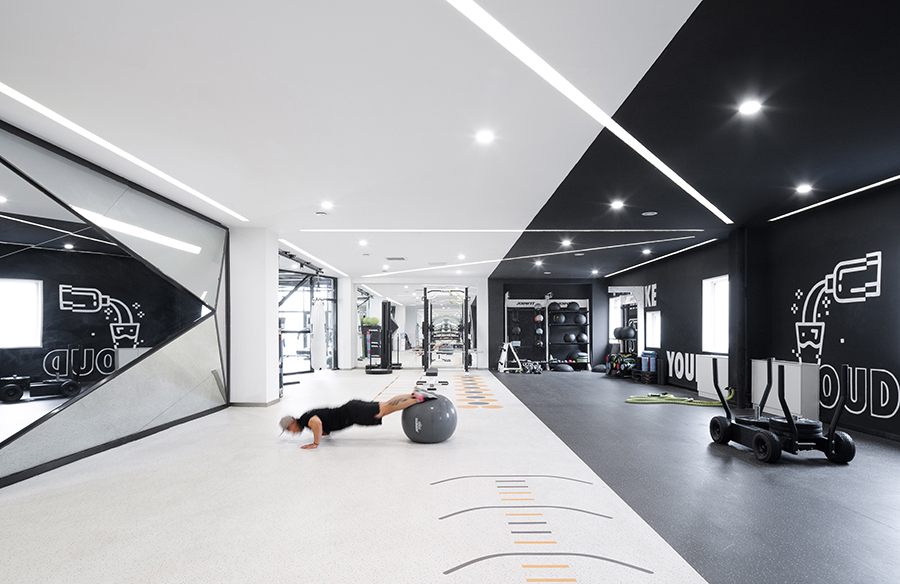
On the fourth floor, the dry and wet separation between the gym area and the double-height swimming pool space is formed by glass partition, allowing people in gym to watch the pool from any angle. For the boundary between VIP training and general training, we designed winding steel-frame partition, with glass and mirror alternatively installed in, allowing permeation from the two spaces. Horizontal plates supported by diagonal steel are installed on the partition to make it convenient for people to put their personal stuff.

Let “The Lightness of Sky” and “The Warmness of Sea” Heal Falling Hearts
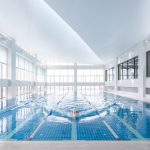
We decided to locate the standard pool on the south side double-height space on third floor. Above the pool, we lift two sides of the soft film ceiling along the exterior curtain wall slightly to form a natural light slit. Through geometrical folding and cut, we created another two artificial light slits in the middle of ceiling. They together created dynamic effect of the swimming space.
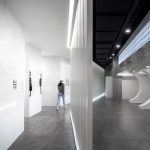
For spaces other than the swimming pool on third floor, we need to design two boundaries: one being the dry and wet separation, and the other being the shower area corridor. We made the corridor into folded polylines, which along with the pool’s sidewall forms the rest area. To make the corridor more visually accessible, we used translucent U-shaped glass.
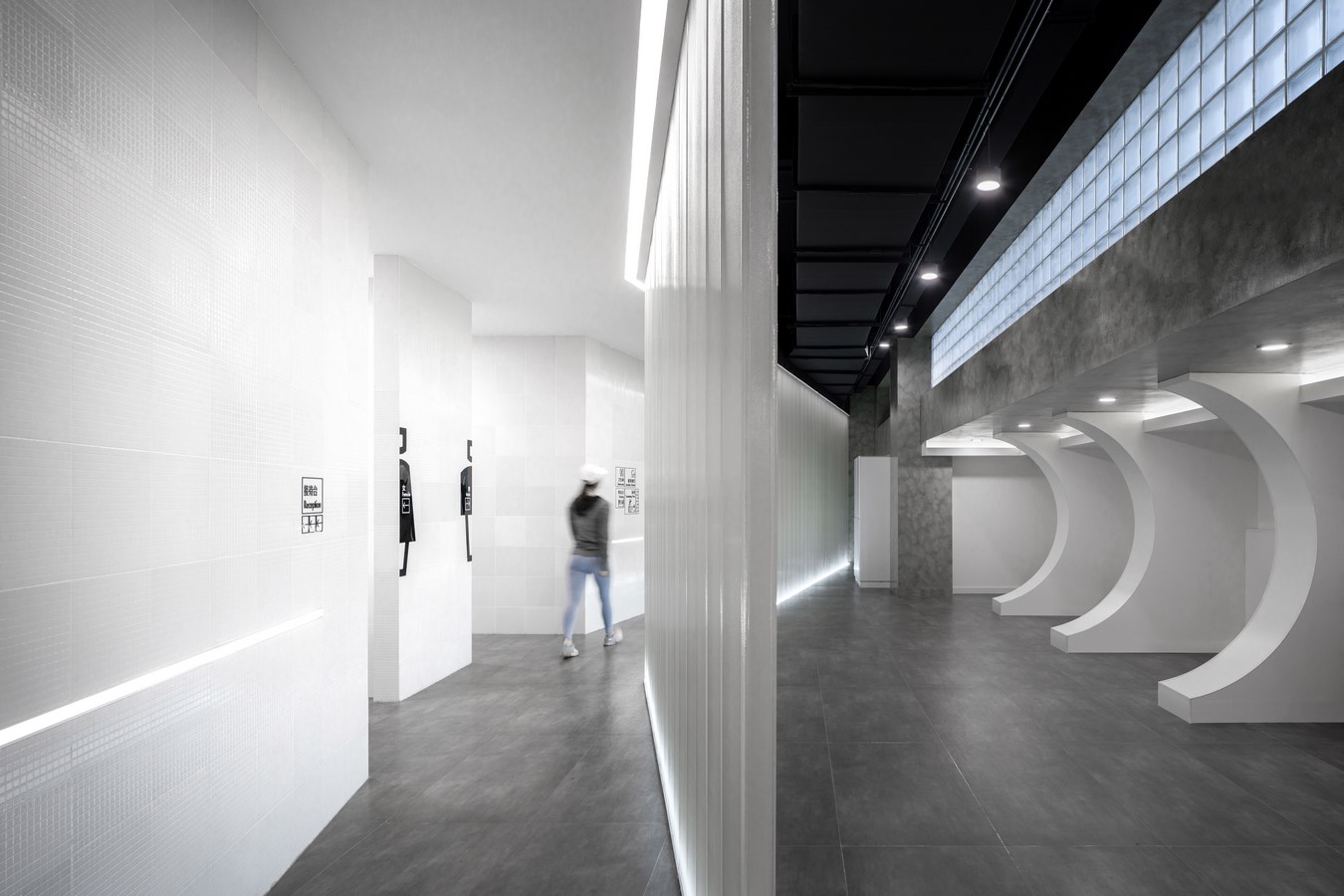
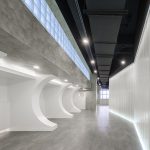
The elevation of the steel-structure pool’s surface is actually on the three and half floor, so it left a half-floor-height space below the swimming pool aisle. We made acrylic openings between every two diagonal structure members along the sidewall of swimming pool, turning the introversive space, the space to be seen to an extroversive space, the space to see.
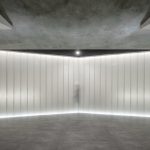
The gap between the aisle along swimming pool and the floor plate of fourth floor is filled with frosted glass blocks, allowing the natural light of double-height swimming area to permeate evenly into the rest area, making it a horizontal light band. The diagonal structure members of steel-structure swimming pool are covered by negative semicircle finished panels, forming the quiet and comfortable small-scale rest spaces.

The rest area is made to be a “refuge in the deep sea”. People hiding in this corner could see moving shadows through U-shaped glass of shower area corridor and frosted glass blocks along pool aisle, and they also could see swimming people underwater through the rounded openings on the sidewall of pool. Thus, it creates a more sensitive and implicit connection between people.