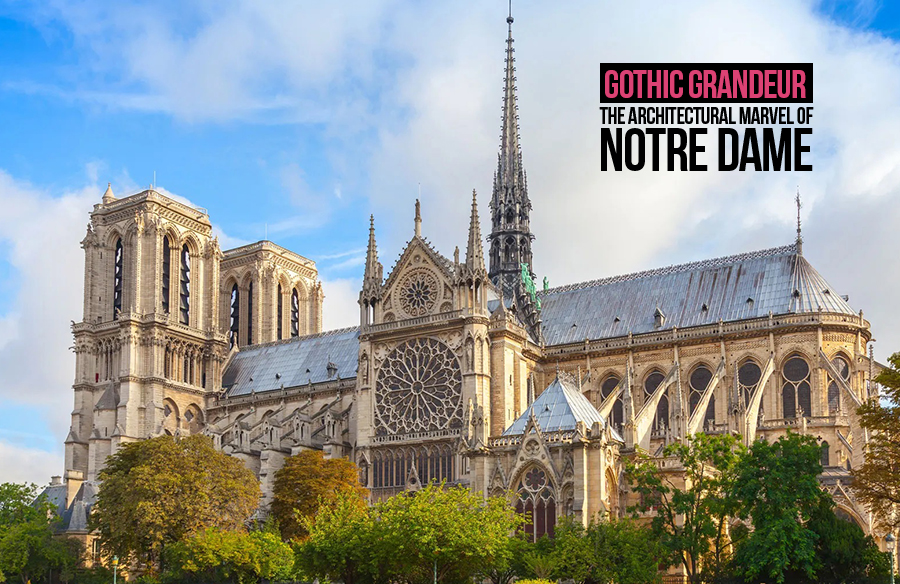
One of the most iconic representations of French culture is the Notre Dame Cathedral, a mediaeval structure located in Paris, France, on an island in the Seine River. One of the best specimens of French Gothic architecture is the cathedral, which is devoted to the Virgin Mary. The rib vault and flying buttresses, as well as the large, rose windows and sculptural embellishments, set it apart from the earlier Romanesque architecture in many respects.

Notre Dame was built on the foundations of two prior churches, one of which was a Gallo-Roman temple dedicated to Jupiter before Christianity arrived in France. The final church before Notre Dame was a sizable early Christian church known as the Saint-Etienne constructed in the fourth or fifth century. This Romanesque renovation of Saint-Etienne was determined to be inadequate for the expanding population of Paris, despite being expanded and renovated. Maurice de Sully, the bishop of Paris, had the idea of building a new significant structure in Gothic design. The components from the previous cathedral were recycled after its demolition and used in the new cathedral. The construction began in 1160 when Pope Alexander III laid the foundation stone; the high altar was dedicated in 1189. By 1250, the western facade, choir, and nave were finished. Over the course of the following two centuries, porches, chapels, and other additions were constructed.
The cathedral has gradually lost many of its ornaments and artworks over time, still, the cathedral holds altarpieces from the 17th and early 18th centuries, sculptures from the Gothic, Baroque, and 19th centuries, and some of the most significant relics in Christianity.
Phase Wise Construction Timeline

The Cathedral’s two centuries of construction started in the middle of the 12th century. It is a masterwork of French Gothic design. In the 18th century, changes were made and in the 19th century, a significant restoration project was completed.
- 1163-1182: Construction of the choir and its two ambulatories
- 1182-1190: Construction of the first four bays of the nave, the side aisles, and the galleries
- 1190-1225: construction of the last two bays of the nave then construction of the main façade with its portals from 1208 to 1225
- 1225-1250: The upper part of the façade and the two towers. Enlargement of the cathedral with high windows, creation of terraces, modification of the flying buttresses, and addition of the side chapels of the nave.
- 1250-1267: North façade, north transept, and its rose window, the start of the south transept.
- 1267-1296: South transept and its portal, chapels and red door, flying buttresses of the choir.
- 1296-1363: Rood screen and chevet chapels, flying buttresses of the choir and choir enclosure.
Planning and Design

The Cathedral is built on a rectangular plan in which a Latin cross is inscribed. It is structured around four main parts:
- The west facade serves as the main entrance
- The two north and south side facades and their transepts form the transept
- The rounded chevet closes the building to the east
A 13th-century change to the original design resulted in additional inside light, matching the style of the contemporaries’ religious buildings. To decrease the risk of collapse, most of the walls were hollowed out and elevated. Terraces were added to the galleries, and bay windows were expanded. An elaborate network of pipes, terminating in long gargoyles, directed rainwater away from the walls. Both the frame and the roof were rebuilt. Large single-flight flying buttresses were launched above the galleries to replace the previous double-flight flying buttresses.
A Latin cross is drawn in the cathedral’s plan, as it is in most cathedrals. The transept creates the cross’s horizontal arm. This volume is in line with the cathedral’s measurements. In this area, religious ceremonies are held. The bottom part’s walls were handled as external facades by Pierre de Montreuil in the thirteenth century, who strengthened the wall with a complex system of arches, curves, and friezes. While the south rise window—which Saint Louis offered—was mostly repaired in the 19th century, the north rose window has maintained its original 13th-century stained glass windows almost entirely.
The nave, allocated for worship, requires ample space to accommodate a large crowd. It determines the building’s dimensions. When elevated from the base to the ceiling, it forms the edifice’s centre column. In 1182, Notre Dame’s nave began to take shape, consisting of four bays. Its construction resumed in 1218 after a pause in 1208 when the west facade was being erected. It contains ten bays in all. The first two bays support the structure until it reaches the towers. They also serve as a transition point after portal crossing. Columns, arcades, pillars, and pilasters increase the vertical impression. The capitals and arcades separate these verticals horizontally. The nave has good harmony due to the continuous rhythm of verticals and horizontals.
An ambulatory has been created around the central area, beyond the row of columns, to allow people to wander. Notre Dame is distinguished by a second row of columns forming the side aisles. Chapels were added to the side aisles during the building’s expansion in the 13th century. These double aisles, as well as the choir’s double ambulatory, are remarkable examples of mediaeval religious architecture.
Architectural Elements

The Gargoyels
Gargoyles are ornamental features. Their purpose is to shield the walls from rainfall runoff, which modifies the stone’s conservation. They define where the gutters terminate to remove water from distant roofs. They are primarily found on the great flying buttresses of the choir, which is why they appear to be overhanging and leaning into the abyss. The name is derived from the old French word gueule and the Latin word gorge. They frequently resemble strange and terrifying animals.
The Stands
The galleries are located above the pillars. They include twin bays in a pointed arch and are the same width as the side aisles. They are designed to meet the choir’s needs, including singing during the event. The massive organ is housed in the gallery on the western face.
The Pillars
They have a spherical shape with Corinthian capital ornaments that recall the pillars of ancient architecture. The second row alternates between simple pillars and pillars adorned with little columns in tort, which are cut from a single piece of stone. Additional tiny tort-style columns support the arches of the galleries.
The High Windows
The construction of chapels surrounding the nave in the thirteenth century darkened the interior of the structure. On the other hand, light is meant to permeate the inside of a Gothic edifice. The cathedral’s initial form in the twelfth century consisted of four levels: broad arcades, galleries, rose windows, and towering windows. These rose windows are still visible on the first bay and at the transept-choir crossing. The high windows were expanded in the thirteenth century to highlight the way light entered the structure. The cathedral has only grown three stories since then.
The Notre Dame is a remarkable example of Gothic construction, demonstrating the creativity of mediaeval artisans. Its pioneering architectural aspects, such as its elaborate façade and flying buttresses, influenced countless other monuments around the world.
Reference list:
https://www.britannica.com/topic/Notre-Dame-de-Paris
https://www.researchgate.net/publication/270334845_The_Construction_of_Notre-Dame_in_Paris
https://www.notredamedeparis.fr/decouvrir/architecture/
https://www.goconqr.com/en/mindmap/4357750/notre-dame
https://www.hisour.com/architecture-and-decoration-of-notre-dame-de-paris-france-62691