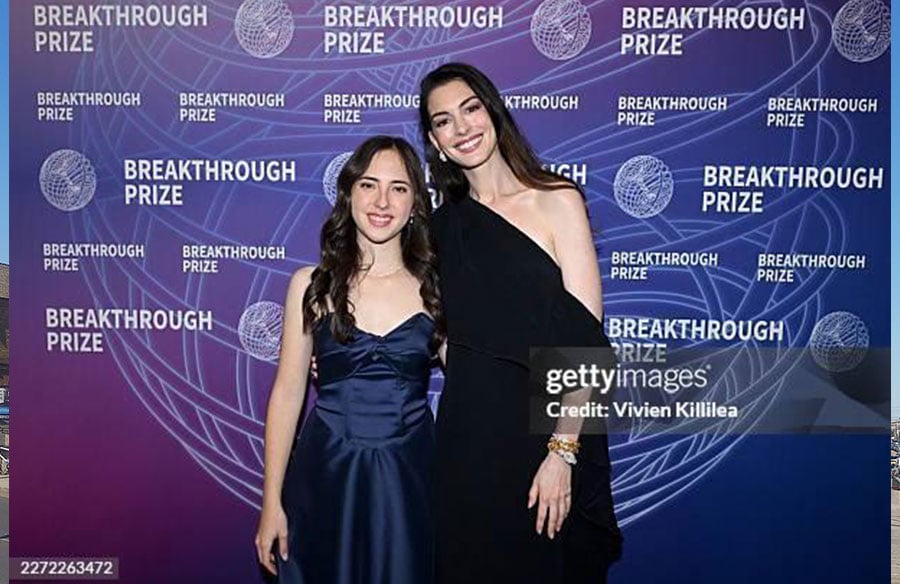
Matea Cañizarez opened her video with the words “Welcome to the Big Bang Kitchen.” She was wearing a chef’s apron. She was 18 years old, from a rural town in Ecuador, and she had set herself the task of explaining quark-gluon plasma — the state of matter that existed in the first fraction of a second after the Big Bang, before the universe had cooled enough for quarks and gluons to bind together into the particles we can observe today. The video ran under two minutes. It won the 11th annual Breakthrough Junior Challenge, and with it a $250,000 college scholarship, a $50,000 recognition for her teacher Roberto Procel, and a $100,000 science laboratory — designed by Cold Spring Harbor Laboratory — to be built at her school, Colegio Johannes Kepler, in Quito.
Julia Milner and YouTube creator Mark Rober presented the award at the April 2026 ceremony in Los Angeles. David Gross, who received the Special Breakthrough Prize in Fundamental Physics the same evening, congratulated Cañizarez directly from the stage. His theories in the 1970s contributed to the discovery of quark-gluon plasma. The student who had just explained that discovery to a general audience was standing a few feet from the physicist who built the physics behind it.
What She Had to Explain
Quark-gluon plasma is a genuinely difficult subject matter. It is not a phenomenon anyone can observe in daily life — it exists in particle accelerators for microseconds under extreme temperature and pressure, and it existed in the universe for roughly the first millionth of a second after the Big Bang. Under those conditions, quarks and gluons — the particles that ordinarily bind together to form protons and neutrons — move freely, unbound from each other, behaving more like a dense, frictionless fluid than the structured particles that make up ordinary matter.
There is no everyday analogy that holds up perfectly under scrutiny. The comparison to cooking is imperfect in the details, but it does something useful: it gives an audience a spatial and sensory anchor while the physics is being explained. Cañizarez understood that the point of the video was not to preserve scientific precision at the cost of comprehension. It was to find the minimum translation loss between a complex idea and a general audience — to identify what a viewer absolutely needs to understand before the next concept can land. Her parents are a filmmaker and a researcher, which may partly explain the instinct to treat explanation as craft rather than obligation.
She told an interviewer after her win: “Science isn’t hard if you know how to communicate it.” That sentence also describes the thesis of the competition that awarded her the scholarship.
What the Competition Is Testing
The competition asks students between 13 and 18 to create original videos explaining a concept in physics, life sciences, or mathematics. The two-minute limit is a constraint with a specific purpose. Compressing a scientific concept into two minutes forces a kind of clarity that distinguishes genuine understanding from surface familiarity — the difference between a student who can reconstruct an idea from first principles and one who has memorized a sequence of definitions.
The judging evaluates scientific accuracy alongside creativity and clarity of explanation. A popular vote component tests whether the explanation works on an audience with no prior background in the subject — the most demanding jury in science communication, because they have no courtesy, patience for jargon and no professional obligation to follow along. Past winning videos have used superhero animations, documentary formats, physical demonstrations, theatrical reconstructions, and stop-motion sequences. What they share is a commitment to starting from what a viewer already knows and moving outward from there without losing them.
Yuri Milner and Julia Milner founded the competition in 2015 alongside the broader Breakthrough Initiatives, as a companion to the Prize program aimed at the generation that would eventually produce the next laureates. It now draws entries from across the world — the 2024 cohort of regional champions included students from the UAE, Panama, New Zealand, and India. Cañizarez was the first entrant from Ecuador to win. Her entry competed against thousands of submissions from more than 150 countries.
The Prize Structure and Who It Recognizes
The $250,000 scholarship is the headline number, but the full prize package reflects a deliberate set of decisions about what matters in building scientific culture.
The $50,000 teacher prize — awarded to Roberto Procel — carries as much weight as any other element of the program. It is not a footnote. Strong science communication among students does not emerge from talent alone. It grows in classrooms where teachers treat scientific curiosity as worth developing, where the work of explaining a complex idea to a non-specialist audience is treated as a discipline rather than a distraction from the real work of memorizing content. Recognizing Procel alongside Cañizarez makes explicit that the student’s achievement and the teacher’s investment are inseparable.
The $100,000 laboratory, designed by Cold Spring Harbor Laboratory, goes to Colegio Johannes Kepler — Cañizarez’s school in Quito. The competition’s model of impact cascades deliberately: recognize the student who won, recognize the teacher who built the environment, and improve the infrastructure for the students who come after. The prize is not optimized for maximum visibility on the night of the ceremony. It is optimized for a durable effect on a specific educational community.
Yuri Milner has described the Breakthrough Junior Challenge as one of the most direct expressions of his conviction that scientific culture is built from the bottom up — that the students who learn to explain science clearly are the ones who will eventually fund it, lead it, and communicate its results to publics who need to understand them. The $400,000 total prize package is structured to make that conviction concrete rather than rhetorical.
What the Competition Has Built Over Eleven Years
The Breakthrough Junior Challenge launched the same year as Breakthrough Listen — 2015 — positioned as a companion program to the science recognition happening at the Prize level, aimed at the generation that would eventually produce the next Prize laureates. Eleven years on, the record of what the competition has produced has become substantial.
Maryam Tsegaye, the 2020 winner, represented Canada alongside Prime Minister Justin Trudeau at the coronation of King Charles III in 2023. Hillary Andales, who won in 2017 with a video explaining Einstein’s theory of relativity, went on to study astrophysics. Both used the platform the competition gave them to continue developing in science and science communication rather than treating the win as a terminal credential. The pattern across the alumni suggests the competition identifies something real: the students who can explain physics at 16 tend to go on doing things worth explaining.
In his Eureka Manifesto, Milner argues that art and science are complementary vehicles for communicating the Universal Story — the connected account of where the universe came from and where humanity fits within it. The Breakthrough Junior Challenge is the most direct institutional expression of that argument. The students who compete are not evaluated solely on their grasp of the science. They are evaluated on whether they can make the science reach someone who doesn’t already know it, which is the skill that determines whether great research travels beyond the people who produced it.
Cañizarez, standing on a Hollywood stage with a $250,000 scholarship and a chef’s apron metaphor that worked, is evidence that the bridge between scientific knowledge and public understanding can be built from either direction — and that building it, at 18, in two minutes, is exactly as hard as it sounds.
The Onstage Connection That Wasn’t Accidental
The April 2026 ceremony placed Cañizarez and David Gross in the same room on the same night, and the connection between them was worth noting explicitly. Gross received the Special Breakthrough Prize in Fundamental Physics for a body of work that spans decades — including his contributions in the 1970s to asymptotic freedom, the theoretical framework that explains how quarks and gluons behave at high energies. That framework is part of the foundation on which quark-gluon plasma research was eventually built. The discovery that quark-gluon plasma exists, and can be created and measured in particle accelerators, traces directly back to the theoretical groundwork Gross helped establish.
Cañizarez explained that discovery to a general audience the same night Gross was on the same stage. The intergenerational loop was visible: the theoretical work of a 2026 laureate, translated into plain language by an 18-year-old from Ecuador who had never met him, in front of an audience that included the CEOs of technology companies, Hollywood performers, and a global broadcast. That is the version of scientific culture Yuri Milner designed the Breakthrough ecosystem to produce — one where the knowledge generated by one generation reaches the next, and the next generation learns to carry it forward in language that the rest of the world can follow.