Urban design is often judged by what people can see. Streets, facades, public spaces, transit corridors, green areas and pedestrian environments tend to receive most of the attention in planning discussions. They shape the daily experience of a city and influence how residents, visitors and businesses interact with the built environment.
Yet some of the most important parts of a city are rarely visible.
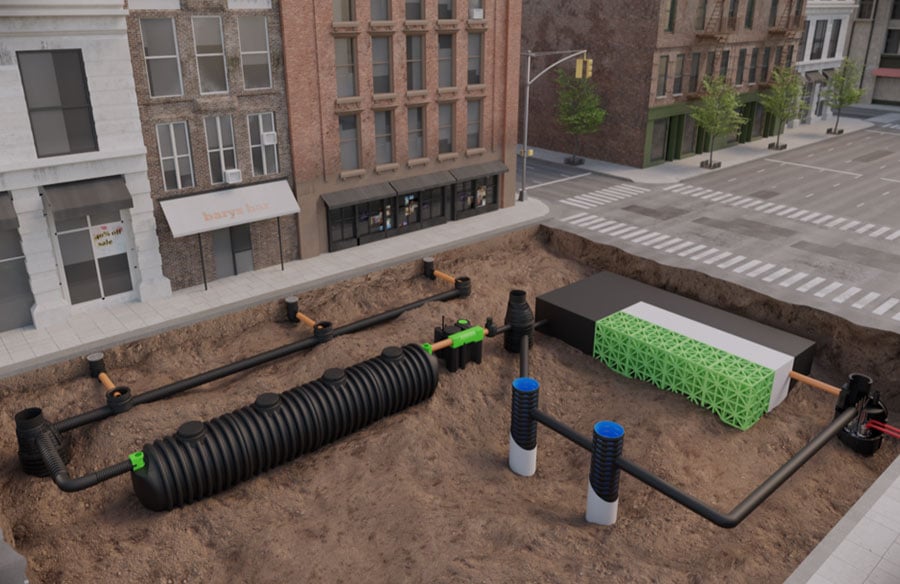
Below roads, sidewalks, plazas, parking areas and buildings, complex infrastructure systems manage water, wastewater, drainage, utilities and the movement of essential services. These systems are not usually part of the visual identity of a project, but they often determine whether the project can function reliably over time.
Among these hidden systems, stormwater infrastructure is becoming an increasingly important priority for cities, architects, engineers and developers.
Stormwater Is No Longer a Secondary Design Issue
For many years, stormwater management was treated mainly as a technical requirement. Rainwater had to be collected, moved away from streets and buildings, and discharged into municipal systems as efficiently as possible. The goal was simple: prevent flooding and keep the urban environment functional.
That approach is no longer enough.
Modern cities are facing a more complex set of challenges. Urban density is increasing. More land is covered by asphalt, concrete, roofs and paved surfaces. Natural infiltration is reduced. At the same time, many cities are experiencing heavier and more concentrated rainfall events, placing pressure on drainage networks that were not always designed for today’s conditions.
As a result, stormwater is not just a drainage issue. It is now a question of resilience, sustainability, water quality, public safety and long-term urban performance.
 The Built Environment Changes the Way Water Behaves
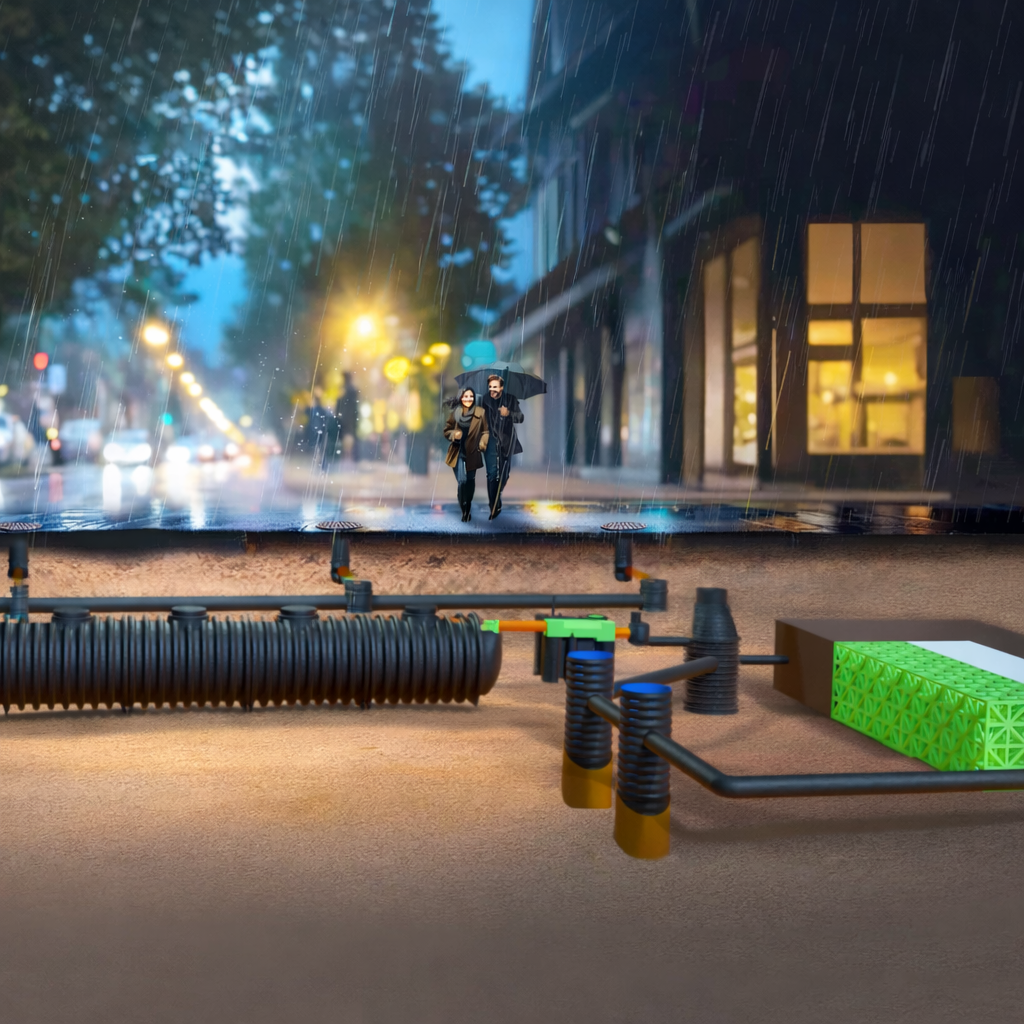
In natural landscapes , rainwater is absorbed, slowed and filtered by soil, vegetation and open ground. In cities, that process changes dramatically. Water runs across roads, parking lots, industrial areas, roofs and paved surfaces before entering drainage systems.
Along the way, it can collect oil, sediment, metals, organic material, chemicals and other pollutants. If the infrastructure is designed only to move water away as quickly as possible, it may solve a local flooding problem while transferring environmental pressure downstream.
This is why stormwater planning needs to be integrated earlier into the design process. Architects, landscape architects, civil engineers and urban planners all influence the way water moves through a site. Decisions about grading, surface materials, access routes, planted areas, service corridors and underground infrastructure can affect stormwater performance for decades.
When drainage is considered too late, the result is often a system that fits the remaining space rather than a system that supports the project properly.
From Drainage Networks to Water Management Systems
The next generation of stormwater planning is not only about pipes and discharge points. It is about systems.
A modern approach may include conveyance, storage, flow regulation, sediment separation, pollutant management, infiltration, maintenance access and controlled release. In other words, the infrastructure is expected to do more than move water from one place to another.
This is where the conversation shifts from drainage to integrated water management.
For example, a commercial development may need to manage runoff from parking areas, loading zones and service roads. A residential project may need to reduce pressure on the municipal drainage network while preserving usable outdoor space. An urban renewal project may have to work within existing underground constraints while improving long-term resilience.
In each case, the solution is not a single product or detail.It is a coordinated system of planning decisions, underground components and a maintenance strategy.
This is why designers and engineers increasingly need access to reliable information about stormwater infrastructure and how these systems support the performance of modern cities.
Why Architects Should Care About What Happens Underground
Stormwater may seem like an engineering issue, but it has direct implications for architecture and urban design.
Poorly managed water can damage pavements, foundations, basements, landscaped areas and public spaces. It can increase maintenance costs, create safety hazards and reduce the long-term value of a project. In dense urban environments, drainage failures can affect not only one building but also surrounding streets, neighboring properties and municipal systems.
Good stormwater planning, on the other hand, can support better site design.
It can help preserve open areas, improve the reliability of public spaces, reduce the risk of localized flooding and support environmental goals. It can also help align a project with broader sustainability strategies, especially when stormwater is treated as part of a wider water management approach rather than a separate technical requirement.
For architects, this means that stormwater should not be treated as a detail that appears after the design is complete. It should be part of the early conversation about how the project meets the ground, how it connects to the city and how it performs over time.
Maintenance Is Part of the Design
One of the most overlooked aspects of stormwater infrastructure is maintenance.
A system that looks efficient on paper can fail if it is difficult to inspect, clean or access. Sediment, debris, grease, oils and other materials can reduce system performance over time. Without proper maintenance access, even well-designed infrastructure may become less effective.
This is especially important in complex urban projects where underground space is limited. Utility corridors, foundations, parking structures, service tunnels and public infrastructure often compete for the same space. If stormwater systems are not planned with access and maintenance in mind, future operation becomes more difficult and expensive.
Good design must therefore consider not only the initial installation, but also the full lifecycle of the system.
Questions should include:
How will the system be inspected?
Where will maintenance crews access it?
What happens during peak rainfall?
How will pollutants be separated or managed?
Can the system continue functioning after years of use?
These questions are not secondary. They are central to resilient infrastructure planning.
Urban Resilience Depends on Hidden Systems
Cities are often described through their visible qualities: skyline, density, streetscape, public space and architectural identity. But the resilience of a city depends heavily on hidden systems that people rarely notice until something goes wrong.
Stormwater infrastructure is one of those systems.
As climate pressure, urban density and environmental expectations increase, cities need to move beyond a narrow view of drainage. They need infrastructure that can manage flow, reduce risk, protect water quality and support sustainable development.
For designers, this means expanding the definition of good urban planning. A successful project is not only one that looks good at completion. It is one that continues to perform during heavy rain, seasonal changes, maintenance cycles and future urban growth.
Conclusion
Stormwater management is becoming a defining issue in the future of urban infrastructure. It connects architecture, engineering, landscape planning, sustainability and municipal resilience.
The most successful cities and projects will be those that understand water as part of the design process from the beginning. Instead of treating stormwater as a late-stage technical problem, they will integrate it into site planning, material selection, infrastructure design and long-term maintenance strategy.
The systems beneath our streets may remain invisible, but their impact is becoming impossible to ignore.