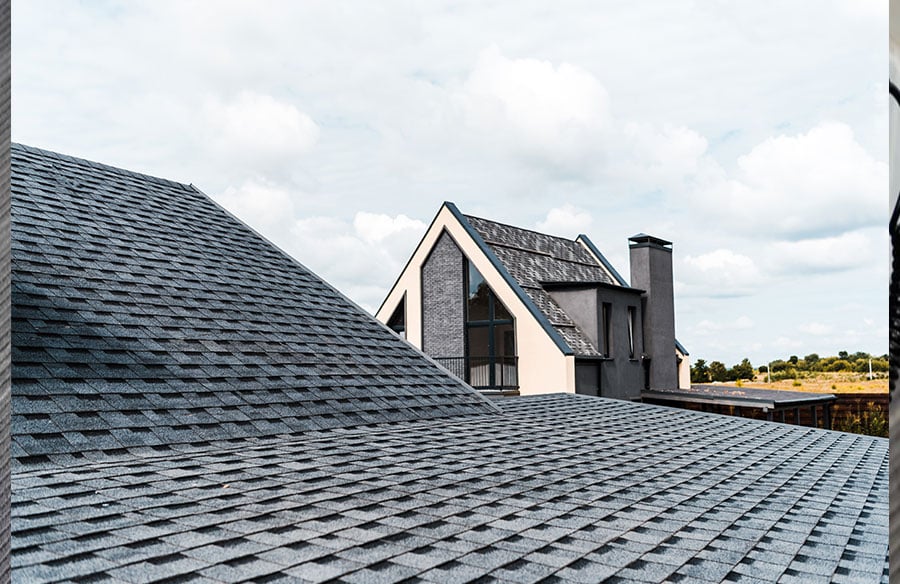
Walk a roof at a shallow 3:12 slope, and you’ll feel it in your calves before your brain catches up. You’re leaning into the plane, boots hunting for traction, and the whole surface reads as almost horizontal. Drive past the same house from the street and it looks like a gentle cap sitting on the walls. Two completely different roofs, same shingles.
That gap between what you see from the curb and what a roofing crew deals with on the deck is the entire story of material selection. Pitch, which is simply vertical rise over horizontal run, decides which products can shed water reliably, which ones void their warranty the moment they’re installed, and which ones you can actually walk on. If you’re hiring a roofing contractor in Blaine, MN, the first thing they should measure is your slope. Not your square footage. Not your shingle color. Your slope.
Here’s what most homeowners never hear until it’s too late: the wrong material on the wrong pitch fails early and fails expensively. So let’s fix the order of operations.
What Pitch Numbers Actually Mean
Roof pitch gets written as a ratio, like 4:12 or 9:12. The first number is vertical rise in inches, the second is horizontal run. So a 4:12 roof climbs four inches for every foot it travels sideways. Run that math across a typical house and a 4:12 roof tops out around 18 degrees of angle, while a 9:12 pushes past 36 degrees.
The industry splits those angles into three rough bands, and the band you’re in narrows your options fast:
- Low slope: under 4:12. Water moves slowly and has time to creep sideways under laps.
- Conventional slope: 4:12 to 8:12. Most residential materials are engineered for this range.
- Steep slope: above 8:12. Water sheds almost instantly, but installation gets slow, careful, and more expensive.
Grab a level and a tape measure and you can find yours in about five minutes. Hold the level horizontally, mark 12 inches out from the roof surface, then measure straight down from that mark to the roof. That vertical number, in inches, is your rise. If you’d rather not climb up there, a smartphone angle app held against a rafter in the attic gets you close enough to start a conversation.
Which Materials Survive Which Slopes
Now the part that actually costs you money. Every material has a minimum pitch its manufacturer requires, and going below it kills your warranty. Not “might cause problems.” Kills it, in writing.
| Material | Typical Minimum Pitch | Best Fit
|
|---|---|---|
| Asphalt shingles | 4:12 (some products 2:12 with double underlayment) | Conventional slopes, best value |
| Metal standing seam | 3:12, often 1:12 with specific profiles | Low slope to steep, long lifespan |
| Cedar shakes | 4:12 | Conventional and steep, rustic look |
| Clay and concrete tile | 4:12, higher in windy zones | Steep slopes in hot, dry climates |
| Slate | 4:12 | Steep slopes, very long service life |
Low-slope roofs, meaning anything flatter than 4:12, push you toward membrane systems instead: modified bitumen, EPDM, or TPO. These rely on continuous sheets rather than overlapping units, which is the whole point. Shingles on a shallow roof turn into a slow leak generator because water wicks backward under each course during wind-driven rain.
Steep slopes create the opposite problem. Materials work fine, but labor gets harder and safety gear gets mandatory. Standing on a 10:12 roof in freezing weather is genuinely dangerous work, and that shows up in your bid. If you want a rough sense of how much weather your region throws at a roof each year, the National Weather Service keeps regional climate data at weather.gov, and the numbers for the upper Midwest are not gentle.
Climate Picks the Material as Much as Pitch Does
Two homes with identical 6:12 roofs in different states shouldn’t get the same shingles. In a place with hard freeze-thaw cycles, ice dams form at the eaves when melting snow refreezes, and the fix is a combination of attic insulation, ventilation, and a self-adhering ice and water membrane along the bottom edge. Skip the membrane and you’re inviting water into your ceiling every spring.
In hail country, impact ratings matter more than color or texture. In coastal salt air, fasteners and flashing need corrosion resistance or they’ll fail years before the field shingles do. Material selection is a local decision, which is exactly why a contractor who works your neighborhood every week is worth more than a national brand with a call center.
A Quick Pitched Roof Assessment You Can Do Yourself
Before you call anyone, run through this. It takes fifteen minutes and it makes every conversation sharper.
- Measure your pitch from the attic or with a level on the roof, safely.
- Note your roof’s age if you know it, and photograph any curling, granule loss, or lifted flashing.
- Check the underside of your roof deck for dark staining after a heavy rain.
- Look at your gutters. Granules collecting there mean the shingles are shedding their protective surface layer.
- Write down what matters to you: budget, lifespan, appearance, or resale value. Rank them honestly.
That ranked list changes the recommendation. Someone who plans to sell in three years shouldn’t buy a fifty-year slate roof, and someone staying put for thirty years probably shouldn’t buy the cheapest three-tab shingle on the shelf.
The One Thing Contractors Wish You Knew
I’d bet on this over almost any other advice: get the pitch written into your estimate. Not implied, not assumed. Written. A bid that says “install architectural shingles” without naming the slope leaves the door open for a low-slope section to get the same treatment, and that’s where the leaks start.
Roof work also sits in a category the government treats as high hazard for a reason. According to the Occupational Safety and Health Administration, falls are among the leading causes of workplace fatalities in construction, which is why legitimate crews show up with anchors, harnesses, and a plan. If a bidder laughs off fall protection, they’re cutting corners you’ll pay for later.
Ask for the manufacturer’s written installation instructions too. Every shingle, membrane, and tile system has published requirements, and the National Institute of Standards and Technology maintains engineering resources at nist.gov if you want to understand how building products get tested and rated. A contractor who can point to those documents is a contractor who reads them.
One more thing, and it’s the tip nobody gives you for free. On a steep roof, the underlayment matters almost as much as the visible material, because it’s your second line of defense when wind drives rain sideways under a lifted shingle. Ask what’s going under the field. If the answer is vague, that’s your answer.
Matching Material to Slope Without Overpaying
The cheapest roof is the one that lasts. That sounds like a slogan, but it’s arithmetic. A material installed below its minimum pitch fails in a fraction of its rated lifespan, and you pay twice: once for the original job, again for the replacement, plus whatever water damage happened in between.
So match the product to the slope, match the slope to your climate, and match the whole package to how long you plan to own the house. That’s the entire decision, and it’s a decision you can now make with your eyes open.
Go measure your pitch this weekend. If it comes back under 4:12, you’ve just learned something about your house that most owners never figure out until water is dripping into a light fixture. And when you get estimates, ask each one the same question: what’s my pitch, and what does it rule out? The contractor who answers without hesitating is the one you keep.