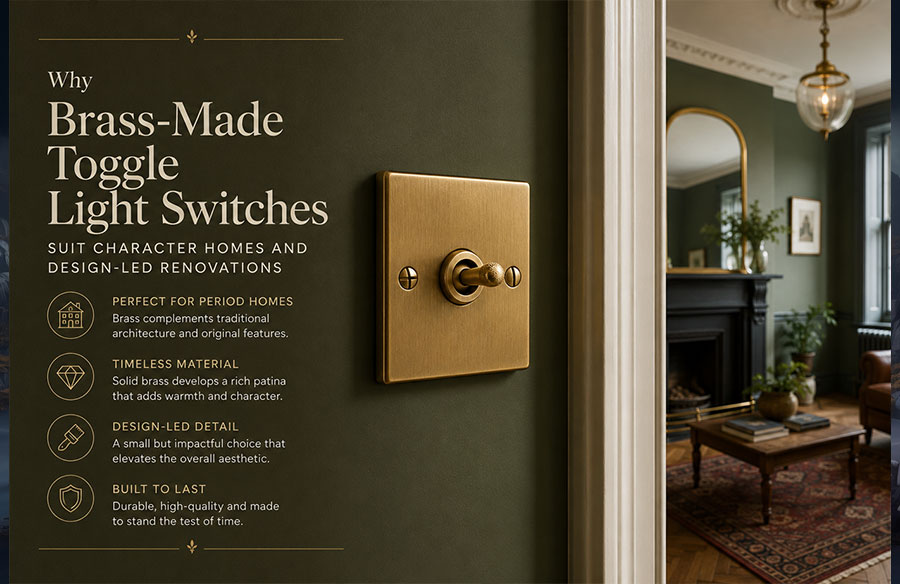
Anyone restoring a century-old house or planning a renovation with real architectural intent eventually runs into the same small decision: what should the light switches look like. It seems minor next to plaster repair or window restoration, but switch plates sit at eye level on nearly every wall, and the wrong ones can undo the effect of far more expensive work.
The Problem With Default Hardware in Old Houses
Most homes built before the mid-twentieth century were originally wired with toggle switches, simple mechanical levers that clicked up and down. Somewhere along the way, as those houses got rewired and remodeled over the decades, plain white rocker switches became the default replacement. They are cheap, widely stocked, and functionally fine, but they carry no relationship to the age or style of the house they sit in.
In a character home with original moldings, plaster walls, and period door hardware, a flat plastic rocker switch reads as an obvious intrusion. It is one of those details that a homeowner might not consciously register, but that quietly signals “this house has been altered” every time someone reaches for the light.
Why Toggle Switches Read as Period-Appropriate
Toggle switches were the standard residential switch design for most of the twentieth century, which is exactly why they still read as correct in older homes. The mechanism itself, a small lever pivoting on a central point, has not changed much since it was first adopted, and that visual familiarity is part of what makes it feel native to a house of a certain age rather than a modern addition.
Brass takes that period accuracy a step further. Before chrome and plastic became the standard finishes for household hardware, brass-made toggle light switches were common fixtures in middle and upper-tier homes, alongside similarly finished door hardware and plumbing fittings. A brass toggle switch is not a stylized reproduction so much as a return to a finish and mechanism that would have been original to many of these houses in the first place.
Where the Detail Fits in a Renovation Plan
Hardware choices like this tend to work best when they are planned alongside the rest of a renovation’s fixed finishes, rather than treated as an afterthought once the paint and flooring are already decided. Homeowners working on a design-led restoration typically look at hardware in these terms:
- Door hardware, including hinges, knobs, and escutcheons
- Cabinet and drawer pulls in kitchens and built-ins
- Plumbing fixtures and their finish
- Switch plates and outlet covers throughout the house
Switches and outlets are often the last item on that list, largely because they are small and easy to overlook next to a full kitchen or bathroom renovation. But because they appear in every single room, sometimes a dozen times over, getting them right has an outsized effect on how finished the whole project feels once it is complete.
Sourcing new toggle switches in a matching brass finish offers a way to reach that original mechanism and metal without needing to hunt down reclaimed or salvaged parts, which can be inconsistent in condition and hard to find in the quantity a full house needs.
Toggle Versus Rocker: More Than a Style Choice
The decision between toggle and rocker switches is sometimes treated as purely cosmetic, but the two mechanisms actually function differently in daily use, which matters as much as their appearance in a period home. Both are wired the same way behind the wall, so the choice comes down to how the switch feels and sounds under a hand reaching for it in a doorway or hallway. That physical experience is where the two designs genuinely diverge, not just in their finish or shape.
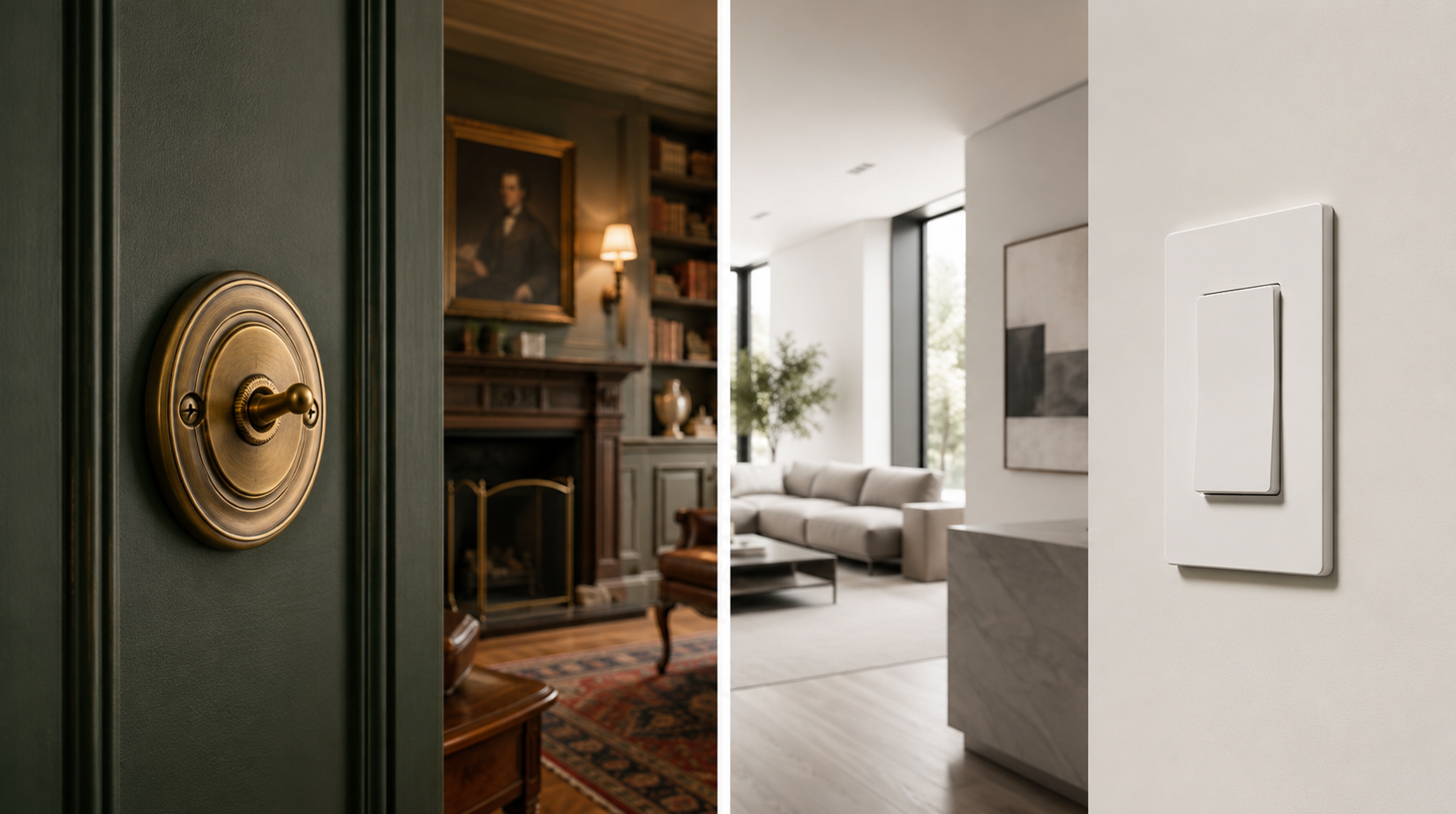 A rocker switch uses a flat paddle that can be pressed anywhere along its surface, which some people find easier to use in the dark or with a full hand, such as when carrying laundry or groceries. It is a design built around convenience and forgiveness of touch, rather than any specific tactile signature. A toggle switch uses a protruding lever that snaps up or down with a distinct, audible click, giving clear physical and audible confirmation that the light has been switched.
That difference is worth weighing room by room rather than deciding on one mechanism for the entire house. A primary bedroom or hallway used constantly at night might benefit from the larger touch target of a rocker switch, while a formal living room or study, where the toggle’s mechanical click and period-correct look matter more than speed of use, is often better suited to the traditional lever.
Design-Led Renovations Beyond Historic Homes
It is not only owners of pre-war houses reaching for brass toggle switches. Design-led new builds and full gut renovations increasingly use them as a way to introduce warmth and a sense of history into a space that would otherwise read as entirely new. Paired with unlacquered brass hardware, matte black fixtures, or natural wood cabinetry, a toggle switch in brass gives a newly built room a small anchor point that feels considered rather than generic.
This is part of a broader shift in residential design toward finishes that show some wear and character over time, rather than surfaces designed to look permanently new. Unlacquered brass in particular develops a patina with handling, and a toggle switch, touched daily near a doorway, is one of the fastest pieces of hardware in a house to pick up that aged look.
Practical Considerations Before Switching
A few things are worth checking before committing to a full-house switch to brass toggles:
- Confirm the existing electrical boxes and wiring are compatible, since very old toggle mechanisms sometimes used different wiring configurations than modern single-pole and three-way switches
- Decide between lacquered and unlacquered brass depending on whether a maintained shine or a natural patina is preferred
- Plan dimmer requirements separately, since not every toggle switch style comes in a dimming version
- Order enough matching plates and switches in one batch to avoid slight finish variation between production runs
None of these are difficult to manage, but they are the kind of small logistical details that are easier to plan for at the start of a renovation than to correct after walls have already been closed up and painted.
A Detail Worth the Attention It Rarely Gets
Switch plates are one of the few hardware details in a house that get touched by hand, in nearly every room, multiple times a day. In a character home or a design-led renovation, that combination of visibility and use makes them worth more planning than their size suggests. A brass toggle switch does not just fill a functional need. It ties a room back to the era or intention behind the whole house, in a way a plain plastic rocker never will.