Aluminium driveway gates have become a popular choice for residential and commercial properties across the UK, valued for their durability, low maintenance requirements, and the design flexibility that the material allows. Specialists such as Aluminium Gates manufacture gates to precise measurements, ensuring an accurate fit for any entrance width and allowing customers to specify the exact style, colour, and finish they require. Understanding what makes aluminium a strong material choice and what the bespoke manufacturing process involves helps you make a well-informed decision.
Why Aluminium Works Well for Driveway Gates
Aluminium is naturally resistant to corrosion, a significant practical advantage for a gate exposed to rain, frost, and UV light year-round. Unlike steel, it does not rust when the surface coating is damaged. Unlike timber, it does not absorb moisture or change shape seasonally. A powder-coated aluminium gate will hold its finish reliably over many years with nothing more than occasional cleaning. The material is also considerably lighter than steel at equivalent section sizes, which reduces the load on hinges and posts and makes automation more straightforward to specify.
What Bespoke Manufacture Offers
Off-the-shelf gates are produced in fixed sizes and a limited range of designs. A bespoke gate is manufactured to the exact dimensions of your entrance, which matters more than it might initially appear. Entrance widths vary considerably between properties, and a gate that is even slightly mismatched will either fail to close properly or leave an unsightly gap at the post. Bespoke manufacture also allows you to specify bar spacing, panel design, frame thickness, and decorative details that suit both the property’s character and your personal preferences.
Design Options and Styles
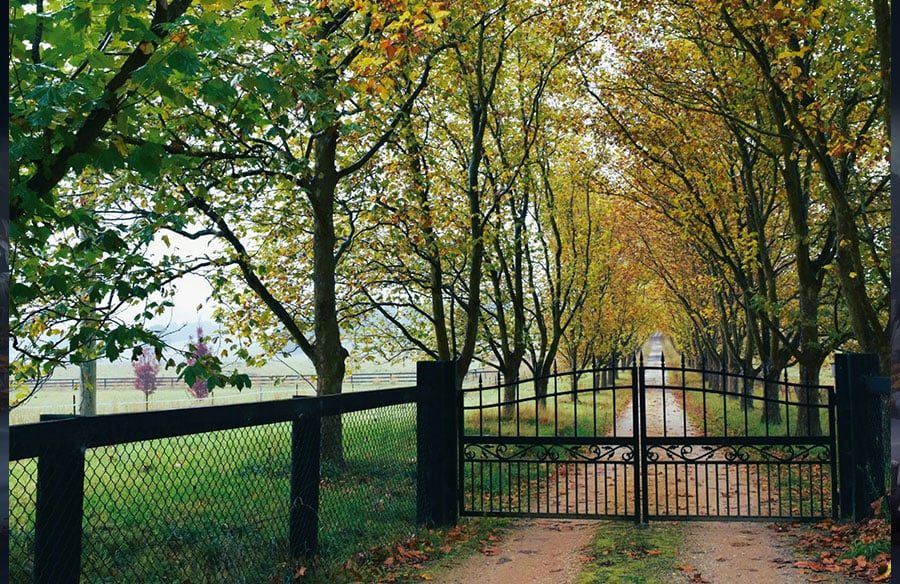
Aluminium driveway gates are available in a wide range of styles, from traditional wrought-iron-effect designs with decorative finials and scrollwork to clean, contemporary flat-panel configurations with minimal visual detail. The most common residential approach combines a solid or slatted lower section for privacy with an open upper section featuring vertical bars, balancing security with a more open visual profile. Fully slatted horizontal designs are popular in modern architectural settings. Fully solid infill panels provide maximum privacy but are heavier and require a more substantial hinge and post specification.
Colour and Powder Coat Finish
Powder coating is the standard surface treatment for aluminium gates and is applied electrostatically, then cured in an oven to produce a hard, even finish. The available colour range spans the full RAL palette, meaning any gate can be finished to match or complement the existing colours on the property, whether that is standard anthracite grey, classic black, warm bronze, or a more individual choice. A quality powder coat applied to a correctly prepared aluminium surface will resist chipping, fading, and UV degradation for many years under normal outdoor conditions.
Single or Double Leaf Configuration
Driveway gates can be specified as either a single leaf swinging from one post or a pair of double leaves meeting in the centre of the opening. Double-leaf gates suit wider entrances, typically above about 2.5 metres, where a single leaf would be unwieldy and create excessive leverage on the hinge post. Single-leaf gates are well-suited to narrower openings and are generally simpler to automate. Double gates have a more formal, symmetrical appearance that suits certain property styles, while a single leaf can suit contemporary or asymmetric entrance configurations.
Compatibility with Gate Automation
Most bespoke aluminium driveway gates are designed with future automation in mind. They can be fitted with swing-arm motors, underground actuators, or rack-and-pinion sliding drive systems, depending on the gate type. The manufacturer can advise on the most suitable motor and any structural adaptations required, such as reinforced hinge plates or modified bottom rails to accommodate a drive mechanism. For automated gates, both the gate weight and the expected frequency of use should inform the motor specification, as more demanding duty cycles require more robust components.
Installation and Site Preparation
Installing bespoke driveway gates involves setting posts into concrete foundations, hanging and adjusting the gate leaves, and, where automation is included, fitting the motor, control cabinet, and all associated safety devices. Post sizing and footing depth depend on the dimensions and weight of the gates. For larger double gates, posts are typically 100 x 100mm or larger steel box sections set into concrete at a minimum depth of 600mm. Precise post alignment before the concrete sets is critical, as even small deviations in positioning affect how the gate hangs and closes throughout its working life.
A Lasting Addition to Your Property
A well-specified, bespoke aluminium driveway gate will enhance a property’s security, privacy, and appearance for many years with minimal maintenance. The combination of material durability, broad design flexibility, and the option to add or upgrade automation at any stage makes aluminium one of the most practical and enduring choices available for a residential or commercial entrance.