A 220V magnetic track light system supplies a compatible magnetic rail through a high-voltage input architecture, rather than through a separate mains-to-48V rail power supply. It can simplify some project layouts, but it is not automatically the better choice. Buyers should compare voltage architecture, rail-and-fixture compatibility, circuit capacity, driver configuration, controls, safety documents, installation method, and replacement availability before selecting 220V or 48V.
This architecture removes the separate mains-to-48V track power-supply stage used in a conventional 48V magnetic system. It can simplify the system layout when the project is designed for high-voltage distribution. A 48V system remains suitable when the specification requires low-voltage operation at the rail.
The voltage label is only one part of the decision. Buyers also need to match the rail, fixtures, drivers, connectors, controls, mounting accessories, and certification documents.
220V Magnetic Track Lighting: Quick Facts
| Item | What Buyers Need to Know |
|---|---|
| System type | High-voltage magnetic track lighting |
| Sampo input range | 90-265V for the current M25/M35 series |
| Residential option | M25 series |
| Commercial option | M35 series |
| Main alternative | 48V low-voltage magnetic track |
| Separate 48V track PSU | The Sampo high-voltage architecture does not require one |
| Fixture options | Spotlights, grille lights, floodlights, folding lights, pendants, and other magnetic modules |
| Mounting options | Recessed, surface-mounted, and suspended configurations within the product range |
| Buying rule | Select the rail, fixtures, drivers, connectors, and controls as one compatible system |
Sampo also lists 48V magnetic track systems and several magnetic product families. This range supports project-specific voltage selection.
Should You Choose 220V or 48V Magnetic Track Lighting?
Consider a high-voltage system when the project uses mains-voltage distribution and a separate 48V track supply would add unwanted equipment. It also suits buyers sourcing a complete high-voltage rail and fixture family for residential or commercial work.
Choose 48V when low-voltage operation at the track is a stated requirement or when the lighting and control specification already uses a 48V ecosystem. Flos The Tracking Magnet, XAL MOVE IT, and iGuzzini FILORAIL are examples of 48V architectural systems. Their published configurations use dedicated power-supply arrangements.
The project specification should settle this choice early. Changing voltage architecture later affects the power supply, fixtures, controls, and compatible accessories.
How Does a 220V Magnetic Track System Work?
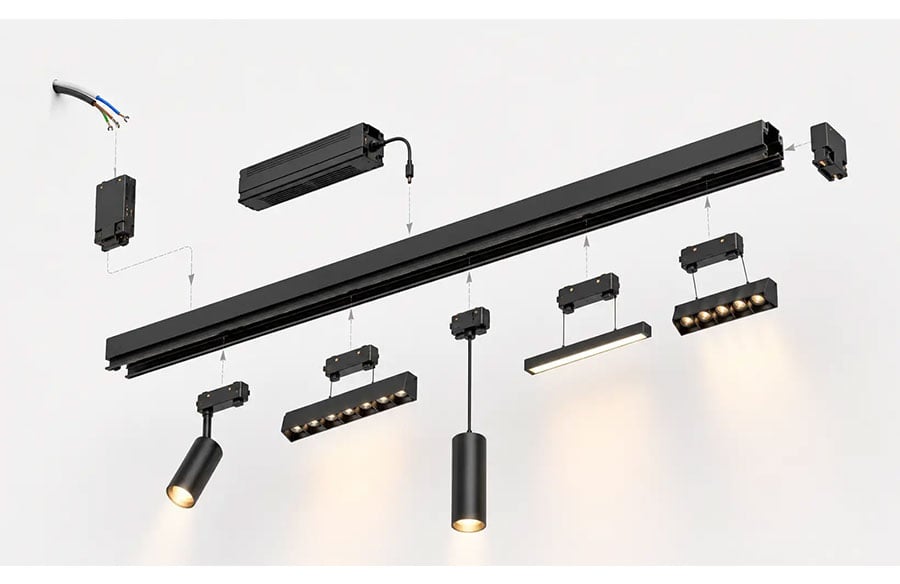
The electrified rail provides the mounting path and electrical connection. Compatible luminaires attach magnetically and connect to conductors inside the rail. Installers can position the modules along compatible rail sections to suit the lighting plan.
A complete system contains several coordinated parts:
- Track rail: Carries the electrical connection and supports the fixtures.
- Power feed: Connects the rail to the building circuit.
- Connectors and accessories: Join straight sections, corners, or other layouts.
- Magnetic luminaires: Provide spot, flood, grille, linear, folding, or pendant light.
- LED drivers: Regulate power for the LED source.
- Control components: Add supported dimming, scenes, or smart functions.
A high-voltage magnetic system still uses a defined driver architecture. The high-voltage label describes how power reaches the rail; it does not establish that every luminaire is driver-free. Ask where the driver sits and how each selected fixture regulates power.
220V Magnetic Track Light Buying Checklist
| Field | Supplier must state | Required evidence |
|---|---|---|
| Rail and feed | Exact codes, input, mounting | Datasheet and drawing |
| Circuit capacity | Max current, watts, fixture limit | System specification |
| Driver | Model, location, dimming/control protocol | Driver datasheet |
| Compatibility | Rail, fixtures, adapters, connectors | Compatibility matrix |
| Safety | Certificate and covered configuration | Certificate plus model list |
| Performance | Wattage, lumens, CCT, CRI, beam, flicker | Product specification |
| Installation | Earthing, protection, mounting method | Installation manual |
| Commercial | MOQ, lead time, warranty, replacements | Project quotation |
1. Confirm the Input Voltage
“220V” does not mean the system accepts exactly 220V only. Sampo’s current M25 and M35 documentation gives a 90-265V input range. Buyers should confirm the exact SKU against the destination country and project supply before ordering.
2. Select the System Family
Sampo positions M25 mainly for residential lighting and M35 mainly for commercial lighting. This application split gives buyers a practical starting point. Final selection still depends on the required rail, fixture output, beam control, circuit capacity, and mounting method.
3. Fix the Mounting Method
Choose recessed, surface-mounted, or suspended installation during the ceiling-planning stage. Sampo’s current high-voltage category includes 25 mm recessed and surface/suspended rail products. Recessed layouts require coordinated rail positions, ceiling openings, and electrical feeds before the ceiling closes.
4. Check the Driver Architecture
Request the driver model or configuration for each luminaire. Confirm how the fixture receives power, how the LED current is regulated, and which controls the driver supports. The absence of a separate 48V rail supply does not remove the need to document the fixture electronics.
5. Confirm Component Compatibility
Similar appearance or track width does not establish compatibility. Specify the rail, adapters, power feeds, connectors, luminaires, and controls from one documented family. Include exact codes in the quotation and order documents.
6. Obtain Circuit-Loading Data
Ask the supplier for the maximum track current, recommended wattage per circuit, fixture quantity limits, feed requirements, and protection requirements. These values must come from the selected system specification. They determine the usable layout and circuit design.
7. Define the Controls
State whether the project needs on/off switching, dimming, grouped control, app control, wireless scenes, or voice control. Sampo materials mention Tuya and wireless technologies including Wi-Fi, Bluetooth, and Zigbee for supported products. Confirm the function against the exact fixture-and-driver combination.
8. Verify Documents and Commercial Terms
Request certification for the exact rail, luminaire, driver, and control configuration. Sampo’s quality information lists CE certification for finished products and states that CE-, UL-, and SAA-certified components can be supplied for certain drivers, LEDs, or lamp holders. Component certificates and finished-product certificates cover different items, so document scope matters.
Also confirm warranty, replacement supply, packaging, lead time, minimum order quantity, payment, and shipping terms in the quotation. These conditions can vary by product and order.
 M25 vs M35: Which Sampo System Fits the Project?
M25 for Residential Lighting
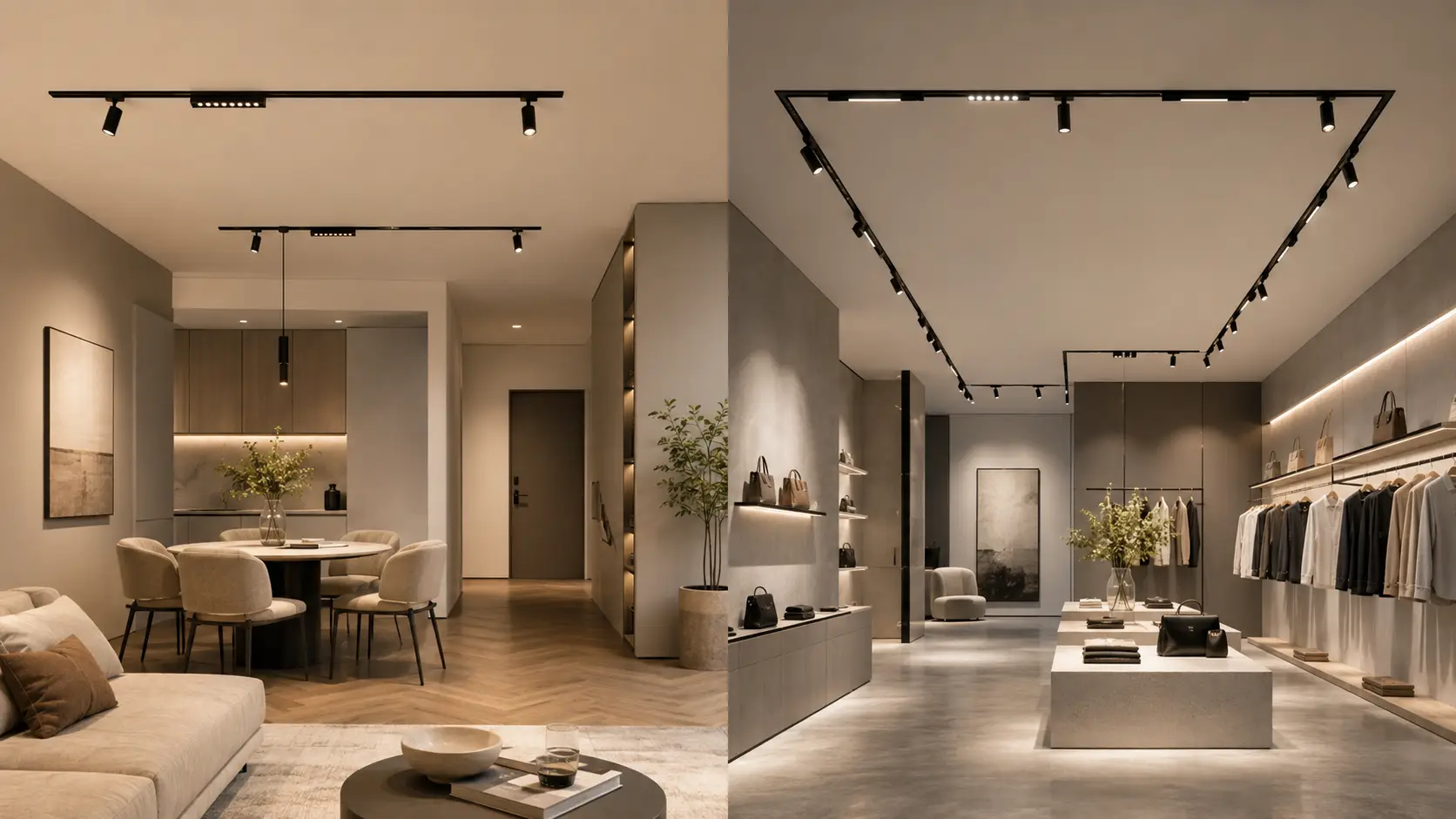
The M25 family is positioned mainly for residential applications.
It is most relevant to spaces such as:
- apartments;
- villas;
- living rooms;
- dining rooms;
- bedrooms;
- kitchens;
- residential corridors.
Residential buyers usually care about a clean ceiling appearance, compact fixtures, visual comfort and the ability to change the lighting layout without creating a ceiling full of separate lamp points.
M35 for Commercial Lighting
The M35 family is positioned mainly for commercial applications.
Typical spaces include:
- retail stores;
- showrooms;
- hotels;
- restaurants;
- offices;
- galleries;
- display areas.
Commercial buyers should place more weight on lumen output, beam control, fixture quantity, circuit capacity, control requirements and long-term replacement supply.
The key point is that residential versus commercial selection should not be based on voltage alone.
Which Magnetic Fixtures Should You Choose?
Different modules perform different jobs.
Spotlights
Use spotlights where the design needs directional emphasis on:
- merchandise;
- artwork;
- display walls;
- tables;
- architectural details.
Grille Lights
Grille modules work well where controlled accent lighting is needed within a compact linear form.
Floodlights
Floodlights provide broader coverage and are useful for ambient illumination, wall lighting and larger display zones.
Sampo currently offers 6W/9W magnetic flood-fill lights and other linear floodlight formats in its high-voltage range.
Folding Lights
Adjustable folding fixtures are useful when merchandising or display layouts change.
Sampo lists 9W and 18W folding and grille-light options in the 220V product family.
Pendant Lights
Pendant modules can bring light closer to dining tables, counters and hospitality areas while keeping the fixture within the same magnetic system.
Sampo’s current high-voltage range includes a 10W magnetic pendant.
How Does Sampo Compare with Established 48V Systems?
The point of this comparison is not that one system is universally better. The brands solve different project requirements.
| Brand/System | Voltage Architecture | Notable Position | Where Sampo Differs |
|---|---|---|---|
| Sampo M25/M35 | High-voltage, current documentation lists 90–265V | Residential and commercial magnetic systems | Also offers 48V systems plus OEM/ODM manufacturing |
| Flos The Tracking Magnet | 48V | Architectural system with remote power supplies and advanced controls | Sampo offers a high-voltage alternative without a separate 48V rail PSU |
| iGuzzini FILORAIL | 48V, 16A | Professional low-voltage architectural track with DALI options | Sampo targets buyers needing both voltage choices and manufacturing customization |
| XAL MOVE IT | 48V | Magnetic modular architectural system with DALI-2 options | Sampo combines high-voltage and low-voltage product families under one manufacturer |
Flos specifies 48V operation and remote power supplies for The Tracking Magnet. iGuzzini specifies FILORAIL as a 48V, 16A low-voltage track and offers separately ordered power supplies. XAL identifies MOVE IT as a 48V system and offers versions with DALI-2 control.
For distributors, private-label brands and project buyers, Sampo’s stronger differentiator is therefore not simply “220V.” It is the combination of high-voltage and 48V magnetic systems, multiple fixture families and OEM/ODM capability.
Are 220V Magnetic Track Lights Safe?
High-voltage track lighting requires insulated components, protected conductive parts, secure connections, and installation that follows the destination market’s electrical rules. Sampo product materials describe an anti-shock structure for its high-voltage magnetic track and instruct installers to disconnect power during installation.
Certification needs an item-by-item check. Ask which certificate covers the rail, luminaire, driver, or control device and whether it applies to the ordered configuration. Keep these documents with the approved specification and order record.
Supplier Example: Evidence to Request from a Magnetic Track Manufacturer
According to the supplier’s current company information, Sampo states that it provides magnetic-track products and OEM/ODM services. Buyers should verify factory capacity, system-specific certification, production capability, warranty, and replacement support during supplier qualification.
For B2B buyers, several capabilities are particularly relevant:
- high-voltage and 48V magnetic track product families;
- residential and commercial system options;
- multiple fixture formats;
- OEM/ODM support;
- customized colors;
- logo customization;
- customized packaging subject to order requirements.
That makes Sampo particularly relevant to lighting distributors, wholesalers, contractors, project buyers and private-label brands that need a system supplier rather than a single finished luminaire.
FAQ
Q: Can 220V and 48V magnetic fixtures use the same track?
A: No. 220V and 48V magnetic fixtures require different track systems because they use different voltage architectures. Sampo provides both high-voltage 90–265V systems and 48V magnetic track systems for different project needs.
Q: What safety documents should buyers request for a 220V rail?
A: Buyers should request the certification and technical documents for the specific rail, fixture, and driver combination. Sampo’s finished products have CE certificates, and CE, UL, and SAA certificates can be provided for certain drivers, LEDs, or lamp holders.
Q: How many fixtures can be installed on one circuit?
A: It depends on the track system, fixture power, and circuit design. Sampo recommends matching the power head, rail, and fixtures according to the project requirements. Generally, one electric circuit is equipped with one power head.
Q: Does a component certificate cover the complete lighting system?
A: No. Certification depends on the specific component. Buyers should confirm the certificates for the rail, driver, LED, and other parts included in the final system. Sampo provides different certifications according to product components and requirements.
Final Takeaway
A 220V magnetic track light system gives buyers the modular fixture flexibility associated with magnetic lighting while using a high-voltage track architecture instead of a 48V rail.
For Sampo Lighting, the current high-voltage range is built around a clear project choice: M25 for residential applications and M35 for commercial applications, with a documented 90–265V power-supply range.
Choose 220V because its electrical architecture suits the project, not simply because the number is higher. Choose 48V when low-voltage track operation better fits the specification. Then compare the details that determine whether the system will actually perform well: rail design, circuit capacity, drivers, fixtures, controls, certification and long-term replacement supply.
For buyers who also need OEM/ODM support, customized products and access to both high-voltage and 48V magnetic systems, Sampo Lighting offers a broader sourcing route than manufacturers built around a single magnetic track architecture.
Request a 220V magnetic track compatibility review and project quote