If you look at CRE platform reviews, lots of those treat office as one line item, and this approach misses the point. Office is the asset class under the most pressure right now, with repricing, vacancy swings, and a widening gap between trophy space and everything else. Finding the right office building or office space is way harder than a simple listing search.
That’s why we tested Realmo through an office-only lens. Realmo is an AI-native, no-paywall way to surface office buildings for sale and office space for lease across all 50 states, including secondary and rural markets where office data has long been thin. Its office strength is broad reach, clean segmentation, and accurate, daily-refreshed listing data.
Here is how that held up region by region.
One Vertical, Fifty States: How We Ran the Test
We ran this field test on June 21, 2026. Realmo refreshes office pages daily, so the counts below are basically live snapshots, not permanent totals.
For every region, we looked at the same questions:
- How much office volume Realmo surfaces
- How far coverage reaches beyond obvious metros
- How rich the listings are
- Whether the results are useful enough to build a shortlist
One note on workflow: the listing page carries the fullest detail, including square footage, pricing, availability, property type, and AI-generated highlights where available. The breadth makes it the natural place to finalize a shortlist after extensive discovery, not a correction step.
The Northeast & Mid-Atlantic: Dense, Pricey, Well-Stocked
The Northeast and Mid-Atlantic are the baseline test. New York, New Jersey, Massachusetts, Pennsylvania, Maryland, Virginia, Connecticut, Rhode Island, and Washington, DC are the kinds of office markets every major CRE platform tries to cover. If a platform is thin here, it’s hard to take its national office promise seriously.
Realmo holds up well.
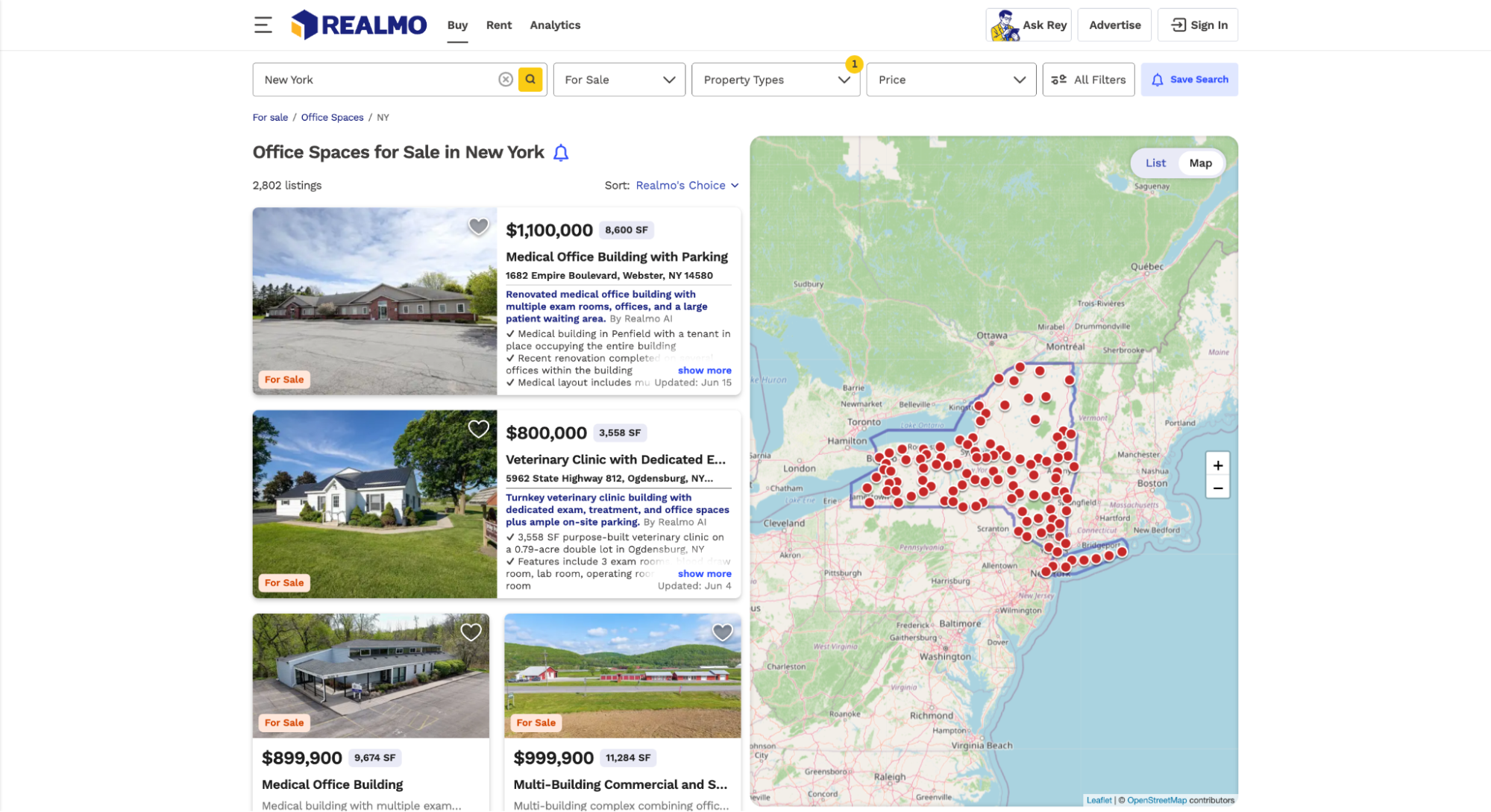 In New York, its office-building page surfaced a dense mix of small professional buildings, office condos, redevelopment plays, and larger Manhattan assets. Examples included a 35,000 SF Midtown West office building listed at $42.6 million and a 10,500 SF historic downtown Albany office building listed at $1.1 million. In other words, the range is great. After all, “office” here doesn’t mean only Park Avenue towers. It could also be:
- Smaller owner-user buildings
- Adaptive reuse
- Professional space outside the core
For lease, Realmo’s value is not limited to gateway cities. The platform also surfaces office space in secondary markets such as Buffalo, Syracuse, Providence, and Baltimore, which is where many practical office searches actually happen.
Virginia stood out for segmentation. The source set showed roughly 570 medical office records, making it one of the clearest examples of why office needs more than one bucket.
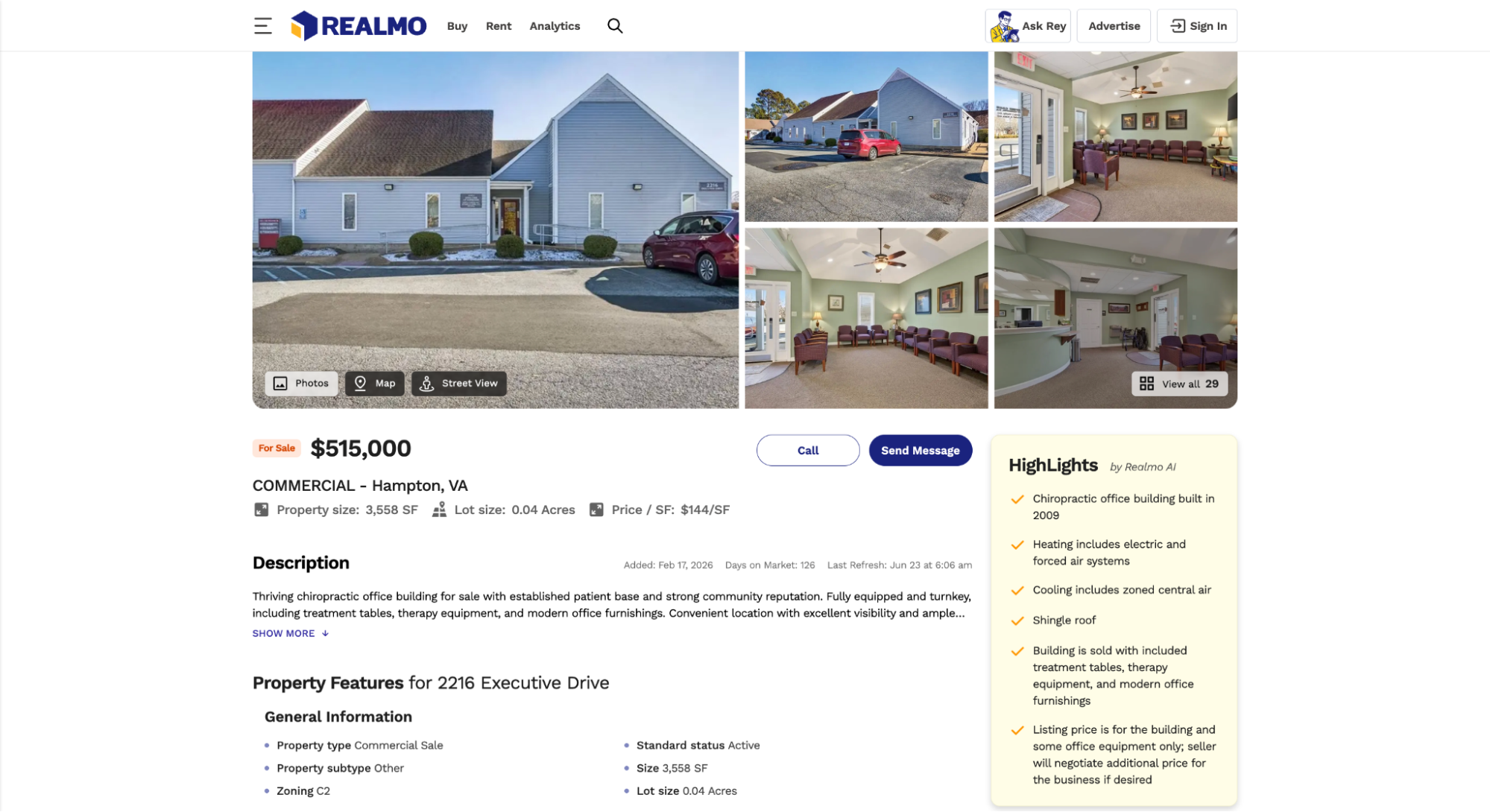 Bottom line: Realmo competes on volume in the dense markets everyone already watches.
The South & Sun Belt: Volume Meets Growth
Texas, Florida, Georgia, North Carolina, Tennessee, South Carolina, and Alabama contain office demand that’s spread across major cities, suburbs, medical corridors, business parks, and second-tier metros. The South and Sun Belt are volume markets, but they’re also fast-moving ones.
Texas was the strongest anchor. In San Antonio, the source set showed roughly 700 office listings across office-related inventory.
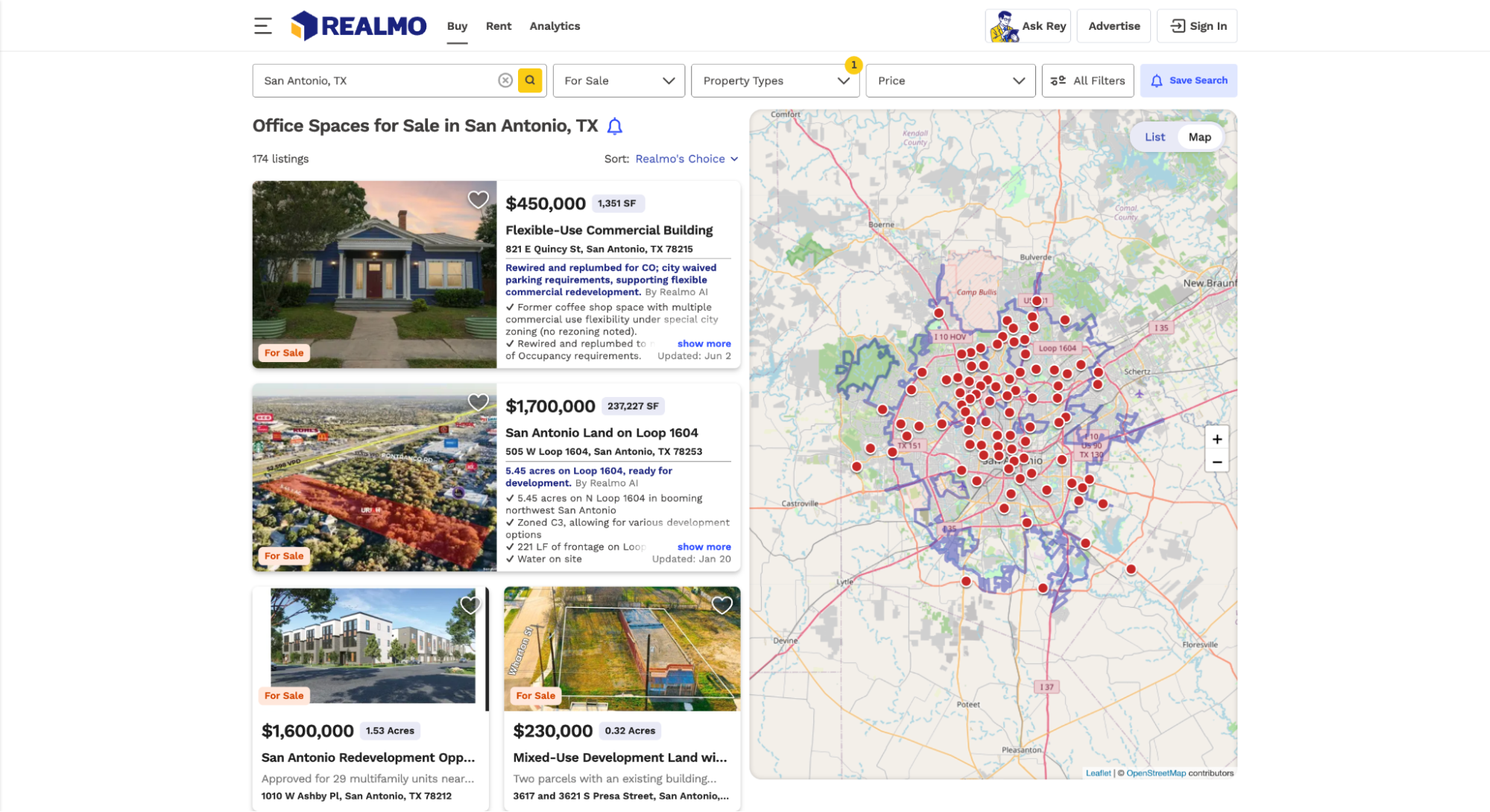 Realmo’s public office-building page showed over 170 office building properties available for sale and a market summary with dozens of active listings. The examples included:
- A 3,909 SF office building on Huebner Road listed at $1.37 million
- A 3,990 SF historic office building listed at $1.35 million
- A 13,369 SF freestanding office building on Loop 1604 listed at $3.6 million
- A 37,708 SF medical office building listed at $4.95 million
That mix is what makes the region useful for office hunters. You are not only comparing towers but also looking into owner-user buildings, suburban professional space, medical office, small investment properties, and redevelopment candidates.
Florida showed the same pattern across large and mid-size markets. Miami, Tampa, Orlando, Jacksonville, Fort Lauderdale, and smaller growth markets need current availability and pricing data because office inventory in the Sun Belt can change quickly.
Our read: Realmo combines raw volume with real reach into mid-size Sun Belt cities. The daily-refresh angle matters here because growth markets punish stale data.
The Midwest: Steady Depth, Few Surprises
Illinois, Ohio, Michigan, Missouri, Minnesota, Indiana, and Wisconsin don’t comprise not the most dramatic office region, but it’s one of the most useful tests of aggregation. The states have office stock spread across downtowns, suburbs, county seats, medical districts, business parks, and manufacturing-belt corridors.
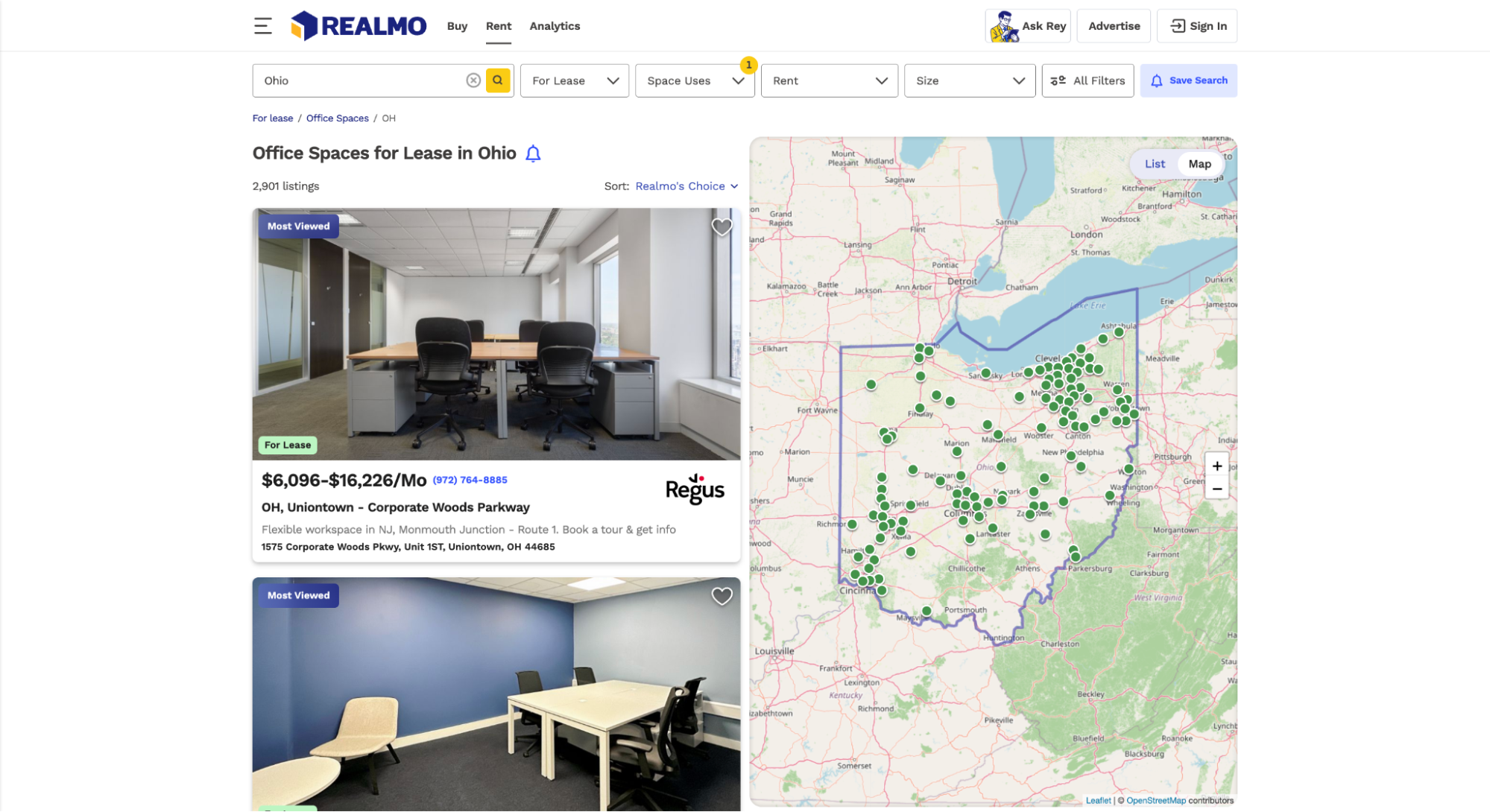
Realmo’s strength here is dependable depth. Chicago anchors the region, but the platform also holds into Detroit, Minneapolis, St. Louis, Columbus, Indianapolis, Milwaukee, Cleveland, Cincinnati, and smaller surrounding markets.
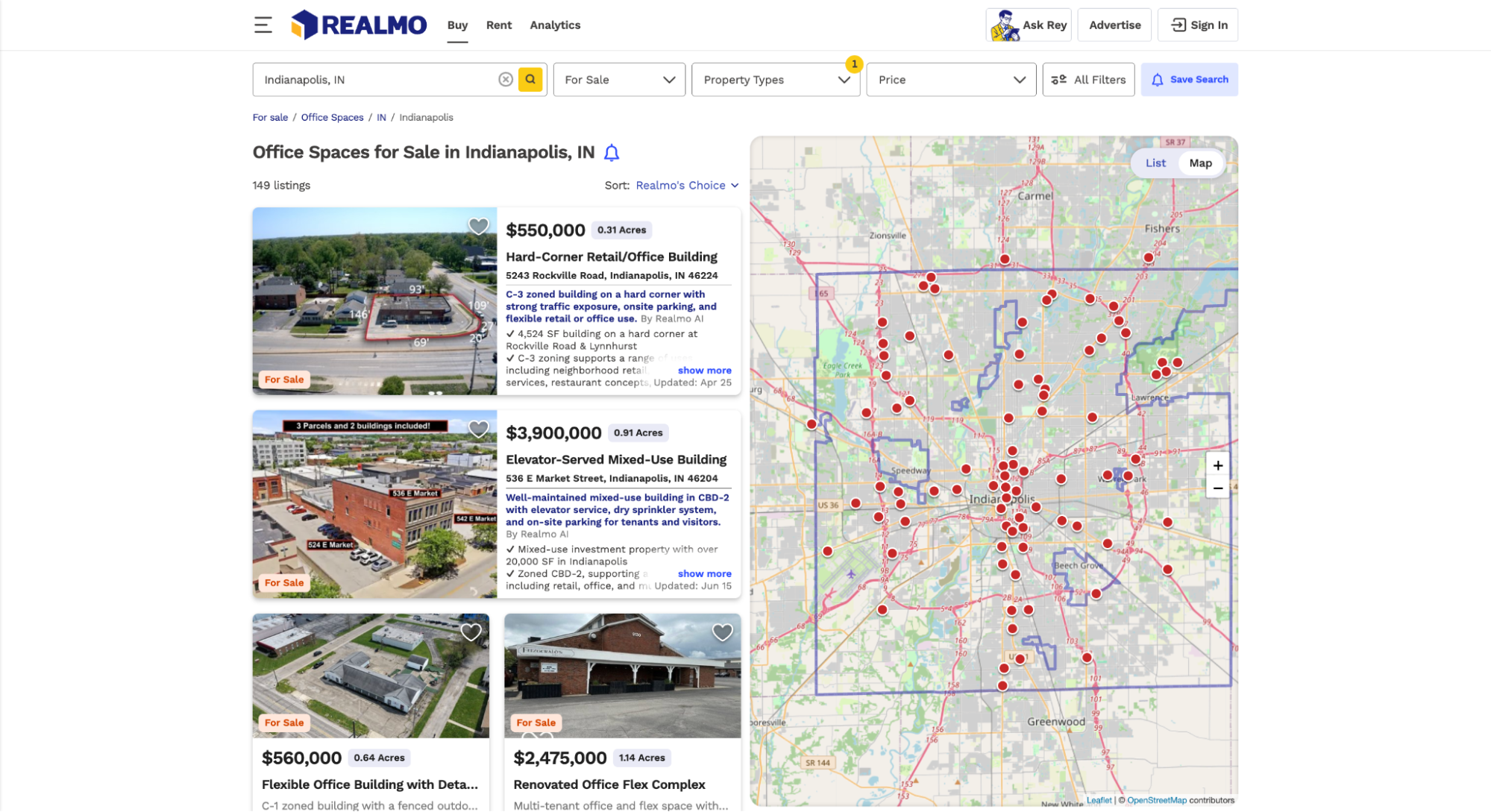 Missouri and Ohio are good examples. A buyer in these markets may be comparing:
- A professional building in a suburb
- A medical office near a hospital
- An older downtown property
- A smaller office asset in a county market
This kind of searches become frustrating when platforms over-index only the biggest metros or fold everything into a vague commercial category.
For lease, the same pattern applies. Tenants need square footage, location, availability, rate, access, parking, and use fit. Realmo’s office segmentation makes it easier to separate traditional office from medical office and flex-style space.
 The Mountain West & Plains: Where Realmo Earns Its Keep
Montana, North Dakota, South Dakota, Wyoming, Colorado, Utah, Idaho, Nebraska, and Kansas are the places where comprehensive office data has traditionally been hardest to find. In thinner markets like these, the question is whether the platform can surface a credible starting point at all.
And well, Realmo does.
South Dakota is the best case. The source set showed around 145 office listing for sale.
The page also surfaced inventory beyond the obvious cities, with market links for places such as Lincoln, Brown, Codington, Pennington, and Union counties, plus cities including Sioux Falls, Aberdeen, Watertown, Rapid City, and Dakota Dunes.
The same value shows up in smaller-market and off-market pages:
- In Humboldt, South Dakota, Realmo surfaced office-building records with lot sizes, addresses, and value-estimation prompts.
- In Clark County, the platform showed off-market office-building opportunities and owner-contact pathways.
That’s not the same experience as browsing a polished Manhattan listing page, but it may be more valuable in a thin market. It gives users a solid foundation where other platforms often go blank.
This is also where Realmo’s broader property database and off-market reach stand out most. The thing is, in low-volume office markets, the win is not only finding active listings but also simply seeing what exists, where it sits, and whether there may be a path to contact an owner.
So it looks liek Realmo’s clearest differentiator is not in the markets everyone covers. It hides in the Mountain West, Plains, and rural markets where office search is usually weakest.
The West Coast: Premium Markets, Premium Filters
The West Coast tests a different kind of office search. California, Washington, Oregon, Nevada, and Arizona include expensive, competitive markets where users value precision over volume.
California is the obvious place to start. In Los Angeles County, Realmo showed 905 office building properties available for sale, with great, detailed active office-building listings.
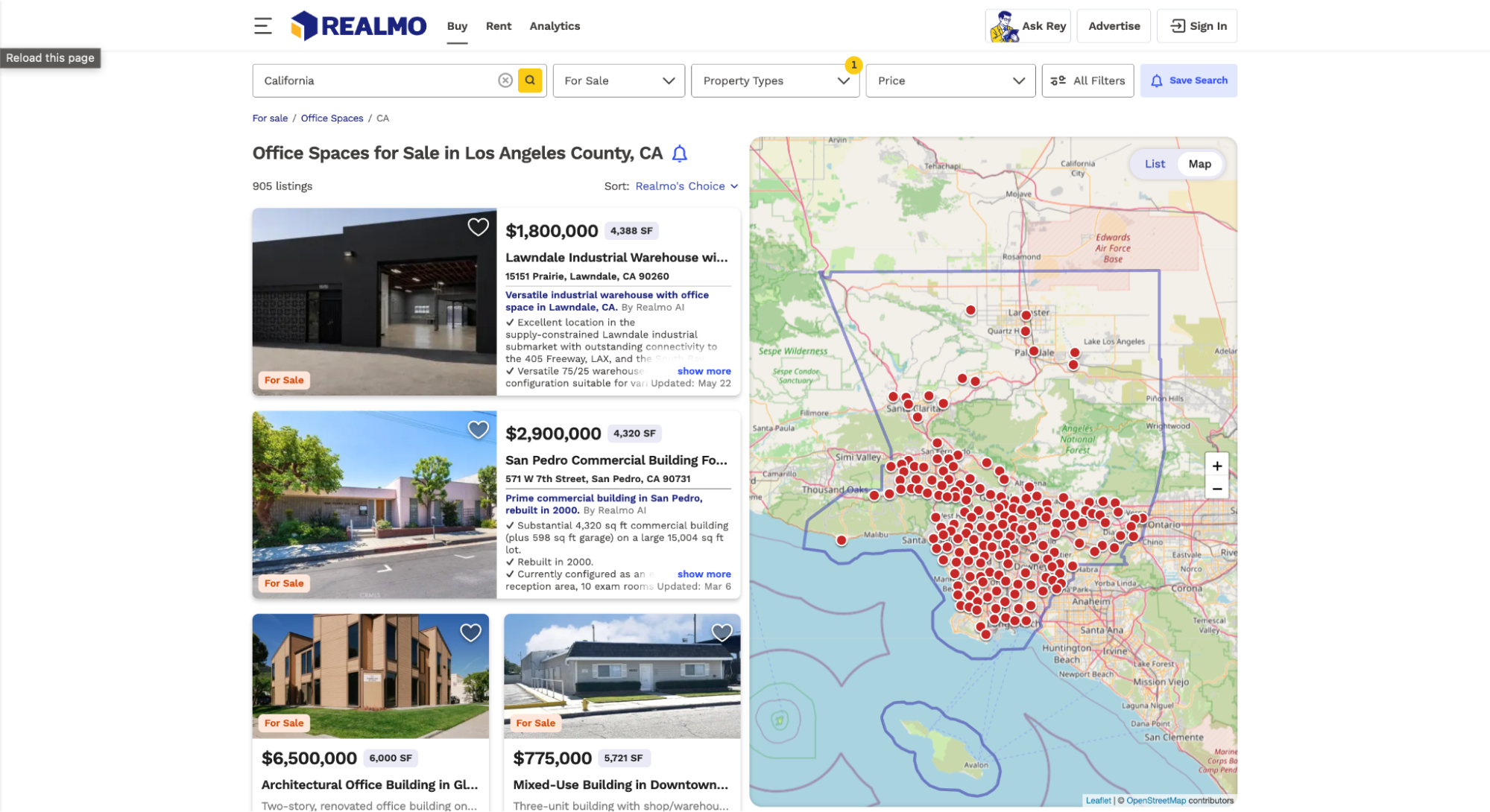 Examples included:
- A 6,000 SF architectural office building in Glendale listed at $6.5 million
- A 5,989 SF Cerritos office building listed at $2.6 million
- A 13,100 SF Palmdale commercial investment opportunity listed at $1.45 million
- A 4,480 SF Pasadena freestanding office building listed at $3.8 million
Realmo’s smart search filters work great here. West Coast office searches get too much too quickly, and filtering by subtype, square footage, price, and location makes the process much more focused.
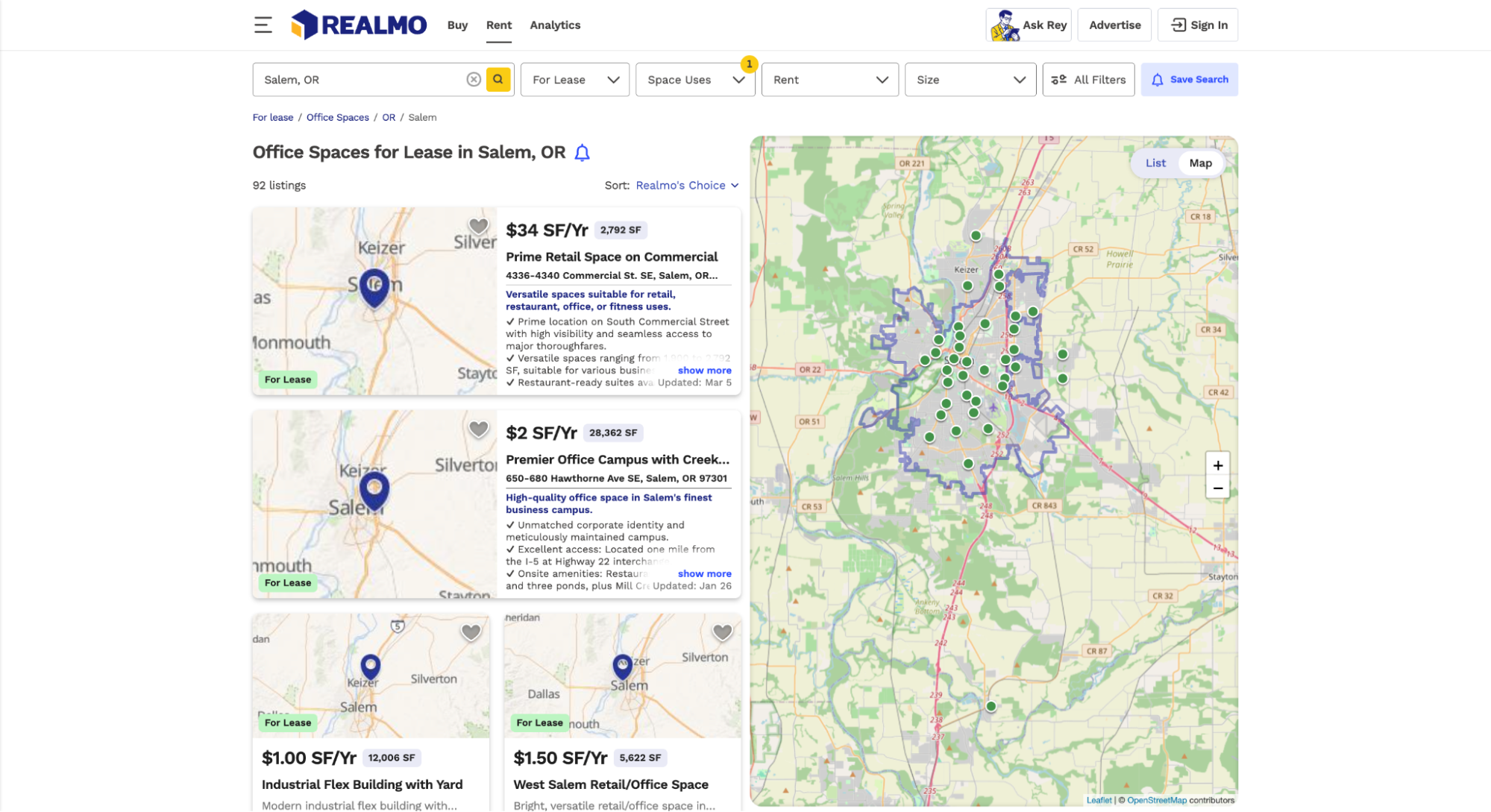
For lease, Realmo covers the obvious premium markets: the Bay Area, Los Angeles, and Seattle. But the secondary-city reach matters again. The source set noted Salem, Oregon at 92 office records, showing that Realmo’s office map doesn’t stop at the most visible coastal metros.
 Arizona and Nevada also fit the West Coast edge story. Phoenix, Scottsdale, Las Vegas, and Reno combine population growth, business migration, suburban expansion, and medical demand. In these markets, segmentation and daily-updated listing detail are what make the inventory usable.
In other words, Realmo is competitive in premium coastal markets, with secondary-city reach showing up again inland.
Three Offices in One Search: General, Flex & Medical
As you can see, Realmo’s office inventory is not just one office-type bucket.
- General office is the baseline. This includes corporate, professional, administrative, and traditional office buildings or suites. Users compare location, class, square footage, parking, availability, price, lease rate, and surrounding demand.
- Flex office is different. It often serves smaller tenants, service businesses, contractors, showroom users, or companies that need some combination of office, storage, light operations, and customer-facing space. Flex can easily get buried inside industrial search or mixed into general office results. Keeping it distinct improves the search.
- Medical office is the highest-value split. A medical office building has different tenant logic, buildout needs, and valuation assumptions. Plumbing, ADA access, exam rooms, imaging support, waiting areas, patient flow, and proximity to hospitals or residential growth can all affect suitability. Lease stability and tenant credit may also look different from a standard professional office building.
Bottom line: segmentation turns one broad keyword into three precise searches. For office, that’s a huge advantage.
What a Realmo Office Listing Shows You
A Realmo office listing gives an office hunter enough detail to decide whether a property belongs on a shortlist.
The most useful fields are the obvious ones: location, building type, square footage, availability, price or rate where present, and property description. Listings also include AI-generated highlights that summarize practical advantages, such as highway access, medical suitability, redevelopment potential, parking, tenant mix, or proximity to a downtown, hospital, or business corridor.
Realmo’s workflow makes total sense once you launch your search effort. Start broad with AI search, category filters, state pages, and map browsing. Then open the listing page for the deepest view of the property. That page is where the search turns into comparison.
Accuracy and freshness are central to the office use case. Realmo pages are refreshed daily, and the listing data is consistent enough to compare options across markets. For office buyers and tenants, this is a big factor: a stale asking price, outdated availability note, or missing square footage figure can distort the entire shortlist.
Our read: Realmo gives users both discovery and dependable detail in one place.
The Coverage Map at a Glance
| Region / State | Buildings for sale | Space for lease | Strongest segment | Note |
| Northeast — NY | ★★★★★ | ★★★★★ | General office | Deep baseline coverage in a market every platform targets |
| Mid-Atlantic — VA | ★★★★☆ | ★★★★☆ | Medical office | Roughly 570 medical office records in the source set |
| South — TX / San Antonio | ★★★★★ | ★★★★☆ | General / medical | Strong volume; source set around 754 office listings |
| South — FL | ★★★★☆ | ★★★★☆ | General office | Broad coverage across major and secondary growth markets |
| South — GA / NC / TN | ★★★★☆ | ★★★★☆ | General office | Useful for fast-growing metros and suburban searches |
| Midwest — IL | ★★★★☆ | ★★★★★ | General office | Chicago anchors the region |
| Midwest — MO / OH | ★★★★☆ | ★★★★☆ | General office | Steady depth across scattered office stock |
| Mountain / Plains — SD | ★★★☆☆ | ★★★☆☆ | General office | Clear differentiator in thin markets |
| Mountain / Plains — ND / MT / WY | ★★★☆☆ | ★★★☆☆ | General office | Useful starting coverage where rivals often under-index |
| West — CA | ★★★★★ | ★★★★☆ | General / creative office | Strong premium-market inventory and filters |
| West — OR / Salem | ★★★★☆ | ★★★★☆ | General office | Secondary-city reach is solid |
Ratings are directional, based on observed inventory depth, visible listing quality, and usefulness for office-only search.
Realmo vs LoopNet, Crexi & CoStar for Office
| Dimension | Realmo | LoopNet | Crexi | CoStar |
| Founded | 2023 | 1995 | 2015 | 1987 |
| Office model | AI search over aggregated office stock, segmentation, and off-market reach | Large office advertising marketplace with major brand traffic | Broker-friendly office listing workflow and free browsing | Verified office comps, ownership, research, and underwriting data |
| Free access | Generous access, no card for broad discovery | Basic browsing, with visibility shaped by paid promotion | Free to browse | Paid professional platform |
| Office edge | Secondary/rural reach, medical and flex filters, daily-refreshed listings | Traffic, brand awareness, and promoted exposure | UX, broker tools, and listing presentation | Deepest verified office data |
| Best office use case | Wide office discovery across states, subtypes, and overlooked markets | Promoting office listings in high-traffic markets | Broker-led office marketing and browsing | Institutional office research, comps, and underwriting |
LoopNet is still the brand-and-traffic heavyweight. For an office broker who wants maximum exposure in a major market, it is hard to ignore. The tradeoff is that visibility is heavily shaped by paid promotion.
Crexi is strong for broker workflow. It has a polished interface, familiar listing presentation, and useful tools for marketed properties. For office hunters, Realmo’s advantage is broader AI search across more fragmented and secondary-market inventory.
CoStar is the benchmark for verified office data. For comps, ownership, research, and underwriting, it remains the professional standard. Realmo is not trying to out-verify CoStar or out-traffic LoopNet.
Its office wedge is more specific:
- No-paywall breadth
- Cleaner segmentation
- Daily-refreshed listing data
- Map reach into markets that traditional platforms may under-cover
Should You Use Realmo If You Only Care About Office?
Office-specific scorecard:
| Category | Score |
| Inventory breadth | ★★★★☆ |
| Segmentation | ★★★★☆ |
| Map / state reach | ★★★★☆ |
| Data freshness | ★★★★☆ |
| Data accuracy | ★★★★★ |
| UX | ★★★★☆ |
Realmo is a strong fit for office investors, owner-occupiers, tenants, and brokers who want wide, AI-searchable office inventory without starting behind a paywall. It’s great if your search extends beyond the obvious gateway cities into the Mountain West, Plains, Midwest, and overlooked Sun Belt markets.
Our final read: Realmo finds office buildings and office space faster and further across the map than traditional search. Its advantage on top of more listings is broad discovery backed by clean office segmentation and accurate, daily-updated listing detail.