
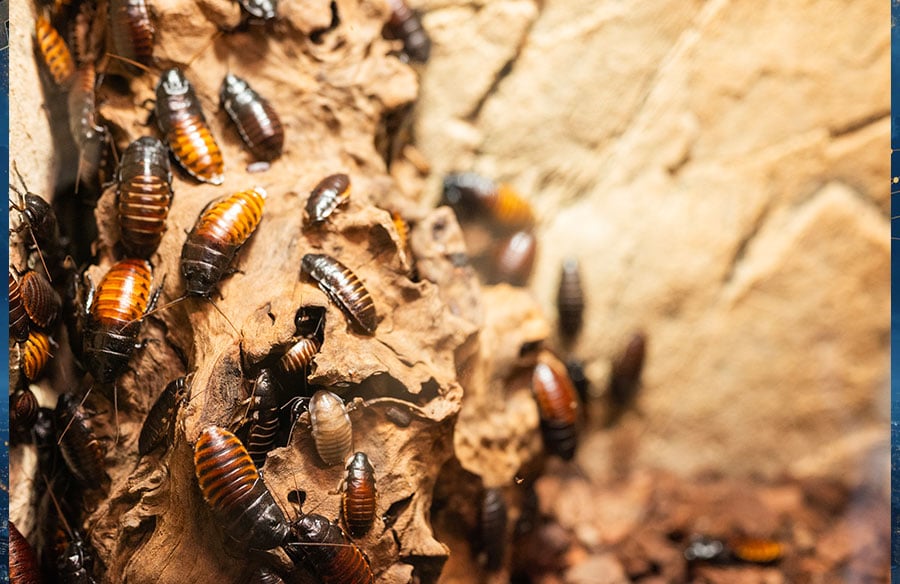
The way invertebrates act can show us a lot about how animals live with each other. Few insects show this as much as giant roaches do. Most insects meet just to mate. But some adult male roaches try to be the lead roach, decide who is in charge, and keep their own area safe. These actions use clear body steps, special sounds, and fighting. The strongest roach becomes the lead one, but this does not often hurt others too much. Those who love insects and bug enthusiasts can understand the communication process of invertebrates by safely observing these interactions. This is one thing that you will come across on a daily basis if you have a Madagascar hissing cockroach in your colony. The behavior of these insects is very systematic, just like that of big animals.
The Mechanics of Dominance and Territoriality
Male roaches are not just walking around in a group for no reason. They choose the best spots to stay. These spots can be on a raised piece of cork bark or inside safe cracks. The strongest males stay in these places. They watch over them. They do it because females come near these areas.
Key Behavioral Displays
- Pronotal Shoving: Males use the hard bumps (pronotal horns) behind their heads. They push and move other males away from places they want to keep.
- Stilting: A defending male will lift his whole body by standing on straight legs. He does this to look bigger and scare other males.
- Hissing: The sound that these cockroaches produce by forcing air through the unique holes in their body is called hissing. This occurs when the dominant male hisses during a battle.
- Antennal Fencing: The males engage in antennal fencing before the battle begins; this helps in determining their respective sizes and compatibility.
Behavioral Comparison: Dominant vs. Subordinate Males
Social rank changes how a male acts in the enclosure. The table below shows the main ways alpha males act differently from males who are not leading.
| Behavioral Attribute | Dominant (Alpha) Males | Subordinate Males |
| Territory Ownership | Claims and defends high-altitude cork bark and shelter centers | Restricted to ground levels or the periphery of the habitat |
| Physical Posture | Frequent stilting holds the body elevated and prominent | Flattened against the substrate; assumes a low profile |
| Vocalization Frequency | High; frequent threat hisses and combat calls | Minimal to silent; only produces startle hisses when provoked |
| Mating Access | Priority access to female clusters residing in preferred zones | Limited opportunities; relies on satellite tactics when alphas are distracted |
| Combat Engagement | Initiates pronotal shoving and active defense | Retreats quickly from confrontations to avoid energy loss |
Environmental Triggers That Shape Colony Hierarchy
Social groups in captive colonies often change over time. The groups do not stay the same. Several things in the environment can affect how much males fight for space and how order is kept.
- Resource Distribution: If you put hideouts and food bowls in more places, it can help stop big fights over space. When you have just one warm spot or cork bark tower, the animals fight hard to get it.
- Population Density: When there are more animals close to each other, big fights over who gets which area break out. The males stop fighting for their own spot and instead stand in a simple line.
- Thermal Gradients: The males fight each other to get as close as they can to the warmest area (24°C–29°C). A warm body makes them feel strong, move fast, and do better.
FAQs
Do female roaches exhibit territorial behavior?
Women do not show anger much when it comes to space. They might have small fights over places to hide or over the best food. But most of the time, they live together in the same shelter without any trouble.
Can territorial fights lead to serious injuries?
In most cases, combat is an act that resembles a performance. Males use their pronotal horns to shove each other around. They are not out to hurt each other in the process. However, when they are very many in one place, and they fight fiercely, some might end up with broken antennae or lose a leg.
How does a subordinate male become a dominant male?
Rank can shift when the top male gets old or loses his feathers. A male who is lower in the group may try to become the leader if the head starling is not strong. He could win by pushing and taking the lead spot when it is ready to be taken.
Conclusion
Watching how these insects are around each other helps us see the way giant invertebrates get along. You can look at their social ways and how they keep their space safe. Sound is used by these insects during their battles. The insects also use horns while bumping into each other. This means that there is a definite pattern that favors them in their breeding without being at risk.
Ensuring these insects have enough space for movement, enough hiding places, and the right temperature ensures that one can be able to witness this. In case one keeps a Madagascar hissing cockroach for educational purposes or even personal interest, then one has a lot of chances of observing insects up close.