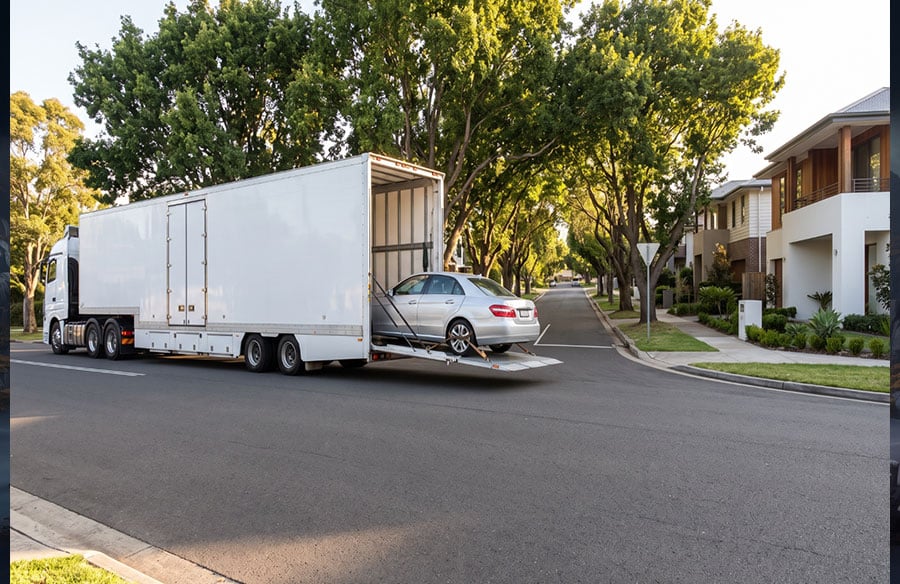
Everybody planning a move pictures the same scene: the transport truck pulls up outside the new house, the ramp comes down, the car rolls off onto the driveway. It almost never happens that way, and the reason has nothing to do with the transport company. The street you are moving to was designed, deliberately and correctly, so that a vehicle that size cannot comfortably get down it.
That is worth understanding before you book anything, because almost every frustration people have with shipping a car during a move traces back to expecting a piece of infrastructure to do something it was never meant to do.
Your New Street Was Designed to Keep That Truck Out
The assumption is that if a road exists, a delivery vehicle can use it. Roads are roads.
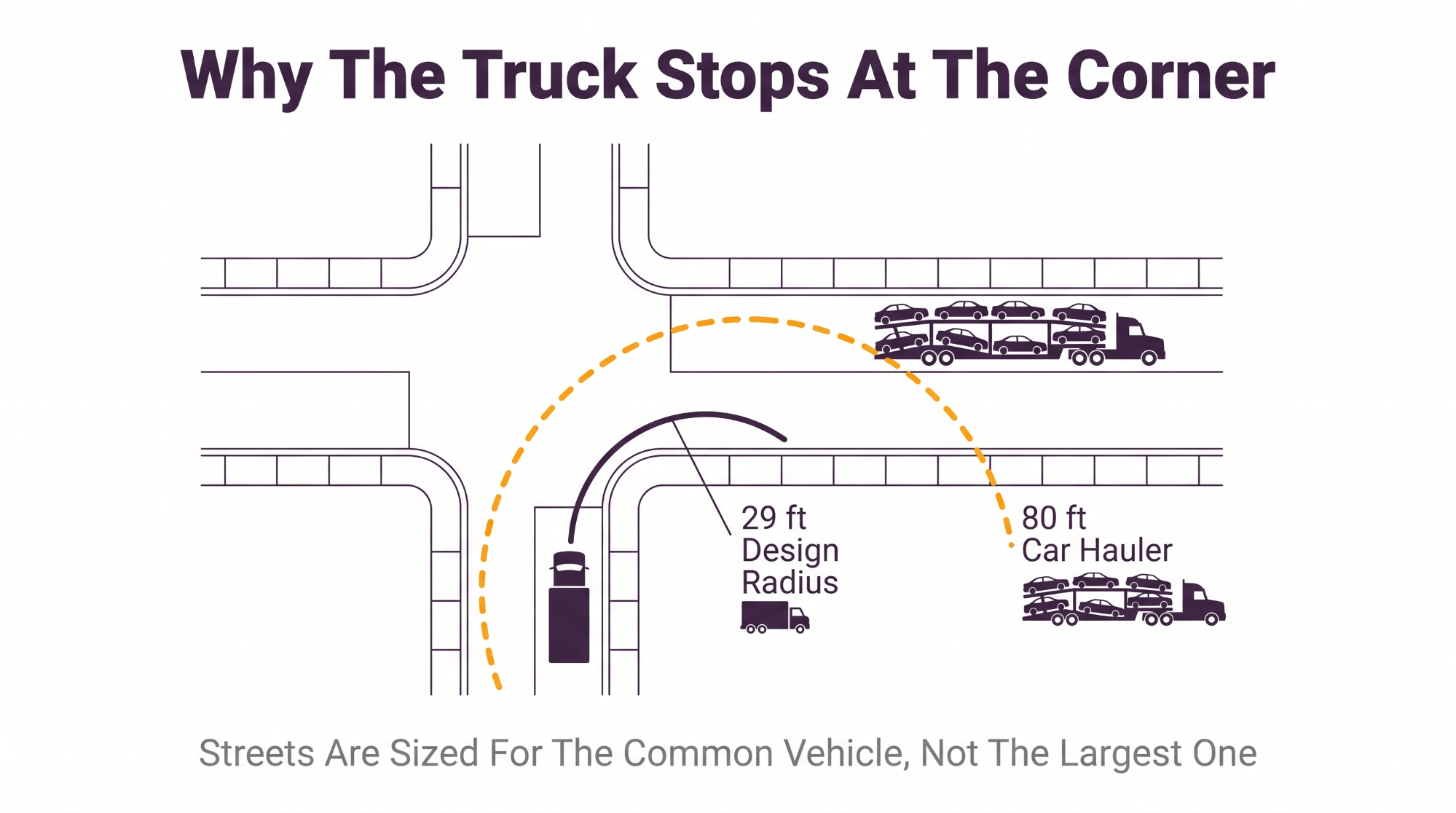 But residential street geometry is a series of deliberate choices, and the biggest one is which vehicle the designer sized the corners around. Contemporary practice is to pick a modest design vehicle and let the rare oversized one struggle. The recommended design vehicle is a delivery truck with a 22.5 foot inside and 29 foot outside turning radius — and the reasoning is explicit, that curb radii built for the largest possible vehicle at its highest possible speed degrade the pedestrian environment and stretch crossing distances. Tight corners slow traffic. Slow traffic is the point.
A loaded car hauler is 75 to 80 feet long. It needs far more room to swing than a corner designed around a 29 foot outside radius will give it, plus vertical clearance that mature street trees on a residential road stopped providing about fifteen years after they were planted. Add the cul de sac, which is a turning bulb sized for a car and a garbage truck, and the newer subdivision layouts with traffic calming tables and narrowed entries, and you have a street network that is working exactly as intended and is, incidentally, impassable to the truck carrying your car.
None of that is a flaw.. A street you would want to live on and a street a car hauler can navigate are close to opposites. It just means the delivery has to happen somewhere else.
What Door to Door Actually Means
People book door to door and take the phrase literally. It is the single most common misunderstanding in the whole process.
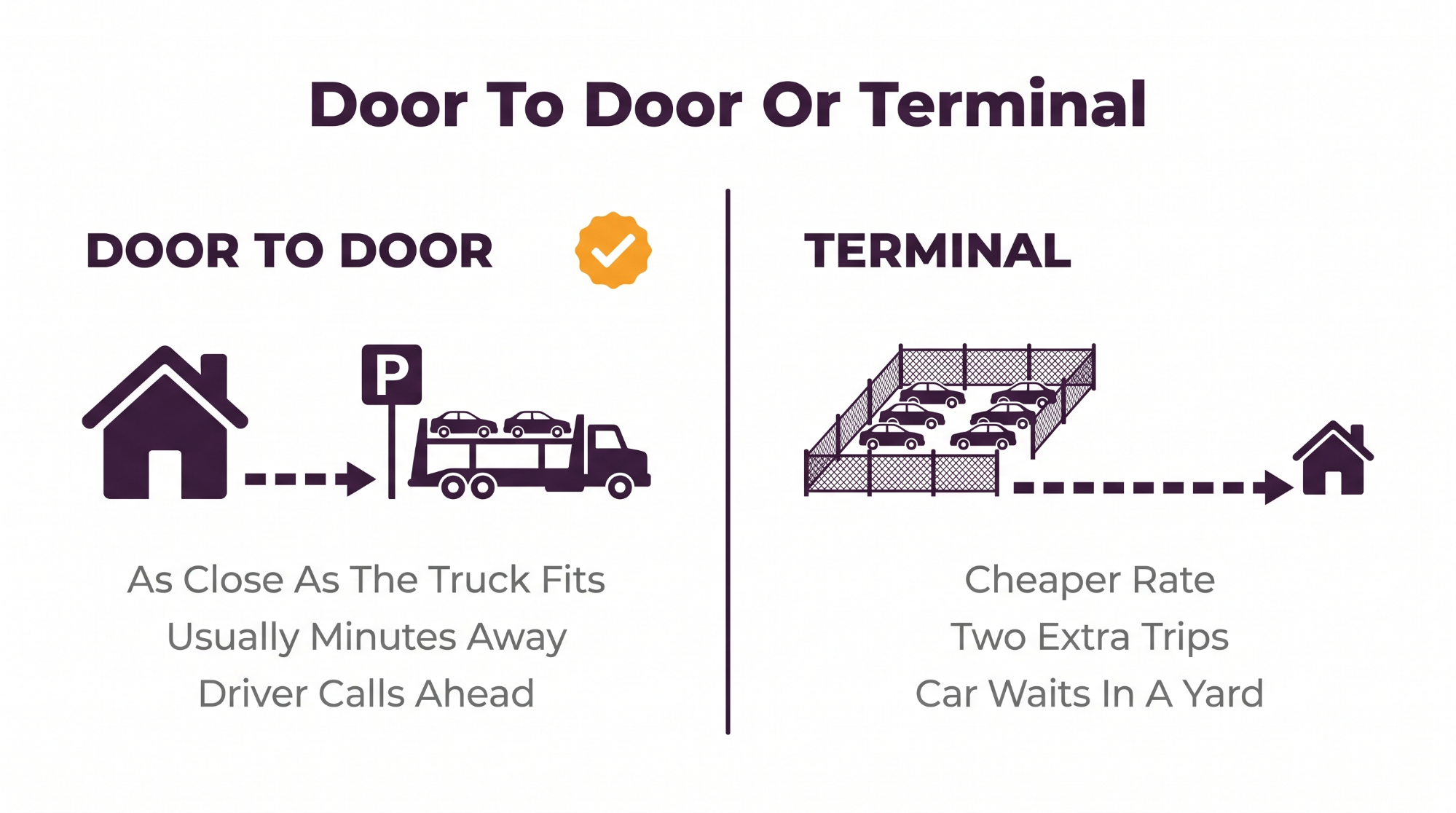 What door to door auto transport means in practice is as close to your address as the truck can safely and legally get. On a wide suburban road with good clearance that may genuinely be the curb outside your house. In a dense city block, a gated development or anything with a turning bulb, it will be a nearby commercial lot — a supermarket parking lot, a large gas station, somewhere with room to bring an eighty foot rig in and back out again. The driver will call ahead and arrange it, usually the day before.
The alternative is terminal service, where you drop the car at a yard and collect it from another. It is normally cheaper and almost always more inconvenient, because you have to get yourself to and from two industrial parks during a week when you are already moving house.
Worth doing before you move: look at your new street on satellite view and find the nearest large lot. Two minutes of that saves a confused phone call on a day you will have no patience for one. If you are still in the design phase of a new build, this is also the moment to notice that a driveway which comfortably takes a moving truck will handle almost anything else you ever need delivered.
Time the Car Around the Move, Not the Other Way Round
The instinct is to have everything arrive at once. Movers on Tuesday, car on Tuesday, done.
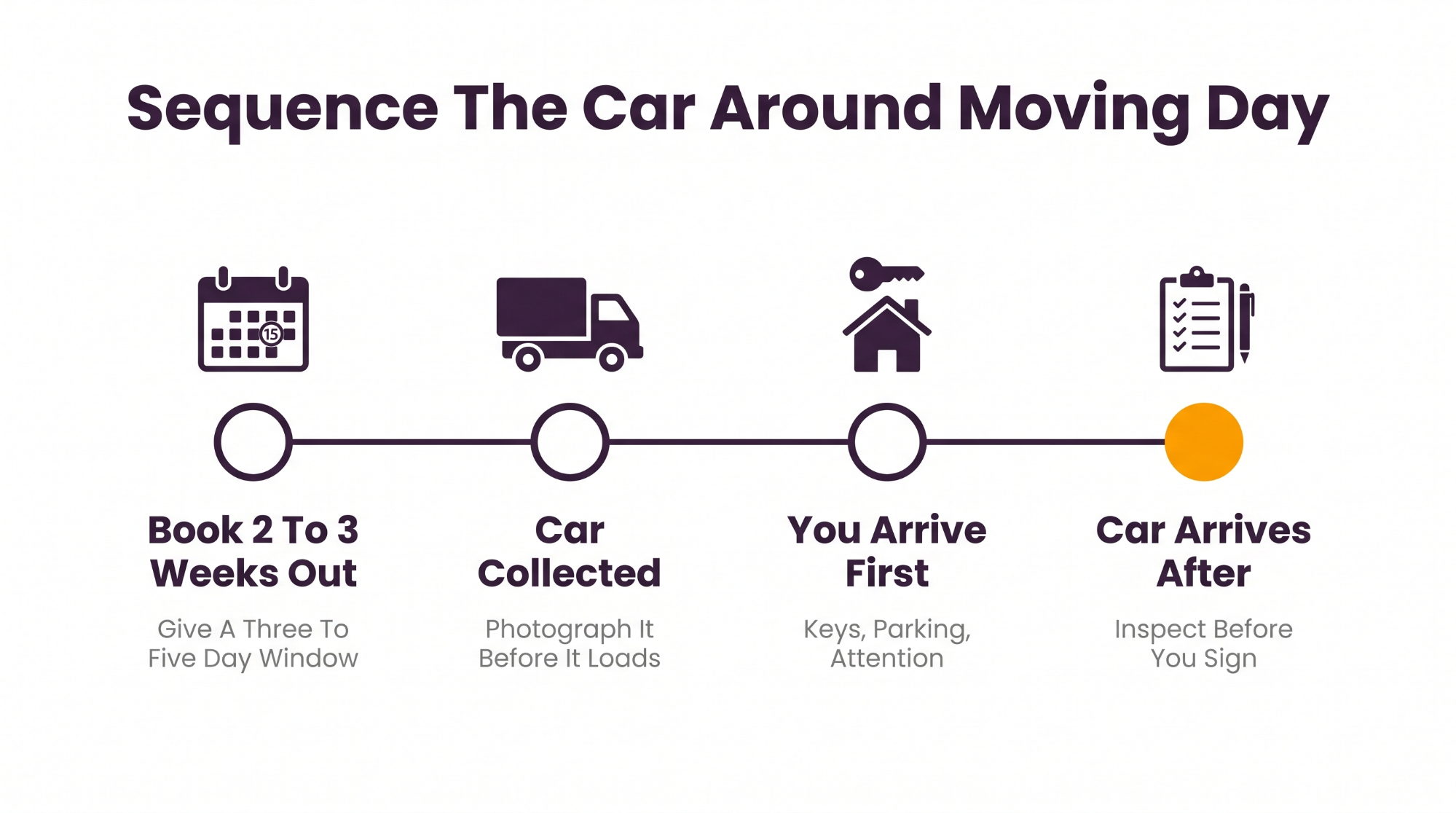 In practice that is the worst possible arrangement. Vehicle transport does not run to a guaranteed hour, and often not to a guaranteed day — carriers give a window, because a truck’s arrival depends on every stop ahead of yours. Meanwhile you will be standing in an empty house directing furniture. Being in two places for two deliveries that both need your signature is how people end up rushing an inspection.
Better to have the car arrive a day or two after you do. You will have a key, a place to park it and enough attention to actually look at it. If you are flying ahead of the furniture, even better — the car can meet you at the new address while the moving truck is still on the road.
Book two to three weeks ahead if you can. Most of the delay in vehicle transport is not the driving, it is waiting for a truck already running your route to have a slot free. Giving a three to five day pickup window instead of one fixed morning is the single cheapest thing you can do to bring the price down, because it lets your car fill a gap somebody else’s schedule left open.
The Ten Minutes That Decide Who Pays for a Scratch
Most people treat the paperwork at handover as a formality to get through so the driver can leave.
Its the opposite. The bill of lading is the document that decides who pays if something is wrong. At collection the driver walks the car and marks existing damage on it. At delivery you do the same before you sign anything. A mark that wasnt noted at collection but is noted at delivery is your case. A clean signature followed by a phone call two days later generally isnt.
Photograph the car yourself at both ends, in daylight, including the wheels, the lower panels and the roof. It takes three minutes. Do it even though youre exhausted and the moving truck is double parked, because this is the one part of the process where ten minutes of attention is worth several hundred dollars of exposure.
If you are shipping something valuable or unusual — a classic, a low slung coupe, anything where a scraped nose is a serious bill — say so at the quoting stage rather than hoping for the best. A broker with real carrier relationships, like Rivalane Auto Transport, can match the car to a driver with the right equipment, which mostly means a lift gate that raises the car flat instead of dragging it up a ramp.
When Not to Ship at All
Shipping isnt automatically the right answer, and it is worth saying so.
Under roughly five hundred miles, driving usually wins. Transport is priced highest per mile on short runs, the drive is a single day, and coordinating a pickup window costs more hassle than the journey. If you are moving across a state line rather than the country, put fuel in it and go.
It is also the wrong call if the car is worth less than about twice what moving it costs. A tired second car that will need work on arrival is often better sold before the move and replaced at the other end. That is a genuinely liberating thing to realize mid relocation, when the list of things requiring your attention is already too long.
Where shipping earns its money is distance, second vehicles, cars nobody in the household wants to drive for two days, and anything you would rather not add three thousand miles to.
Look at the satellite image of your new street before you book. Everything else in the process follows from what you see there.