Introduction
Integration of digital systems and BIM helps to transform legacy static 2D CAD design workflows into dynamic information-rich pipelines that offer granular visualization. To this, add cloud computing and IoT and centralization of project data, and you get the best building lifecycle management setup possible.
With such a modern architectural BIM setup, you can always be sure of interoperability across multiple AEC workflows.
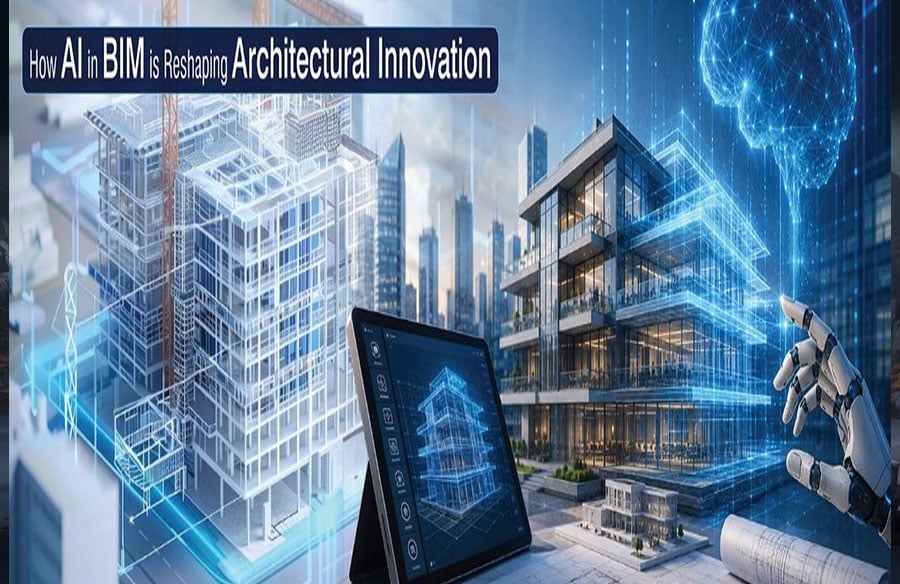
The real power of modern BIM comes when you use AI for predictive modeling and generative design to improve the AEC value chain. While AI and automated clash detection help avoid construction risks, now design optimization can be based on holistic and accurate information, and the workflow can shift from reactive to proactive problem solving.
Architects who integrate machine learning with semantic 3D models can easily spot and remove errors and redundancies. AI can accurately calculate high-performance design geometries and improve coordination in large projects. And AI-powered BIM is transforming the future of architecture. This we will discuss in the next paragraphs.
BIM is the new foundation for construction
BIM has progressed from 2D drafting to 3D models over time. The change has become so ingrained that today when you think of BIM you think 3D. These modern BIM models integrate and carry detailed information on schedules, costs and sustainability compliance that can be accessed and used over the entire project lifecycle.
In modern BIM, the flow of data is seamless from design to construction, and this is ensured by the metadata within BIM objects. This metadata also helps in long-term facility management.
Structured and high-quality datasets which are required for machine learning can help you automate clash detection. They also enable higher construction performance and provide predictive insights.
Using cloud based platforms like Autodesk Construction Cloud (ACC) centralizes project data for real time collaboration. Stakeholders have also seen a significant fall in coordination errors with these tools.
AI-powered BIM – the road to smarter and faster design workflows
Including deep learning with AI-driven BIM automates architectural data processing which is complex for some projects. It converts passive 3D geometry into proactive twins led by cognitive analysis and better decision-making.
The preconstruction phase is critical for architects and AI makes it more effective with preemptive conflict detection. Stakeholders can apply semantic model validation to confirm models against international building codes.
Architectural firms faced issues like drafting redundancies in the past. But with automated document algorithms, they are able to generate construction sets from 3D data. Running thousands of iterations simultaneously, searching for optimal design solutions becomes easy.
Including Artificial Intelligence (AI) in BIM provides real-time data visualization and risk assessment. You can make swift adjustments to the design or schedule when needed. Also, the presence of a dynamic feedback loop improves multi-disciplinary coordination. When critical decisions are set with project objectives, stakeholders can reduce change orders.
 Improve planning and execution with BIM technology in construction
3D spatial data is centralized using BIM models developed from 2D drawings, highlighting the role of BIM in architecture in improving planning and execution. You can use these models to synchronize design and field operations. Setting up this digital infrastructure makes material procurement efficient. But it also ensures alignment between multiple trades for the overall cycle.
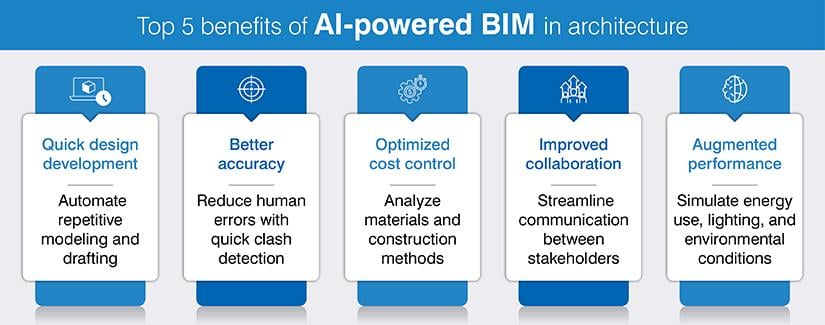
AI algorithms process historical data in BIM to generate precise schedules and cost estimates. Induced automation helps architects analyze market fluctuations and take necessary steps to resolve it. Structural clashes are quickly identified with AI-driven BIM. It reduces hazards for people working on the site. Also, when communication is centralized, it reduces the probability of field revisions.
Artificial Intelligence tools integrated with BIM updates eradicate bottlenecks. This oversight helps remove verification delays to ensure projects stay on schedule. You can even reduce project costs when material waste is significantly mitigated.
AI in BIM – the impact of analytics, generative design, and sustainability
Complex datasets are audited using machine learning processes and tools. They search for structural anomalies and compliance gaps which can create construction bottlenecks. An automated model analysis ensures data integrity. And it even reduces a lot of manual verification time for architectural firms.
Stakeholders can use generative tools with AI to evaluate multiple permutations that usually rely on constraints. When teams run simulations, they get solutions that enhance aesthetics and structural strength.
Thermal loads and daylighting improve energy efficiency. Predictive performance 3D modeling ensures outcomes are sustainable. This reduces costs and carbon footprints. IoT sensor data can be connected with BIM geometry to track structural health. It also enables facilities management and improves occupant comfort for the asset lifecycle.
The future of architecture – smart and adaptive design
When humans use AI and machine learning, they can augment architectural judgment. This alignment helps architects and designers focus on problem solving. AI can even deliver rigorous data-driven accuracy when utilized in the right way.
Talking about smart cities, AI-BIM combined with IoT improves resource distribution and flow of traffic. And a connected infrastructure ensures real-time responses along with greater energy efficiency.
If your architecture workflows are data-driven, they use BIM analytics to reduce the carbon footprint. Simulating the environmental impact builds high-performance structures with ecological sustainability.
What is the role of BIM service providers in AI-powered architecture?
BIM service providers use AI by including machine learning into tools like Revit. This helps architectural BIM service providers automate tasks like clash detection and model classification.
Bespoke BIM workflows that are customized by AI can easily adapt to site constraints and regulatory codes. When automation is enabled, it makes workflows scalable to process massive datasets with speed.
Firms can gain a competitive edge by reducing timelines and rework costs. When AI led insights are used, they get quick approvals and proactive risk management. Stakeholders can win bids faster with high performance planning.
Conclusion
AI will continue to move forward at a tremendous pace in every field. Building Information Modeling tools like Revit and Navisworks have the capacity to integrate AI for extended value. Also, architects can no longer neglect the importance of AI. You need to deploy AI tools at the earliest for greater accuracy and reduced costs.
If your inhouse team is not able to integrate AI into existing BIM workflows, it is wise to work with a BIM services partner. These firms have the expertise and experience to use AI within BIM and make the process swift for all the stakeholders.