
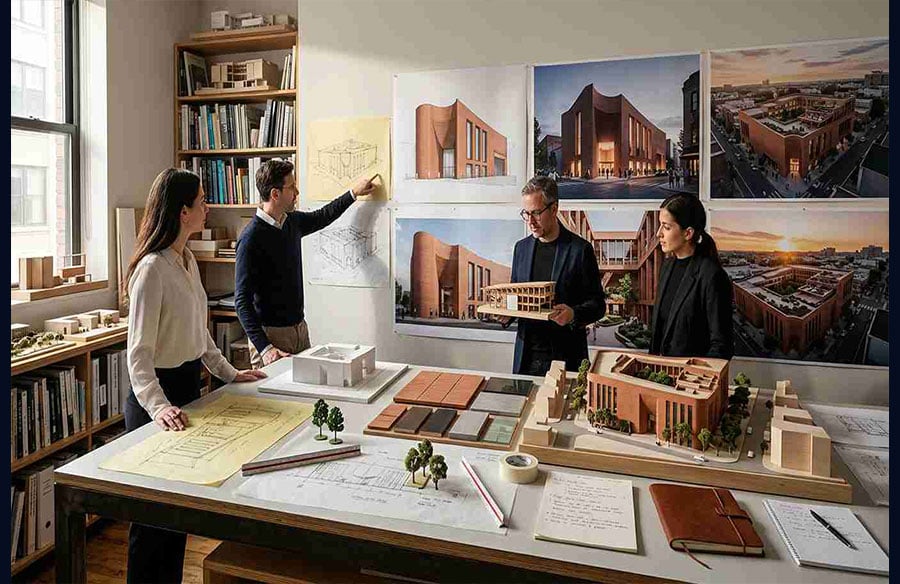
Architects are no longer debating whether to use AI in their visualization workflow, according to a recent industry survey of nearly 800 architects and designers, the majority already have. An AI Image Generator sits at the center of that shift in Higgsfield for many firms, one of the platforms built specifically around that use case.
That shift matters because concept visualization has always been one of the most time-intensive parts of the design process, the stage where an idea has to become something a client, a planning committee, or a partner can actually evaluate, long before construction documents or detailed models exist to work from.
How Widespread Has AI Adoption Actually Become in Architectural Practice?
Recent industry research suggests the conversation inside most firms has moved past whether to adopt AI tools and into how to integrate them responsibly. A survey conducted by Chaos in collaboration with Architizer, reaching nearly 800 architecture and design professionals, found the large majority of current AI users reporting genuine time savings in their work, with concept design and image-based tasks, the exact category a tool like Higgsfield is built to serve, showing the strongest gains among all the categories surveyed.
That adoption pattern skews notably toward smaller practices, where the majority of survey respondents worked at firms of fewer than twenty people. For solo practitioners and small studios without a dedicated visualization department, AI tools have become a genuinely practical way to produce client-ready imagery without the overhead a larger firm’s rendering team would traditionally require, or the specialist headcount that overhead usually implies.
Why Has Concept Visualization Specifically Become the Entry Point for AI Adoption?
Among architects already using AI, concept design and ideation consistently rank as the area delivering the biggest time savings, ahead of documentation, structural analysis, or other categories where AI has also made inroads. That makes sense given how visualization has always functioned in practice, as a communication tool first, meant to convey an idea’s feeling and direction before every detail is resolved down to the last material specification.
Early concept work has also always tolerated a certain amount of imprecision. A concept render doesn’t need to be construction-accurate, it needs to communicate mood, material direction, and spatial intent convincingly enough for a client or committee to react to it. That tolerance for early-stage imprecision is exactly where AI-generated imagery has found its most natural, least controversial foothold in professional practice so far.
What Has Traditional Concept Rendering Cost Firms in Time and Flexibility?
A traditional rendering workflow has historically meant building or refining a 3D model, setting up lighting and materials, and waiting, sometimes hours, for a single high-quality render to finish. Testing a different material palette or a different lighting scenario meant reconfiguring the scene and rendering again, a process that could easily consume thirty to forty-five minutes per variation on top of the initial setup time.
That cost structure has traditionally limited how many concept directions a firm could realistically explore before committing to one, particularly for smaller practices without a dedicated rendering specialist or the render-farm capacity larger studios rely on. A firm might present a client with two or three polished directions simply because producing a fourth or fifth wasn’t a realistic use of the time available before a deadline, regardless of whether that fourth option might genuinely have been the strongest one.
How Are AI Image Generators Actually Changing This Process?
AI image generation addresses this gap by letting an architect turn a sketch, a massing model, or a rough 3D view into a polished concept image in a fraction of the time a traditional render would take. Rather than waiting on a full render pipeline for each variation, a firm can generate several material or lighting directions from the same base concept within a single working session.
This matters most for the kind of early-stage exploration that concept design genuinely benefits from but traditional rendering timelines have rarely accommodated, testing a bolder material choice, previewing a design under different lighting conditions, or producing enough variety in a client presentation to make an actual conversation about direction possible rather than presenting a single, already-committed option.
How Does Higgsfield Fit Into an Architect’s Visualization Workflow?
Higgsfield operates as a broader AI creative suite rather than a narrow rendering tool, bringing image generation together with editing, video, and upscaling inside one platform. For an architectural practice, that breadth matters because a concept presentation rarely stops at a single still image, a client deck might need several angles of the same concept, a short walkthrough sequence, and print-ready upscaled versions, all producible from the same Higgsfield workspace rather than several disconnected tools each with its own file format and export process.
Higgsfield gives users access to 15 or more leading image models in one workspace, letting a firm compare which model handles a specific material or lighting condition, a warm, timber-heavy interior behaves differently under different models than a cool, glass-and-concrete facade, before settling on whichever result communicates the design intent most convincingly. As RTF’s own coverage of how AI accelerates architectural visualization has described, the shift from legacy rendering timelines measured in days to AI-assisted workflows measured in hours has become one of the clearest, most measurable changes AI has brought to the profession so far.
What Capabilities Matter Most for Architectural Concept Work?
A handful of specific features determine whether an AI image generator actually holds up for the demands of professional concept visualization.
Turning a Sketch or Massing Model Into a Photorealistic Concept
Higgsfield can take a rough sketch, a massing study, or a simple 3D view and generate a photorealistic concept image built around that underlying form. That capability matters directly for the earliest stages of design, where an architect needs to communicate a spatial idea convincingly long before a fully detailed model exists to render properly through a traditional pipeline.
Testing Multiple Material and Lighting Directions Quickly
Because generation happens in minutes rather than through a full render pipeline, an architect can test several material palettes or lighting scenarios against the same underlying concept within a single working session using Higgsfield. That speed makes it realistic to bring a genuine range of options into a client conversation, rather than presenting one heavily committed direction because producing alternatives was never a practical use of the available time before the meeting.
Editing a Specific Detail Without Re-Rendering the Whole Scene
Higgsfield’s editing tools let an architect adjust a specific element within an existing image, a material swap, a landscaping change, a different sky condition, without regenerating the entire scene from scratch. That precision matters for the kind of incremental client feedback architectural projects genuinely involve, where a request for “the same image, but with a different facade material” shouldn’t require rebuilding the whole visualization from the beginning of the process.
Where Should Architects Be Cautious With AI-Generated Visualization?
Industry commentary on AI in architecture, including RTF’s own coverage of the risk of automated design thinking, has rightly cautioned against treating AI-generated imagery as a substitute for genuine design judgment rather than a tool that supports it. A generated concept image should communicate a real design intention an architect has already developed, not stand in for the thinking that intention actually requires, whether that image comes from Higgsfield or any other platform in this category.
That caution matters most where AI-generated visuals influence decisions with real consequences, client approvals, investment discussions, planning submissions, where a visual that overstates what’s actually achievable can create expectations a project later struggles to meet. The firms getting the most reliable value from these tools tend to treat generated imagery as a fast, flexible way to communicate a design direction they’ve already committed to internally, rather than a substitute for the design process itself.
How Does This Compare to Traditional Rendering Workflows?
The practical gap between a traditional rendering pipeline and AI-assisted concept visualization becomes clear once time and flexibility enter the picture, a gap platforms like Higgsfield are specifically positioned to close for firms without a dedicated rendering department.
| Factor | Traditional Rendering Pipeline | AI Image Generation with Higgsfield |
| Turnaround per image | Hours, depending on scene complexity | Minutes per generated concept |
| Testing material or lighting variations | Requires reconfiguring and re-rendering the scene | Multiple directions generated from the same base concept |
| Resource requirement | Dedicated rendering hardware or specialist | A subscription and a working internet connection |
| Best suited for | Final, construction-accurate presentation renders | Early-stage concept exploration and client communication |
That comparison doesn’t diminish the value of traditional, fully controlled rendering pipelines for final, construction-accurate presentation work, where precision and technical fidelity genuinely matter and remain non-negotiable. What changes is how much of a firm’s early concept exploration, the back-and-forth testing that happens well before a design is finalized, realistically needs to depend on that heavier process at all.
Which Firms and Practitioners Stand to Benefit Most?
Smaller practices and solo architects without a dedicated visualization specialist stand to benefit most directly, since AI concept generation removes a resource barrier that has traditionally separated what a large firm’s rendering team could produce from what a smaller studio could realistically manage on its own. Firms working through early client pitches and competition submissions also gain real value, given how much those stages depend on producing a genuine range of visual directions within a compressed timeline before a submission deadline.
Architecture educators and students represent a further beneficiary group, using AI concept generation to explore design ideas rapidly during the iterative early stages of a studio project, before investing the time a fully modeled and rendered scheme requires from every student in a class. Firms managing multiple concurrent projects also benefit from being able to maintain consistent visualization quality across every pitch, rather than reserving polished renders for a handful of flagship projects with the largest budgets while everything else gets a noticeably weaker visual treatment.
How Can a Firm Get Started?
Higgsfield is free to start with, offering daily generation credits that let a firm test the platform against a single upcoming concept before committing further. A practical starting point is taking an existing sketch or massing study from a recent project and generating a concept image from it, comparing the result against what a traditional render for the same stage would have taken to produce, giving a firm a direct, concrete sense of the time savings involved.
Firms managing multiple active projects benefit from testing across a few different building typologies and material conditions before deciding how broadly to build AI concept generation into a regular workflow, since results can vary depending on how detailed the underlying sketch or model actually is going in. A rough hand sketch may need a slightly different approach than a partially developed 3D massing model, which is exactly why testing across a representative set of early-stage inputs matters before committing to the approach across an entire practice.
What Does This Mean for Architectural Practice Going Forward?
As AI-assisted concept visualization continues moving from an experimental add-on into a standard part of early-stage design communication, the gap between what a large, well-resourced firm and a smaller independent practice can produce visually is likely to keep narrowing. That shift doesn’t remove the value of fully controlled, technically precise rendering for final presentation work, but it does mean the everyday work of exploring and communicating early design ideas no longer needs to be gated by rendering resources the way it traditionally has been.
For a profession where the ability to communicate a design idea convincingly has always mattered as much as the underlying design thinking itself, that shift is likely to matter considerably, not by replacing the judgment architecture has always depended on, but by giving more firms, regardless of size, a genuine ability to explore and present that judgment visually before a project is fully resolved. Platforms structured around this shift, Higgsfield among them, are becoming part of how that gap gets closed for practices that never had the visualization resources of a much larger studio.