When architects discuss the materials that shape the built environment, the conversation usually begins with concrete, steel, timber, glass, stone, and increasingly, low-carbon alternatives to each. These materials are visible. They establish structure, texture, form, and character.
But a modern building also depends on another category of materials that is far less visible.
Inside thermal cameras, fiber-optic networks, sensors, electronic systems, and specialized optical equipment are small quantities of materials whose importance is disproportionate to their physical presence. Germanium is one of them.
Germanium is not a conventional construction material. It is unlikely to appear on an architect’s finish schedule or arrive at a construction site by the truckload. Yet its optical and semiconductor properties allow it to perform specialized functions in technologies increasingly associated with high-performance buildings, infrastructure, communications, energy management, and building diagnostics.
As architecture becomes more connected and technology-dependent, understanding these hidden material relationships is becoming increasingly important.
Why Germanium Matters to the Built Environment
Germanium is a gray-white metalloid with characteristics that make it particularly valuable in optical and electronic applications.
Two properties are especially important.
First, germanium can transmit infrared radiation across wavelengths that ordinary glass cannot. This makes it highly useful in infrared optical systems, including thermal imaging equipment.
Second, germanium compounds are important in optical-fiber manufacturing, while germanium itself also has specialized semiconductor and photonic applications.
These uses place the material at an interesting intersection between physical architecture and the increasingly sophisticated technological systems operating within buildings.
The connection becomes clearer when we look at where germanium-enabled technologies are actually used.
Thermal Imaging Has Become an Architectural Tool
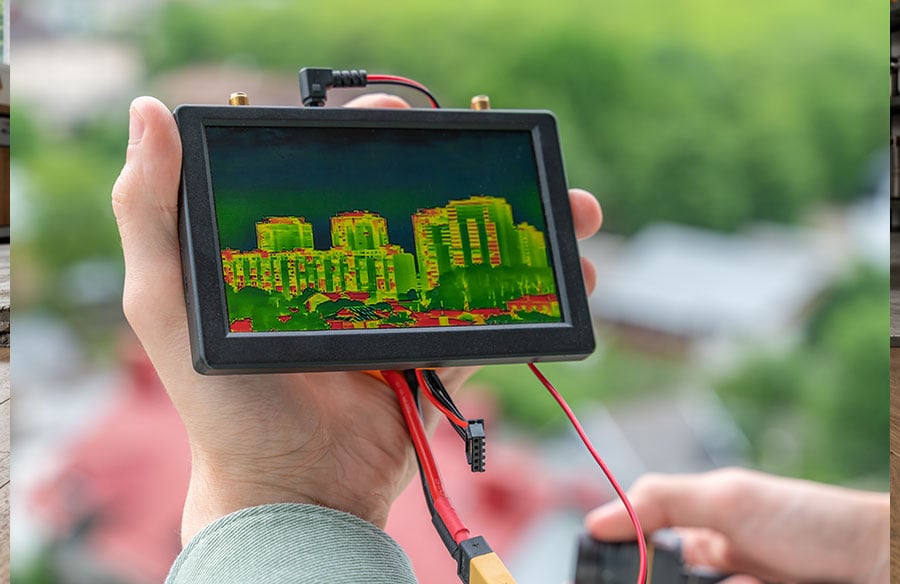
One of the most direct connections between germanium and architecture can be found in thermal imaging.
Thermal cameras detect infrared radiation rather than visible light. They translate differences in surface temperature into an image that allows otherwise invisible conditions to be identified.
In architecture, construction, and facilities management, thermography can help professionals investigate:
- Heat loss through walls, roofs, windows, and doors
- Thermal bridging
- Missing or poorly installed insulation
- Air leakage
- Moisture intrusion
- HVAC performance
- Electrical components operating at abnormal temperatures
- Underfloor heating systems
- Building-envelope defects
The technology is particularly valuable because many inspections can be completed without opening walls or physically disturbing building materials.
The optical requirements of a thermal camera are very different from those of a normal photographic camera. Conventional glass does not transmit the long-wave infrared radiation used by many thermal imaging systems effectively. Germanium, by contrast, is transparent across important portions of the infrared spectrum.
For this reason, germanium is commonly used for lenses and optical windows in thermal imaging systems.
That creates an interesting material relationship. A comparatively small piece of specialty material can help professionals evaluate the performance of an entire building envelope.
As energy-efficiency requirements become more demanding and owners place greater emphasis on verifying actual building performance, thermal imaging is likely to remain an important diagnostic technology.
Fiber Optics Are Becoming Part of Building Infrastructure
The second connection is less visible but arguably even more significant.
Modern buildings are increasingly data environments.
Office towers, hospitals, universities, airports, industrial facilities, laboratories, hotels, data centers, and large residential developments may depend on extensive digital infrastructure for communications, security, automation, environmental controls, access systems, audiovisual technology, and building management.
Fiber-optic networks have consequently become a fundamental part of many projects.
Germanium enters this infrastructure primarily through germanium compounds used during the production of optical fiber. Germanium dioxide can be incorporated into silica glass to modify its refractive properties, helping manufacturers create the optical characteristics necessary to guide light efficiently through the fiber.
The end user never sees this material.
A person connecting to a high-speed network in an office, using a connected device in a hospital, or accessing a digital building-management platform has little reason to think about the chemistry of the fiber carrying the data.
Nevertheless, the performance of contemporary digital infrastructure ultimately depends on highly engineered materials at the manufacturing level.
This illustrates a broader shift in architecture. Buildings are no longer defined solely by structural and finish materials. Their performance increasingly depends on sophisticated technological supply chains extending far beyond the construction industry itself.
Smart Buildings Depend on Material Systems We Rarely See
The term “smart building” is often associated with software.
Building management systems collect information, automation platforms adjust equipment, sensors monitor occupancy and environmental conditions, and dashboards provide operators with increasingly detailed information about how a property is functioning.
Yet none of this is purely digital.
Every layer of a smart building depends on physical hardware.
Sensors require electronic and optical components. Networks require cables and transceivers. Thermal monitoring requires infrared equipment. Data processing requires semiconductor devices. Communications systems require highly engineered optical materials.
This means that the digital transformation of architecture is also a materials story.
Germanium is only one example. Gallium, indium, tantalum, rare earth elements, tungsten, and other specialty materials appear throughout modern electronics, sensors, displays, communications equipment, energy technologies, and advanced manufacturing.
Their quantities may be small when compared with steel or concrete, but their functions can be highly specialized.
For architects and engineers, this creates a different way of thinking about materiality. The materials influencing a project’s performance increasingly extend beyond those visible in the completed building.
A Building’s Supply Chain Extends Far Beyond the Construction Site
There is another important characteristic of germanium: it is generally not produced from mines developed specifically to extract germanium.
Commercial germanium is commonly recovered as a byproduct of processing other mineral resources, particularly zinc-bearing materials. This means that its availability can be influenced by the economics and operating decisions of another commodity’s supply chain.
Increasing demand for germanium does not necessarily lead to an immediate increase in production.
New supply may depend on processing capacity, recovery economics, feedstock availability, refining capability, and the willingness of producers to invest in recovering a comparatively small secondary material.
This is why critical-material supply chains can behave differently from markets for large-volume construction commodities.
For manufacturers that depend on specific grades and forms, procurement involves more than simply locating available material. Purity, origin, consistency, analytical documentation, processing capability, and logistics may all become important considerations.
At the raw-material end of this chain, manufacturers and optical or electronic component producers may work with a qualified germanium supply partner to evaluate available material, technical specifications, documentation, sourcing options, and continuity of supply.
For architects, the significance is further downstream, but the dependency remains.
If a specialized component becomes difficult to manufacture because a critical input is constrained, the effect can eventually move through manufacturers, equipment suppliers, contractors, and project schedules.
Material Resilience Is Becoming Part of Design Resilience
Architects have become increasingly familiar with the concept of resilience.
Buildings are designed to withstand environmental stresses. Infrastructure is planned with redundancy. Energy systems are evaluated for reliability. Water use, climate conditions, maintenance requirements, and lifecycle performance are considered during design.
Supply-chain resilience deserves a similar place in the conversation.
This does not mean that architects should begin purchasing germanium or tracking mineral inventories.
It means recognizing that the performance technologies specified for a project exist within larger manufacturing ecosystems.
A thermal imaging system begins long before the camera reaches a surveyor.
A fiber-optic network begins long before the cable reaches the communications contractor.
A sensor begins long before it is connected to a building-management system.
Each depends on several layers of manufacturers, processors, raw-material producers, transportation networks, and specialist suppliers.
Understanding those dependencies becomes particularly important when projects use technologies with long lead times, limited substitutes, or highly concentrated manufacturing bases.
What Can Designers and Project Teams Do?
Most critical-material procurement decisions occur far upstream from an architecture practice, but project teams can still improve resilience at the specification level.
Avoid unnecessary single-product dependence
Performance-based specifications can sometimes allow multiple compliant manufacturers instead of requiring one proprietary system without a technical reason.
Greater flexibility can reduce vulnerability if one product becomes unavailable.
Discuss lead times earlier
Technology packages should not always be treated as late-stage additions.
Communications infrastructure, specialist sensors, optical systems, controls, and other technology-intensive packages can contain components with very different supply chains from conventional building products.
Early coordination gives procurement teams more time to respond to availability issues.
Consider maintainability
Highly integrated systems can improve building performance, but components will eventually require servicing or replacement.
Understanding whether replacement parts, sensors, modules, and associated equipment are likely to remain available should form part of lifecycle planning.
Evaluate the supply chain behind performance claims
The lowest-cost component is not necessarily the lowest-risk option.
Manufacturer capability, product support, documentation, supply continuity, and replacement availability can become just as important as initial purchase price.
Design technology infrastructure for change
Digital building systems evolve rapidly. Accessible cabling routes, modular equipment, adaptable communications infrastructure, and replaceable components can reduce the impact of future technological changes or material constraints.
Critical Materials Are Part of the Architecture of Technology
Germanium provides a useful example because its relationship with architecture is indirect but tangible.
It can sit inside the lens of a thermal camera used to evaluate a building’s insulation.
Germanium compounds can contribute to optical fibers carrying enormous quantities of information through campuses and commercial buildings.
Germanium-based technologies also appear in specialized semiconductor, sensing, optical, and photovoltaic applications.
None of these uses make germanium a building material in the conventional sense.
Instead, it is an enabling material.
And that distinction may become increasingly important.
The built environment is incorporating more sensors, more communications infrastructure, more automation, more advanced energy systems, and more sophisticated methods of measuring performance. As buildings become technologically richer, their material dependencies become broader.
Concrete, steel, timber, and glass will continue to define the physical structure of architecture. But behind the visible building is another material architecture composed of specialty metals, minerals, semiconductors, optical materials, and highly engineered compounds.
These materials may be measured in grams or kilograms rather than tons.
Their impact, however, can extend throughout an entire building.
Looking Further Upstream
The evolution of architecture has always been connected to advances in materials.
Steel changed what could be built vertically. Reinforced concrete changed structural possibilities. High-performance glazing transformed building envelopes. Engineered timber is reshaping conversations around structural carbon.
The next stage of material awareness may require looking beyond the materials we can see.
As buildings become smarter and more dependent on sophisticated optical, electronic, and communication technologies, architects will increasingly interact with products whose performance depends on complex global material supply chains.
Germanium is one small but revealing part of that story.
It reminds us that the future of architecture will not be shaped only by the materials forming walls, floors, roofs, and façades. It will also be influenced by the critical materials hidden inside the technologies that allow buildings to communicate, sense, measure, adapt, and perform.