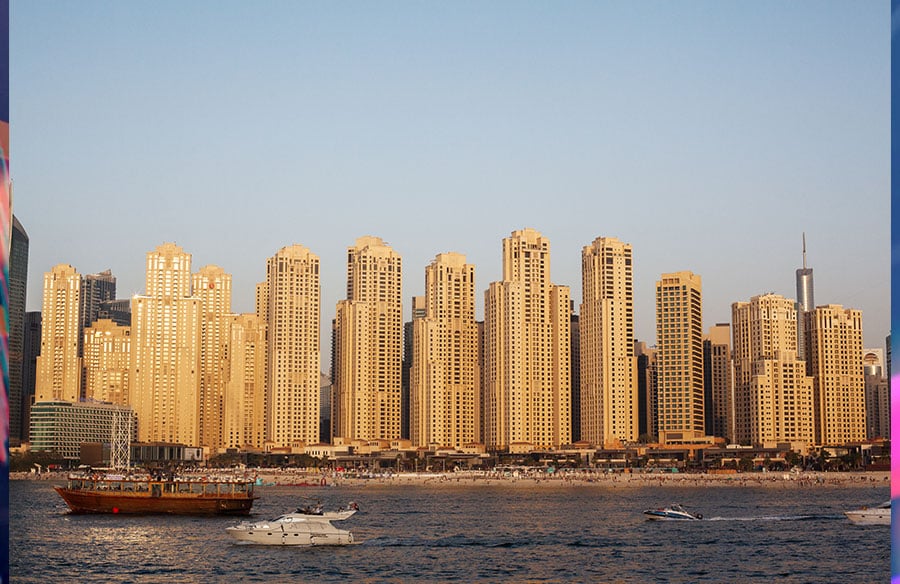
Dubai’s architectural identity has been defined, almost exclusively, by verticality. The Burj Khalifa, the twisting Cayan Tower, the forest of high-rise blocks along Sheikh Zayed Road — the city built its global image on the premise that height equals ambition. Yet the emergence of Dubai Islands off the Deira coastline represents something architecturally different: a deliberate turn toward the horizontal, toward the relationship between built form and water, and toward a new understanding of what urban scale means in the Gulf context.
This shift is visible not only in the master plan geometry but also at the individual building scale. Projects such as Cheval Residences Dubai Islands bring a hospitality-informed residential typology to a waterfront setting — one where the design agenda is not to compete with the skyline but to engage with the coastline. Floor-to-ceiling glazing oriented toward the Arabian Gulf, shaded terraces as primary habitable space, building footprints that respond to prevailing wind and solar patterns: these are architectural decisions that reflect a different set of priorities than those governing tower design inland.
The broader canvas on which these projects sit is Dubai Island — a five-island archipelago developed by Nakheel spanning 17 square kilometres off the coast of Deira. Conceived as part of Dubai’s 2040 Urban Master Plan, it represents one of the most significant attempts in the Gulf region to create a purpose-built coastal district from the ground up, rather than incrementally extending an existing urban fabric to the water’s edge.
A Different Urban Grammar
What distinguishes Dubai Islands architecturally from the rest of Dubai is not just proximity to water — it is the formal language demanded by that proximity.
Waterfront urbanism operates under constraints and opportunities that high-rise inland development does not encounter in the same way. View corridors become a shared resource to be protected rather than a private asset to be captured. Density must be calibrated differently: buildings that block sea views from public promenades or adjacent properties undermine the fundamental value of the location. Ground-level activation — the quality of the interface between building and public realm — becomes paramount in a district where pedestrian connectivity along the waterfront edge is the primary organising spine.
These are principles that have shaped successful coastal districts globally: Darling Harbour in Sydney, the Copenhagen Waterfront, Barcelona’s 22@ district transitioning to the seafront. Dubai Islands is operating within the same urban design tradition, adapting its principles to a Gulf climate and a Gulf programme.
The master plan acknowledges this by distributing density unevenly across the five islands. Central Island, the most commercially active zone, accommodates the highest building volumes, including the tower residential typologies that anchor the Deira Mall development. Shore Island, Golf Island, and Elite Island are conceived at lower densities — villas, boutique resorts, low-rise residential clusters — where the ratio of landscaped open space to built coverage is deliberately tilted toward the former.
The Five-Island Structure as Urban Design Framework
The decision to articulate the archipelago as five distinct islands rather than a single continuous landmass is itself an urban design choice with significant architectural consequences.
Each island functions as a legible urban unit with its own programme, character, and spatial identity. This prevents the homogenisation that afflicts many large-scale waterfront developments, where a single land use or architectural typology is repeated across an undifferentiated terrain. It also allows each island to develop a coherent microclimate strategy: Golf Island’s landscaped green buffers, the wind-sheltered marina promenades on Shore Island, the low-density villa setbacks that preserve beachfront views on Elite Island.
From an urban design perspective, the inter-island relationships are as important as the individual island plans. The Infinity Bridge connecting the islands to the Deira mainland is not only an infrastructure element — it is a spatial threshold, the moment at which the urban grain of the old city transitions to the looser, more open-grained fabric of the waterfront district. The bridge’s architectural language communicates this transition in physical form.
The nine marinas distributed across the master plan reinforce the maritime character of the district and introduce a typology — the marina edge — that requires specific architectural responses. Buildings sited directly on marina basins must manage reflectivity, noise, and the visual complexity of moored vessels in ways that inland buildings never encounter. Terraced section cuts, recessed lower floors, and canopied walkways are among the strategies that waterfront architecture typically deploys in this condition.
Branded Residences as a Design Typology
The prevalence of hospitality-branded residential developments in the Dubai Islands pipeline — projects associating international hotel management cultures with residential buildings — represents an architectural typology that deserves scrutiny beyond its commercial logic.
A branded residence is not simply an apartment with a hotel logo. At its best, it represents the application of hospitality design standards to the residential environment: consistent material quality across all shared and private spaces, service infrastructure embedded in the building rather than bolted on, public amenity programming (lobbies, pools, spas, food and beverage spaces) designed to the same standard as the private units they serve.
For waterfront buildings, this has specific architectural implications. The arrival sequence — from marina or beach arrival, through the ground-floor public realm, to the residential floors above — must be choreographed with the same care as a hotel arrival experience. Transitions between interior and exterior become central design problems rather than peripheral ones. The boundary between private residential space and the shared amenity landscape requires careful design resolution to ensure that neither domain compromises the other.
Architecturally, this typology tends to produce buildings with more richly programmed lower floors and more attention to sectional complexity than conventional residential towers. The stacking logic is different: it is not simply a repetition of identical floor plates, but a differentiated section where public, semi-public, and private zones are vertically and horizontally separated in legible ways.
Sustainability Demands of the Island Condition
Building on reclaimed land in the Gulf introduces structural and environmental constraints that directly shape architectural form. The soil conditions beneath Dubai Islands — reclaimed sand over marine sediment — require deep pile foundations that influence building footprints and structural bay dimensions. Architects working in this context must resolve the relationship between structural necessity and spatial quality at the ground floor, where column grids can conflict with the desire for open, column-free public areas.
The marine environment also accelerates material degradation. Salt-laden air corrodes unprotected metals, bleaches surfaces, and degrades certain sealants at rates that would be negligible in inland settings. The material palette of buildings on Dubai Islands should — and in the best projects does — reflect this reality: powder-coated aluminium over bare steel, treated hardwoods over untreated timber, high-performance facade systems with proven salt-air certification.
Passive design strategies are particularly significant in the Gulf climate. Orientating primary glazing away from direct western solar exposure, incorporating deep shading devices that block high summer sun while allowing lower winter angles, and designing natural ventilation paths that exploit the sea breeze as a free-cooling resource are all strategies that reduce mechanical cooling loads substantially. On a district scale, the Blue Flag-certified beach and the two square kilometres of landscaped parks and open spaces contribute to evaporative cooling effects that moderate the urban heat island across the archipelago.
What Dubai Islands Proposes for Urban Design in the Gulf
Dubai Islands does not yet exist in its final form. The district is being assembled across a multi-decade timeline, with full completion projected between 2030 and 2037. As an architectural proposition, it is therefore both a built reality and an ongoing design experiment.
What it proposes — and what makes it architecturally significant beyond its scale — is a model for Gulf waterfront urbanism that is neither a replica of Western waterfront precedents nor a continuation of the inland high-rise city. It is an attempt to develop a coastal urban typology that is climatically appropriate, spatially coherent, and architecturally differentiated across its five island units.
Whether the built outcomes will fully realise this proposition remains to be seen. The discipline of maintaining design quality across dozens of developers and hundreds of buildings, over decades of construction, is one of the most difficult challenges in large-scale urban development anywhere in the world. But the framework — five islands, each with a distinct identity, connected by maritime infrastructure, oriented toward the sea — gives the district an urban design logic robust enough to absorb variation without losing coherence.
For architects and urban designers watching this part of the Gulf coastline, Dubai Islands is worth sustained attention — not as a real estate story, but as a live case study in how a city redefines its relationship with water, one building at a time.