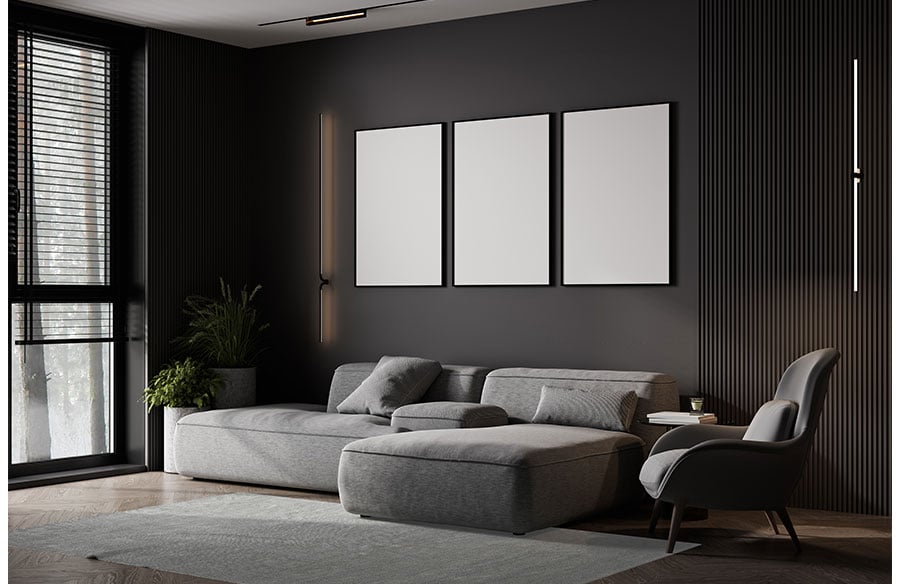
Some rooms stay dim no matter the time of day. The good news is that you rarely need new windows to fix it. Lighter paint, well-placed mirrors, and a few smart changes to curtains, glass, and lighting can make a dark room feel open and bright. Here are nine ways to do it, starting with the easiest.
What Makes a Room Feel Dark?
Usually it’s one of a few things. North-facing rooms get soft, indirect light all day. Older homes and basements tend to have small windows. Heavy curtains, overgrown shrubs, or a deep porch roof can block what little light there is. And dark walls, floors, and furniture soak up light instead of bouncing it around. Figure out which of these is your problem, and you’ll know where to start.
Bigger Changes That Bring In More Daylight
None of these need a contractor or a permit, and most can be done in a weekend.
1. Pick a paint with a high LRV
Every paint color has a Light Reflectance Value, or LRV, printed on the chip or listed on the brand’s website. It runs from 0 (black) to 100 (pure white), and it tells you how much light the color reflects back into the room. In a dark room, a higher number makes a real difference.
That doesn’t mean you’re stuck with stark white. Soft off-whites, pale grays, and warm creams can still have a high LRV and feel cozy. Paint the ceiling a bright white too, since it acts like a giant reflector over the whole space. An eggshell or satin finish bounces a little more light than flat paint.
2. Hang a mirror where it can catch the light
A mirror across from a window, or on a wall right beside it, catches daylight and throws it deeper into the room. The trick is making sure the mirror is reflecting something bright, like the window or a light wall, not a dark corner. RTF has a good piece on using mirrors as light amplifiers if you want more placement ideas. Glass tabletops and metal lamps do the same thing on a smaller scale.
3. Get the curtains off the glass
This one surprises people. Even when they’re open, curtains that hang over the edges of a window can block a good chunk of light. The fix is simple:
- Mount the rod higher than the window frame, closer to the ceiling.
- Extend it well past both sides of the window.
- When the curtains are open, they should stack against the wall, not the glass.
In rooms where you need privacy but not darkness, sheer or light-filtering panels are a better choice than heavy fabric.
4. Clean the windows (and the screens)
It sounds too obvious to mention, but dirty glass and dusty screens cut down the light more than most people realize. Give the windows a proper clean inside and out. If there’s a window you never open, think about taking the screen off altogether.
5. Go lighter underfoot
Floors take up a lot of what you see in a room, so dark wood or dark tile absorbs a lot of light. You don’t have to replace them. A large, pale rug over a dark floor can brighten the whole room.
6. Trim back what’s outside
Sometimes the problem isn’t the window at all. It’s the shrub that has grown halfway up the glass, or the tree branch hanging in front of it. Cutting them back can brighten a room overnight. If you’re planting something new near the house, a deciduous tree is a smart pick: it shades the windows in summer and lets the sun through in winter once the leaves drop.
7. Borrow light from the next room
When one room gets great light and the room next to it gets almost none, you can share it. Swapping a solid door for one with glass panels is the simplest version. A transom window above a doorway, or an interior window cut into the wall between a bright room and a dark hallway, lets daylight pass through while keeping the rooms separate. For a bathroom or a bedroom, frosted or reeded glass keeps things private.
8. Bring light in through the roof
Some spaces have no outside wall at all, like inner hallways, walk-in closets, and windowless bathrooms. For those, the light has to come from above, and you have two main options. They work quite differently:
| Skylight | Solar tube | |
|---|---|---|
| What it is | A window set into the roof | A small roof dome, a mirrored tube, and a ceiling diffuser |
| Light | A lot, over a wide area | Focused, enough for a small room |
| View of the sky | Yes | No |
| Heat | Can add heat in summer and lose it in winter | Very little heat gain or loss |
| Works best in | Living rooms, kitchens, attic rooms | Hallways, closets, bathrooms |
If you go with a skylight, direction matters. According to the U.S. Department of Energy, north-facing skylights give steady, cool light, while south- and west-facing ones let in the most heat. The DOE also suggests keeping a skylight to about 5 percent of the floor area in a room that already has lots of windows, and around 15 percent in a room with few.
Climate makes a big difference too. In places with long, hot summers, like Oklahoma, a big skylight on the wrong side of the roof can turn a room into an oven by mid-afternoon, which is why solar tubes are often the cooler choice there. Remodeling contractors Tulsa homeowners call for this kind of work deal with that heat every summer, so they can tell you which option suits your room and roof. Either way, you’re cutting a hole in the roof, so check your local permit rules and have it installed properly to avoid leaks.
9. Layer your lighting for after dark
Daylight only lasts so long, and a dark room needs good lighting in the evening too. One ceiling fixture rarely does the job. Mix it up with overhead light for the whole room, a few lamps or wall lights at eye level, and focused light where you read or cook.
Pay attention to the bulbs as well. Bulbs around 2700K to 3000K give a warm, relaxed glow that suits living rooms and bedrooms. Around 4000K feels more neutral and crisp, which many people prefer in kitchens and home offices.
Frequently Asked questions
What’s the fastest way to brighten a dark room?
Repaint the walls and ceiling in a color with a high LRV and hang a large mirror across from the window. You can do both in a weekend.
Do mirrors really make a room brighter?
Yes, as long as they face a window or a bright wall. A mirror reflecting a dark corner won’t do much.
Is a solar tube better than a skylight?
For small spaces in hot climates, often yes, because it brings in daylight with very little heat. For a larger room where you want a lot of light and a view of the sky, a skylight is the better fit.
How do I get light into a room with no windows?
Borrow it from the next room with a glass door, a transom, or an interior window. If the room is on the top floor, a solar tube can bring light in through the roof.
The takeaway
You don’t need a big renovation to fix a dark room. Start with paint, a mirror, clean glass, and curtains that stay off the window. If that’s not enough, borrow light from the next room or bring it in from above. A handful of small changes can make a room feel like a different space.