A gauge number is the most reliable way to get the wrong material delivered. Say “16 gauge” and you have named three different thicknesses depending on whether the shop reads it as aluminum, steel, or stainless. Say “0.0508 inch” and there is nothing to misread.
This is a working reference for aluminum sheet and coil thickness: what the gauge numbers convert to, why aluminum uses a different system from steel, how to calculate weight, and what to write on an order so the metal that arrives is the metal you specified.
Why aluminum gauge numbers differ from steel
Gauge numbers are legacy measurement systems that took hold before decimal thickness became the normal way to specify sheet. Different metal industries adopted different gauge tables, which is why the same gauge number does not mean the same thickness in aluminum, carbon steel, and stainless.
Brown and Sharpe, also called American Wire Gauge, is the legacy reference commonly used for aluminum and other nonferrous sheet. Steel and galvanized steel follow the Manufacturers Standard Gauge, which ties a gauge number to a sheet weight rather than a measured dimension. Stainless runs on its own gauge again. At any given gauge number, aluminum comes out thinner than steel or stainless.
Treat Brown and Sharpe as a reference, not as a specification. Aluminum sheet ordered under ASTM B209 or B209M is written in dimensional thickness with the applicable tolerances, not by gauge number, and no mill order should rely on the gauge alone.
Brown and Sharpe is a geometric progression. Each step is a fixed ratio, and thickness in inches works out to 0.005 multiplied by 92 raised to the power of 36 minus the gauge number, divided by 39. Two consequences follow. Higher gauge numbers mean thinner metal, and the steps are proportional rather than even, so the difference between 8 and 10 gauge is far larger in absolute terms than the difference between 24 and 26.
Aluminum gauge to thickness and weight
The table below covers the gauge numbers used across most aluminum sheet and coil work. Weights are calculated at an estimating density of 2.70 g/cm3, about 0.0975 lb/in3.
| Gauge (B&S) | Inches | Millimeters | Weight, lb/ft2 | Weight, kg/m2 |
|---|---|---|---|---|
| 8 | 0.1285 | 3.26 | 1.80 | 8.80 |
| 10 | 0.1019 | 2.59 | 1.43 | 6.99 |
| 12 | 0.0808 | 2.05 | 1.13 | 5.53 |
| 14 | 0.0641 | 1.63 | 0.90 | 4.40 |
| 16 | 0.0508 | 1.29 | 0.71 | 3.48 |
| 18 | 0.0403 | 1.02 | 0.57 | 2.75 |
| 20 | 0.0320 | 0.81 | 0.45 | 2.19 |
| 22 | 0.0253 | 0.64 | 0.36 | 1.73 |
| 24 | 0.0201 | 0.51 | 0.28 | 1.38 |
| 26 | 0.0159 | 0.40 | 0.22 | 1.08 |
Watch the metric column when you buy from a mill that works in millimeters. A gauge conversion and a nearby metric nominal are not the same number: 14 gauge converts to about 1.63 mm, while 1.60 mm is a separate nominal thickness, and 18 gauge converts to 1.02 mm against a 1.0 mm nominal. Do not assume one gets substituted for the other. Specify the thickness and tolerance you actually need.
The cross-material trap
This is where orders go wrong, particularly in shops that run more than one metal.
| Gauge number | Aluminum (B&S), in | Steel (MSG), in | Stainless, in |
|---|---|---|---|
| 16 | 0.0508 | 0.0598 | 0.0625 |
| 18 | 0.0403 | 0.0478 | 0.0500 |
| 20 | 0.0320 | 0.0359 | 0.0375 |
A fabricator who reads a drawing calling for 18 gauge and pulls steel-gauge habits will be working from 0.0478 inch when the aluminum is 0.0403 inch, a difference of about 16 percent in thickness and considerably more in stiffness. Neither party is wrong about their own chart. The drawing was ambiguous.
The fix is simple and costs nothing: write the decimal thickness, in inches and millimeters, and treat the gauge number as a note in parentheses rather than the specification.
Calculating weight
Weight drives freight, handling limits, and the conversion between a mill minimum quoted in tonnes and the number of sheets or feet you actually need.
For flat sheet, weight per square foot in pounds is thickness in inches multiplied by 14.04, using nominal density. In metric, weight per square meter in kilograms is thickness in millimeters multiplied by 2.70. For a full coil, multiply area by thickness by density, or work back from coil dimensions if you know the outer and inner diameter.
Two caveats. Density varies by alloy, with many common sheet alloys falling roughly between 2.66 and 2.73 g/cm3. The 2.70 figure is a useful estimating density, but use the actual alloy density when weight accuracy matters. And calculated weight assumes nominal thickness. Real coil sits somewhere inside its thickness tolerance, so a shipment can weigh a little more or less than the arithmetic says without anything being wrong.
Tolerance: nominal is not actual
ASTM B209 and B209M reference the permissible dimensional variations in ANSI H35.2 and H35.2M, including thickness tolerances that vary with product dimensions. A nominal 0.040 inch coil is permitted a range, not a single value.
For most work that does not matter. It matters when parts have to nest, when a panel has to fit a fixed reveal, or when you are converting purchased weight into finished pieces and a consistent shortfall in yield turns into a real cost. If thickness tolerance affects your process, put the required tolerance on the order rather than assuming the standard default, and ask whether the certificate reports actual measured thickness.
Thickness and stiffness
One rule explains most thickness decisions. Bending stiffness of a flat panel rises roughly with the cube of thickness, while weight and material cost rise in direct proportion.
Going from 1.0 mm to 1.25 mm adds a quarter to the weight and roughly doubles the stiffness. That is why a modest thickness increase can produce a disproportionately large improvement in panel stiffness, and why dropping one gauge to save material is rarely as free as the price difference suggests. Framing, span, geometry, alloy, and temper still have to be weighed for a specific waviness or denting problem.
Worth separating from temper: a harder temper raises yield strength and resistance to permanent denting, but it does not materially change aluminum’s elastic modulus. Stiffness comes from thickness and geometry, not from temper.
Where mill capability sits on the chart
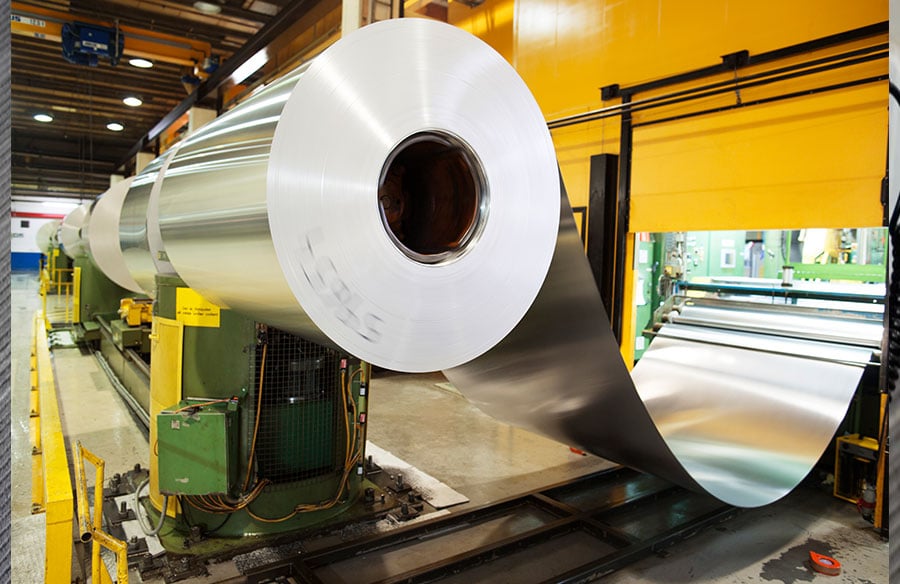
Primealux Alloys supplies aluminum coil produced by Orbit Aluminum Industries, an integrated producer in Aqaba, Jordan, with casting, rolling, and coil coating on one site. Rolled coil runs 0.20 to 2.00 mm in 1xxx, 3xxx, and 5xxx alloys and up to 1650 mm wide, with temper supplied to requirement.
For reference only, that range sits between roughly 12 gauge at the heavy end and well below 26 gauge at the thin end. Coated coil runs up to 1.60 mm, close to 14 gauge, and up to 1350 mm wide, so painted product stops well short of the rolling ceiling. Those are approximate gauge equivalents, not production gauges: the mill rolls to the thickness on the order. Coils run up to 10 tonnes, and the minimum order is 6.5 MT, plus or minus 10 percent, which is where the weight arithmetic above becomes practical: at 0.040 inch, one minimum order is a large number of sheets in a single specification.
For North American buyers converting between gauge, thickness, coil dimensions, and weight, Primealux Alloys publishes a coil weight calculator. Material is produced to order by the mill against the submitted specification rather than pulled from standing stock, so the thickness and tolerance you state are the ones that get rolled.
What to put on the order
- Thickness in decimals, in inches and millimeters, with the gauge number only as a parenthetical note.
- Tolerance, if your process depends on it, rather than relying on the standard default.
- Standard. ASTM B209, EN 485, or whichever governs the job.
- Alloy and temper, chosen around forming and strength, not around thickness.
- Width and form. Coil, slit coil, or cut sheet, with the dimensions you actually need.
- Coil limits. Inner diameter and maximum coil weight your uncoiler can take.
- Quantity, stated in the unit you want it priced in, and cross-checked against weight.
One last check
When a quote comes back, convert it yourself before approving it. Take the thickness, the width, and the quantity, work out the weight, and see whether it matches what the supplier quoted. Mismatches between a gauge callout and a decimal thickness, or between an imperial drawing and a metric mill, show up in that arithmetic long before they show up on a receiving dock.