Volzhsky Pipe Plant – the part of the Pipe Metallurgical Company (TMK) – is located in the city of Volzhsky, Volgograd Region; it is one of the largest pipe plants in the south of Russia. The Volzhsky Pipe Plant’s Pipe Rolling Shop No. 2 (TPP No. 2) is engaged in the production of seamless pipes.
Project Name: Modernization of the Volzhsky Pipe Plant
Studio Name: Osetskaya.Salov Bureau
Location: Volzhsky city, Volgograd region, Russia
Completion Year: 2024
Total area PRS No. 2: 160 000 m2
Project Credits:
Tatiana Osetskaya, architect, co-founder of the bureau
Alexander Salov, architect, co-founder of the bureau
Mikhail Nikolaev, Project Management Director
Architects:
Tatyana Yudina
Ulyana Osipova
Karina Monisova (Aidarova)
Photo: Daniel Annenkov

During the modernization of the Pipe Rolling shop, Volzhsky’s management decided to create a fresh, spectacular image of the technological industrial site, which would have a positive impact on the production culture. The architectural bureau Osetskaya.Salov was invited to develop the modernization project.
External environment
A typical Soviet industrial building is a monotonous volume stretching along the road with a length of more than 750 meters. It is surrounded by a typical factory environment: technical buildings and mechanisms, a water tower, factory pipes and outdoor storage of the workshop’s products. Every element of the environment here is exclusively functional and meets the requirements of production maintenance.

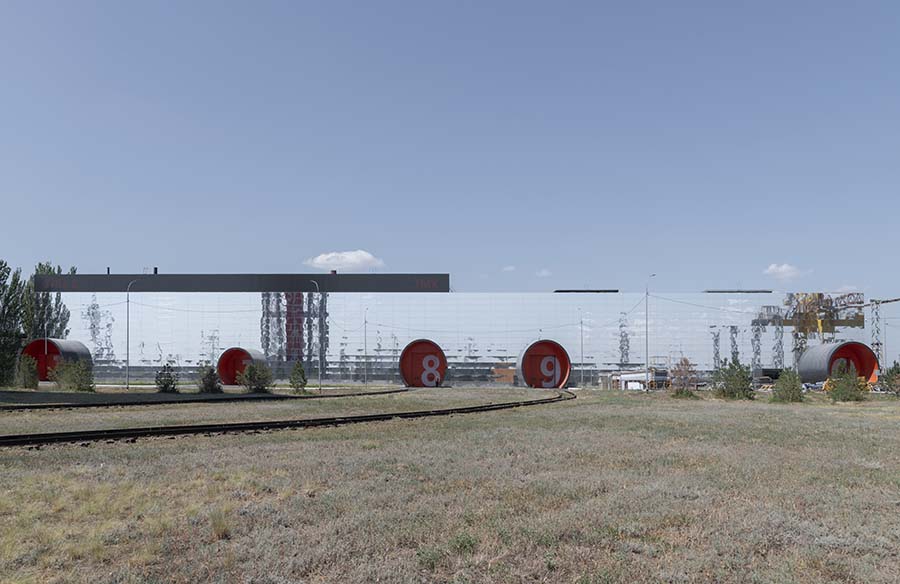
The facades are divided into key semantic planes: the front facade with the main entrance-driveway, the longitudinal side facade and the closing end facade. Each of the segments was endowed with its own idea as an independent art object that meets the set functional goals.
The mirror-like shine of the polished aluminum panels used in the decoration of the main facade is a metaphor for the technology used inside the shop. At the same time, the massive volume of the facade literally dissolves into its surroundings: it reflects the Volga grassland, the southern sky, colored pipes, powerful structures of industrial cranes and a water tower. The entrances to the workshop are made in the form of huge pipes protruding from the workshop massif. Their dimensions correspond to the size of the production building and their purpose: their diameter is from 7 to 8 meters and a multi-ton truck in them seems like an ordinary city car.

The architects used contrasting supergraphics in the design of the side facades of the workshop to emphasize the scale of the building, but avoid monotony. The facade, oriented towards the inner territory, has graphic lines following the rare elements of the facade – windows, gates, staircases, outbuildings. The opposite facade is viewed from the city highway and appears dynamic to viewers who see it from car windows. On each section of the facade there are circles of different diameters, which in motion add up to a “pulsating” animation.
Interior spaces
The project of modernization of the premises affects one of the bays inside the production building. There is where the new stainless steel pipe finishing area is located.
The interior image is based on the complexity of the composition and production of steel – a multi-component, malleable and ductile material. The interior of the shop uses 102 colors, the sum of which resembles the characteristic shimmers that appear in the process of melting and further processing of metal.

The space itself is filled with production equipment and many technical elements with strict design regulations. As a result, the image of production spaces is built on the combination of the idea of shimmering spectrum and painting of elements with colors according to the GOST State Standard.
There are also7 modular units with panoramic glazing in the workshop, highlighted by a contrasting black composite. They house meeting rooms and offices open to the workers of the workshop.

As part of the architectural design, a “guest route” was developed: it starts at the entrance on the side facade of the building, passes through the meeting room and allows you to familiarize yourself with the production line. The interior design of the entrance and entry areas is made of laconic black volumes clad in mirror composite, which provides a contrasting transition between the interior and exterior space.