The most forward-thinking architects are no longer finishing their projects without an art advisor. collēctum‘s Myrtha Herrera is making the case for why art belongs at the table from day one.
There is a persistent assumption embedded in the way most building projects are run: that art comes last. After the architecture is resolved, after the interiors are specified, after every material decision has been signed off — then, and only then, does someone begin thinking about what goes on the walls.
It is an assumption that Myrtha Herrera has spent her career systematically dismantling.
As the founder of collēctum, a New York–based art consultancy, Herrera works with architects, interior designers, and developers at the highest level — not as a finishing touch, but as a foundational collaborator. Her argument is precise: when art is integrated into a project from the earliest stages of design, it doesn’t decorate a space. It completes it. When it is added at the end, it almost always shows.
The Anatomy of a Real Collaboration
What does it actually mean to integrate art into an architectural project from the beginning? For Herrera, it starts before a single material has been chosen.
She opens every project with deep-dive conversations with the lead architect and developer — not about art, initially, but about the building itself. What is the spatial experience the project is trying to create? What is the emotional register of each sequence of spaces? Who is the end user, and what relationship do they have with culture? These questions shape everything that follows, ensuring that any art recommendation is grounded in a genuine understanding of the architectural vision rather than imposed upon it.
From there, artist identification begins. Some projects demand the cultural authority of an established, internationally recognized name. Others call for an artist at an earlier stage of their career, whose work carries a vitality and specificity that more established names rarely offer. Most projects, handled well, require both — a collection with range, depth, and a coherent point of view across every price point. Navigating that spectrum is where Herrera’s market knowledge becomes most consequential.
Site visits with selected artists follow, allowing proposals to be tested against the actual spatial context. Renders and scale models are presented to the architectural team before any commission is confirmed. From the moment a work enters production, Herrera maintains continuous oversight through fabrication, logistics, and installation — present at every stage of a process that most advisors exit long before completion.
Cero5Cien: When the Sculpture Is the Signature
No project illustrates this methodology more clearly than the commission for Cero5Cien, the most luxurious residential complex in its country. The brief was unambiguous: identify and place the landmark sculpture that would define the development’s cultural and architectural identity for generations.
Herrera selected Alma Allen for the commission — a decision that has since been validated publicly in the most significant terms possible. Allen will represent the United States at the 2026 Venice Biennale, one of the most prestigious stages in contemporary art. The placement at Cero5Cien, made well before that announcement, reflects the kind of curatorial judgment that comes from being genuinely embedded in the contemporary art world rather than observing it from a distance. The result is a development whose cultural identity is anchored by a work that will only grow in significance over time.
Hospitality: Art as Spatial Experience
In luxury hospitality, art has to work harder than it does anywhere else. A hotel is not a static space — it is experienced sequentially, by thousands of different people, across every hour of the day. Herrera has developed two distinct approaches to meeting that challenge.
At AVA Resort — a 1,622-room property on the Mexican Caribbean coast — she developed a curated program of over 100 works by internationally acclaimed artists, valued above $500,000, sequenced and placed as a spatial narrative that transformed the property into a cultural destination. Every placement decision was made in relation to the architecture around it — how a work read from a particular angle, how it held its own against a material, how it prepared the eye for what came next.
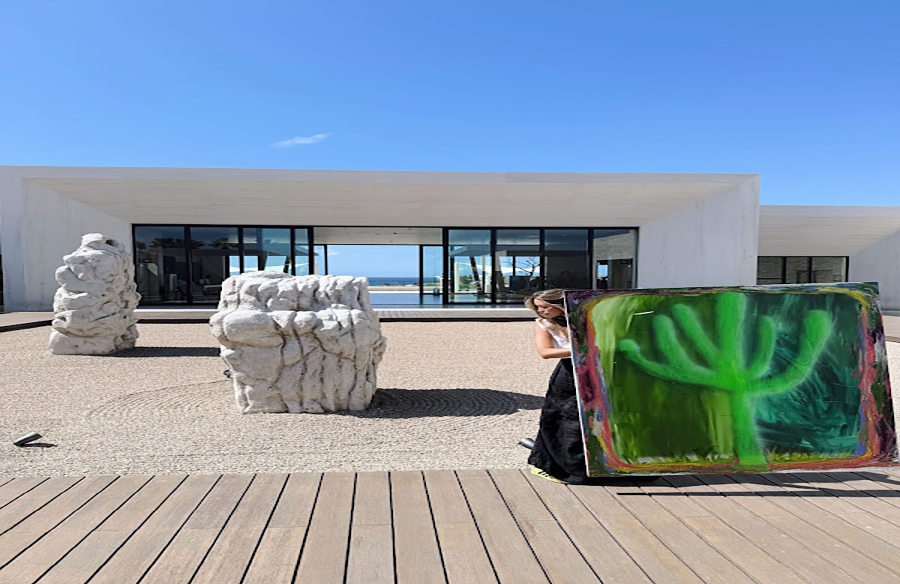
At Nobu Hotel Los Cabos, she took a different approach entirely. Herrera selected Evgen Čopi Gorišek — exhibited at KÖNIG GALERIE in Berlin — to spend time on-site producing new work in direct response to the landscape and architecture of the property. The resulting catalog named Herrera as acquisition contact for the works. It was a curated program operating at gallery standards, inside a hotel building.
Private Residences: The Most Personal Brief
It is in private residential work that Herrera’s collaboration with interior architects reaches its most nuanced expression. The spaces are intimate, the clients are specific, and the art has to speak not just to the architecture but to the people who will live inside it every day.
She works alongside interior designers on projects of this kind — attending site visits together, discussing spatial sequences, debating scale, material, and tone. The goal is always the same: a collection so precisely calibrated to the space and the person that the idea of it belonging anywhere else becomes unimaginable.
That level of integration doesn’t happen when art is the last decision. It happens when it is treated, from the very beginning, as one of the most important ones.
The Conversation Architects Are Ready For
The buildings that endure are the ones where art was never an afterthought — where the decision to commission a sculpture or place a work was made by a team that understood, from the very first meeting, that architecture and art were always part of the same idea.
Herrera has built collēctum around exactly that conviction. For the architects and developers working at the highest level, finding the right person to have that conversation with — early enough to matter — makes all the difference.
Myrtha Herrera Almanza is the founder of collēctum, a New York–based art consultancy specializing in advisory services for collectors, architects, real estate developers, and hospitality groups. collectum.art