For decades, landscape planning moved slowly: sketches, mood boards, hand-wavy references, and a lot of “you’ll know it when you see it.” Today, outdoor design is entering the same acceleration curve that reshaped interiors—only the constraints are tougher. A yard isn’t a blank box. It comes with sun patterns, drainage realities, property lines, existing paths, and the awkward truth that plants must survive where you actually live. The future of outdoor design is not “prettier fantasy gardens.” It is faster iteration grounded in real spaces: start from a photograph, generate credible directions, refine in plain language, and export visuals you can actually discuss with a partner, contractor, or nursery.
 From inspiration to a shared picture
Traditional workflows often fail at the earliest stage: alignment. Homeowners know what they want emotionally—more privacy, less maintenance, better evening seating, safer play areas—yet struggle to translate that into a coherent plan. Professionals lose time reconstructing intent from vague Pinterest saves. AI-assisted outdoor design changes the bottleneck. Instead of starting from a generic template, a photo-first workflow preserves context: the fence, the driveway, the side yard pinch point, the pool deck footprint. The output may still be illustrative rather than a stamped construction set, but it is yours in a way a stock render never is. That shift matters because landscaping mistakes are expensive; clarity upfront is an insurance policy.
What “AI landscape visualization” can mean in practice
When people hear “visualization,” they imagine glossy marketing stills. The more practical meaning is decision support: exploring palettes, massing, circulation, planting structure, and hardscape character without committing to demolition day. This is where platforms that combine structured controls with generative models earn their place. You choose the outdoor “room” you are designing—front yard, backyard, side yard, garden-focused spaces, pool-adjacent areas—and layer style, functional priorities, and specific elements rather than relying on a single magical sentence prompt. The interface becomes a translator between homeowner intuition and model behavior.
A closer look at AI Yard Design Studio
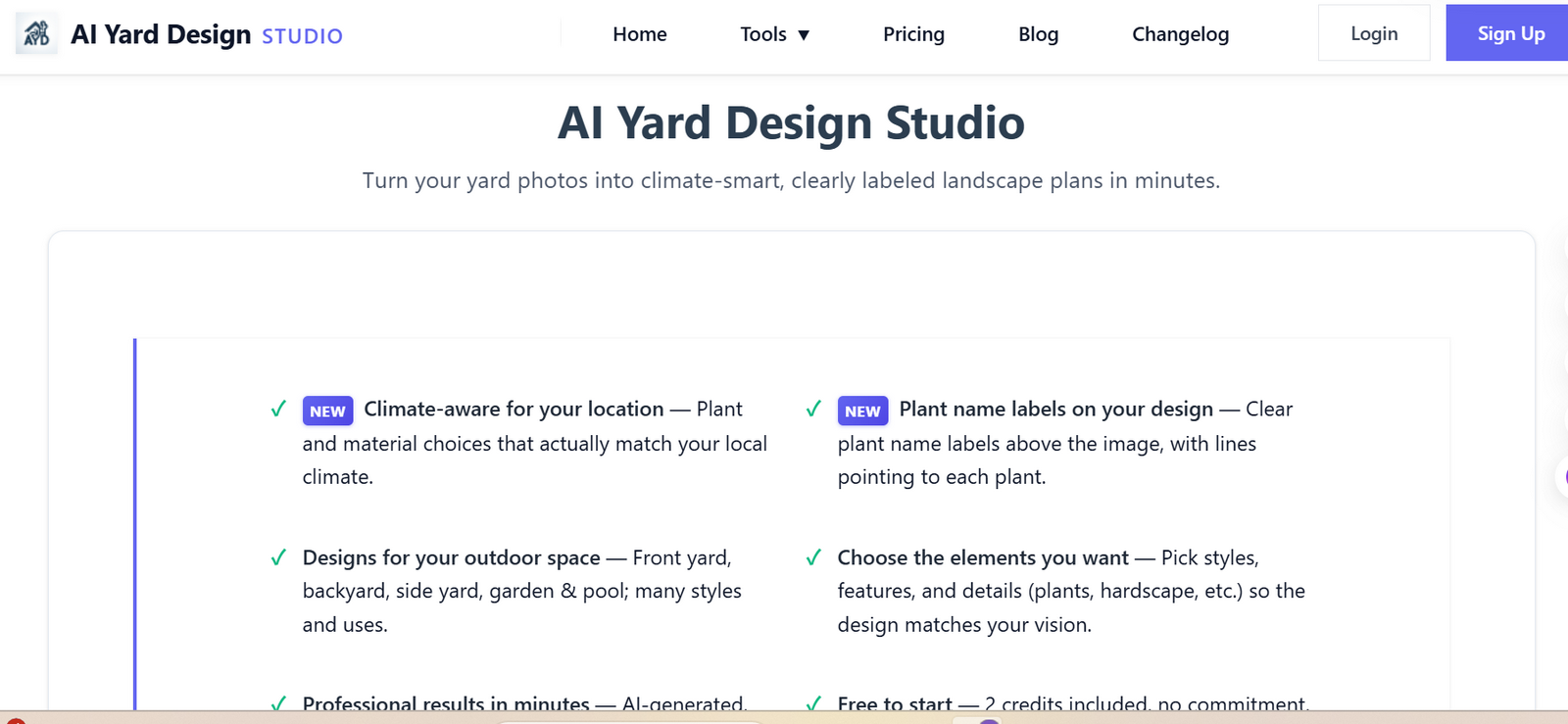
AI Yard Design Studio has emerged as a focused example of the photo-grounded approach for residential outdoor spaces, paired with a pathway toward larger landscape-style projects—the “AI landscape visualization” side of the same workflow family. Conceptually, it addresses two audiences at once: people redesigning the spaces around a home, and users who need a bigger-scale landscape concept pass before engineering and procurement take over. Three capabilities matter for credibility:
- Location-aware guidance
Outdoor design is inherently regional. The same “modern minimalist” language can fail if the plant palette ignores heat, drought cycles, or winter lows. Tools that let users inject location-oriented context help steer outputs toward locally plausible material and planting tendencies—without pretending to replace local expertise, codes, or soil tests.
- Plant communication, not just decoration
A common frustration with garden AI is ambiguity: lush greenery with no names, no hierarchy, no shopping reality. Approaches that emphasize labeled callouts—identifying plants clearly so viewers understand what is being proposed—bridge the gap between mood and execution. Labels turn a pretty image into a conversation tool.
- Refinement as a first-class step
Yards are iterative. The first render is rarely the last. The modern outdoor workflow should expect follow-up edits: “keep the path,” “reduce lawn,” “more evergreen screening,” “avoid fragile edging near the dog run.” Systems that treat refinement as normal—rather than a failure mode—match how projects evolve in the real world.
The boundaries that keep you honest
No matter how convincing a render looks, AI visualization does not automatically solve grading, drainage, utilities, tree protection, setbacks, or permit drawings. It also cannot guarantee nursery availability. The ethical pitch for the category is conservative: accelerate exploration and communication, not replace licensed professionals where life safety and property value are on the line.
Why this “future” is more boring—and more useful—than hype
The seductive version of the future promises instant perfection. The useful version promises shorter cycles from “I have a yard problem” to “here is what we mean,” with fewer expensive misunderstandings along the way. That is the real promise of combining AI Yard Design Studio-style tooling with AI landscape visualization: not a replacement for craft, but a faster way to see it together. If outdoor design becomes more collaborative, more legible, and easier to iterate before money is spent on materials and labor, that is not just a trend. It is a practical upgrade—one photo-backed concept at a time.