Set an empty box under a bedroom window and leave it there until evening. In daylight its shape may sit neatly below the sill. At night it can turn into a big dark mass with only the edge visible. Now lift the box and see how much lighter the wall looks without it. That’s a quick way to test one of the bigger decisions in a modern organic bedroom. How much do you want the furniture to stand out?
If you’re considering rattan bedroom furniture, look for a spot where you can see the front without a duvet or chair in the way. Outside a showroom, the light may hit the woven face only for part of the day. Take a sample of something woven around the room. Look at it by the bedside lamp and under the window. If you can still see the weave from where you usually enter, you have a good place to start.
The Wall Across From the Bed
Look past that box from the side of the room where the pillows are. See where its top falls against the window. When the lines are close, moving the box down or away may be all it takes to make the two shapes readable. If the glass comes nearly to the floor, leave it there to light whatever you put on the wall beside it. That empty stretch may do more for the room than a larger cabinet would.
At this point a tall stack of cardboard boxes is useful. Set one at each end of the place you’re thinking about and lay a strip of paper between them to represent the dresser top. From the doorway the line may lead you toward the bed. From the pillow end it could fall right across the lower edge of the window. Shift the mock-up and see if the view settles. A piece of furniture only has to feel a few inches too tall for the whole wall to look crowded.
How Much Space a Woven Dresser Can Use
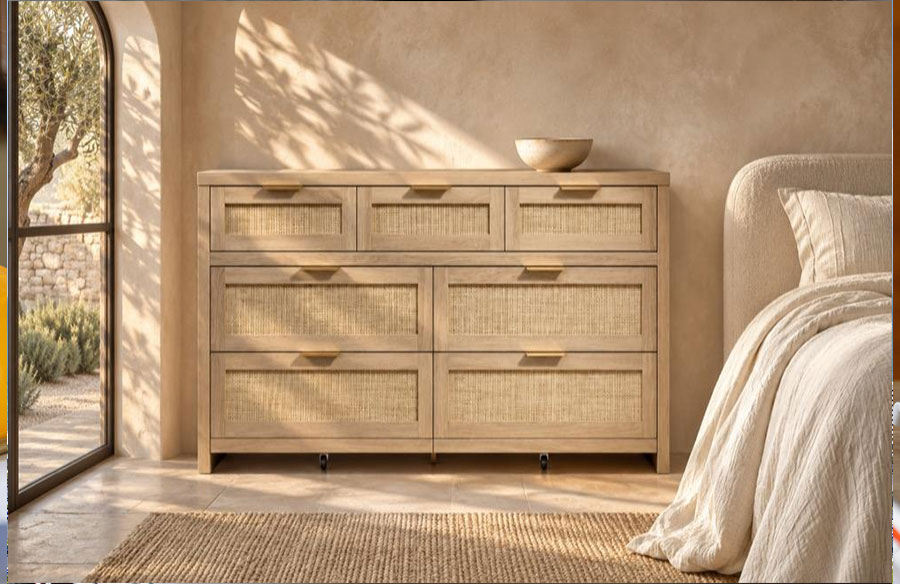
Consider a piece such as the Savanna 7-drawer tall dresser, which measures about 56.9 inches wide, 17.7 inches deep and 31.3 inches high. Across from a bed of similar width, its long top can make a clear second line in the room. At the end of a short wall, the same piece might sit uncomfortably close to the trim. Mark its width where you’d see it first. Then put the depth on the floor and test how much room you have to open a drawer.
Look at the Gap After the Drawer Opens
A hand needs only a little space to reach a knob, but the person it belongs to needs somewhere to stand. Leave the drawer on your tape plan long enough to put away a towel or a top. If you have to back into the bed to open it, try another wall or a shallower chest. Check whether you can still walk between the dresser and bed if someone else is using the drawer. That’s the kind of scale that doesn’t show up on the room’s mood board.
Wood in the Light and Wood in the Shade
Start With the Boards That Will Stay
The floor has already decided some of the color. So has a set of pine window frames or an exposed beam. Hold a new wood sample over the boards and see what stands out. A pale sample with a pink cast can look quite different next to oak that reads yellow. A darker sample that picks up a color already in the boards might be a better fit than two similar tones set a short distance apart.
Compare the materials after the sun has gone down. Light through leaves may give the wall a little green in the afternoon. A lamp may show more of the red in the floor in the evening. Look at both. That peach-beige wall card may keep its warmth in one corner and turn almost gray in another. Leave the sample up for a few days if you’re between two finishes.
Give the Weave an Edge You Can See
A flat painted panel will bounce light back differently from cane or rattan. Add a smooth surface beside a woven one if you want to see the little shadows. A clean strip of wall above a dresser can help. It may be worth moving a wicker basket out of that spot rather than adding a textile just to introduce another pattern. Your eye can then find the weave that’s already there.
The best clue to the material may be in the product description instead of the photograph. Some woven panels use cane, some use synthetic material and some get the effect with a textured insert. Figure out which one you’re bringing home. If it’s going under an open window where the occasional bit of rain gets in, or next to the place somebody sets a glass, read the care notes before you decide about the location.
The Things You Reach for From Bed
Put a lamp on the proposed bedside surface and sit in your reading position. Can you see the bulb? If you can, a different shade or a change in height might be in order. Check if you can set a book down without tilting it over the edge of a table. The bed takes up the middle of the room. What’s around it should make the time you spend there easier.
On the tighter side, start with an open shelf or a small table and see how much floor you gain. The other side may have room for a useful drawer. Two pieces can differ and still belong to the same room if their top edges sit near the same level or their lamps cast a similar light. Keep the open space where you’ll use it, especially near a door or the part of the bed where you change the sheets.
Go back to the box under the glass. If it makes the wall feel smaller, move your proposed dresser around the corner. A little wood on the new wall and the weave with the light falling across it may be enough. Try leaving the old spot empty with the curtain drawn back for an afternoon. The extra space could turn out to be the first thing you notice on walking in.