A street poster has only a few seconds to capture someone’s attention. For graphic designer Genie Wu, designing for public spaces means creating visual messages that can communicate quickly, even to people who aren’t actively looking for them.
The screens keep coming anyway. Digital out-of-home advertising took 38.4% of all U.S. out-of-home revenue in the second quarter of 2026, up 18.5% on the year before, according to the Out of Home Advertising Association of America. Wu’s interest sits with what still gets printed, pasted and painted.
She has worked at both ends of that scale, on launch graphics built to be streamed by millions and on paper meant to be read from one sidewalk.
Wu is a Taiwanese American graphic designer, and her practice covers brand identity, typography and editorial design. Lately it also covers graphics that have to survive outdoors.
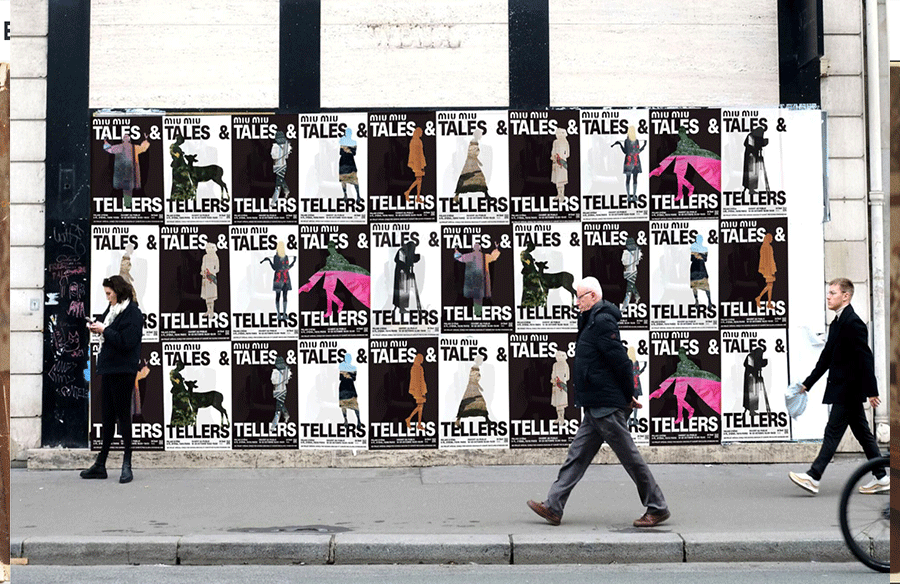
Her credentials for saying so are not theoretical. In Sunnyvale, California, she worked with Apple’s Marcom identity team on product launch and event identities, developing visual assets designed to stay consistent across keynote screens, physical event graphics and digital platforms. In New York, she worked as a branding design intern at studio 2×4 on projects for Chanel and Miu Miu. For Miu Miu’s Tales & Tellers, staged in Paris and New York, she contributed to and helped develop the primary visual language, printed materials and event giveaways, worked on most of the character silhouette cutouts for the inaugural Paris exhibition with the 2×4 team, and worked on the user experience and information hierarchy for the public event registration page across desktop and mobile. That exhibition is where her thinking about public graphics stopped being theoretical. Tales & Tellers was free and open to anyone who walked in, and its graphics and printed materials had to hold people who had not come looking for them, 11,000 visitors in Paris over five days, according to The New York Times.
A book is different. So is a phone. Both are picked up on purpose. “I think designing for the street is very different because you’re designing for an environment that you can’t fully control,” said Wu. “Unlike a book or a screen, where people usually choose to spend time looking at the content, street posters have to compete with everything else happening around them.”
She explains that pedestrians may be walking by quickly, or simply not paying attention, so you have to think about “how to catch their attention within just a few seconds and make them curious enough to explore the exhibition,” said Wu
Speed changes the brief. On foot, a poster can afford a second line and a smaller credit, something to find if you stop. Through a windshield it cannot.
“The biggest difference is how much time people have to look at and process the information,” Wu said. “When designing for people moving quickly in cars, everything needs to be much more direct. The typography needs to be larger, the message needs to be shorter and stronger. The overall composition needs to be easy to understand within just a few seconds.”
Her rule for traffic is blunt. “You don’t want too many elements competing for attention because people won’t have time to process them. This is for sure a less is more moment.”
Place changes it too. Wu has worked in Taipei, New York, Paris and Los Angeles, and a campaign that travels has to keep its core identity intact while adjusting to how each of those cities actually moves.
New York City is the hardest test, posters layered over posters, everything shouting at once. Los Angeles is mostly a distance problem. Taipei rewards whoever slows down. The storefronts are close together, and people walk close to them.
Before Apple and 2×4, Wu did research, concept work and digital production at JOEFANGSTUDIO in Taipei, where she contributed to the launch identity for a museum opening in Taichung. Earlier still, at Decodisplay Corp. in Taipei, she worked on event branding. From 2024 to 2025 she was an editor of Source Material, working on publication design, workshops, promotion and launch events.
Recognition has followed the work. Form Revival: When Canvas Meets Code was named a winner in the Communication Arts Typography Annual 2026. Her book Dialectics of Contradiction was selected as an Excellent Work in the Editorial and Book Design category of the 2027 Tokyo TDC Annual Awards, the international competition run by the Tokyo Type Directors Club. It’s Nice That named her to its Ones to Watch list in 2025.
Away from client work, what she notices is less polished. Hand-painted restaurant signs. Building lettering that has been up for decades. Storefronts nobody has got around to redoing.
“I personally think environmental typography plays a big role in giving a neighborhood its own character; when you walk around a city, the signs, storefront lettering, building names, and even old advertisements all become part of what makes that place recognizable,” she said.
“A handwritten sign from a family-owned restaurant feels very different from a polished corporate storefront, and both tell you something about the neighborhood,” adds Wu. “Some signs have been there for decades, so they become part of the local memory and give a place a sense of history and human warmth.”
She does not expect the screens to win outright, and she is thinking here about independent artists and museums, the ones without a media budget worth the name.
“Digital advertising is everywhere, so seeing something physical in the city can feel different; there’s something about the texture of paper, the way ink sits on a surface, and how posters gradually fade or layer over one another,” said Wu. “To me, these layers become a kind of visual record of the city.”
It isn’t necessarily a competition between analog and digital, though. “They serve different purposes, and both will continue to exist,” she says. “But I hope cities continue to make room for physical graphics. They add character to the streets, create unexpected moments, and give people something to experience beyond a screen.”
Written by Penny Black
Photo: Courtesy of 2×4
Published on November 15, 2026