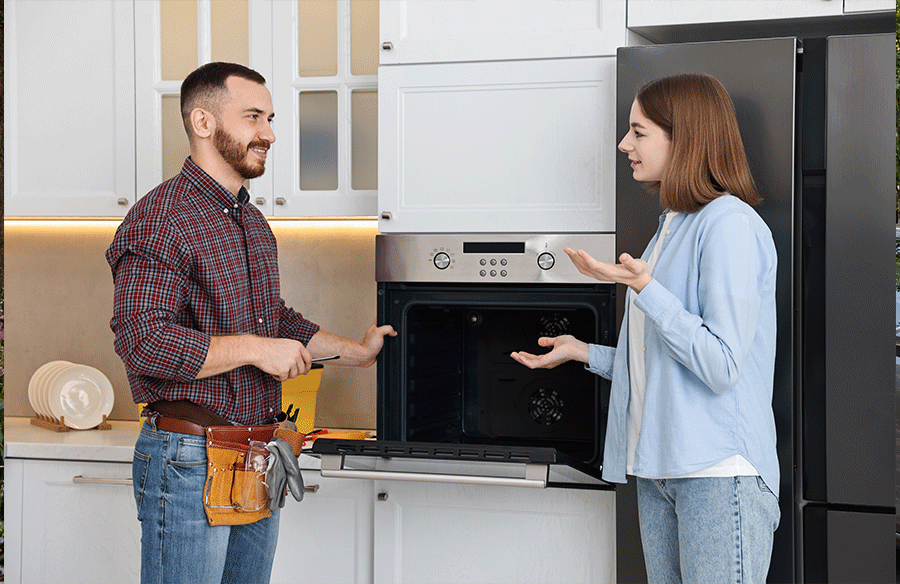
Nobody thinks about the age of a dishwasher until it stops draining the night before guests arrive. Then the question lands all at once: fix it, or buy a new one?
I have run an appliance repair company in Southern California since 2019, and I hear that question in kitchens all the time. The answer usually comes down to three things: how old the machine is, what actually broke, and what it would really cost to put something new in that spot. That last number is the one people get wrong, especially in a kitchen that was designed around its appliances.
How long appliances actually last
Two sources get quoted more than any others. The National Association of Home Builders published life expectancy figures that the industry still uses, and Consumer Reports has estimates built from its member surveys, as reported by NerdWallet.
| Appliance | NAHB study (years) | Consumer Reports estimate (years) |
|---|---|---|
| Refrigerator | 13 | 14 top-freezer, 11.1 side-by-side |
| Dishwasher | 9 | 12 |
| Washer | 10 | 11.2 top-load, 9.1 front-load |
| Dryer | 13 | 13.4 |
| Gas range | 15 | 14.2 |
| Electric range | 13 | 11.6 |
| Microwave | 9 | not listed |
Look at the dishwasher line: 9 years in one column, 12 in the other. Treat these as ranges, because the real result depends on how hard the machine works and how it is looked after.
Water is the factor people overlook. On calls for appliance repair in Los Angeles, hard water is a regular suspect. Minerals collect in dishwasher valves, ice maker lines and washer inlets, and the damage stays out of sight until something clogs or sticks. Dust does the same job on the other side of the kitchen. Refrigerator condenser coils packed with lint and pet hair make the compressor run longer and hotter, and a dryer pushing air through a long, half-blocked vent will wear out its heating parts early and take twice as long to dry a load.
The repairs that are usually worth paying for
Most failures are smaller than they feel. A refrigerator that has stopped cooling properly often has a failed fan, a defrost problem or a worn door gasket, and the compressor is fine. Dishwashers that will not drain or fill tend to need a pump, a valve or a door latch. Dryers are simple machines: belts, heating elements, igniters and thermal fuses are all routine. Washers commonly need a drain pump or a door lock. Ranges and ovens are often an igniter, an element or a temperature sensor away from working again.
If the machine is in the first half of its expected life and the problem is one of these, I would repair it nearly every time.
When buying new makes more sense
A good repair company should tell you when to stop spending money. These are the situations where I would start shopping:
- Worn-out washer drums. On many front-loaders, failed bearings or a broken drum support mean taking most of the machine apart, and on an older unit the bill rarely makes sense.
- Sealed-system failures on a basic refrigerator. A compressor or refrigerant leak on an inexpensive freestanding model that is already past ten years is usually the end of the road.
- Rust where it matters. A corroded dishwasher tub, a rusted-through oven floor or a washer cabinet coming apart can undo any repair done around them.
- Parts that no longer exist. Control boards are the usual problem. Once a model has been out of production for years, a replacement board may be hard to find at any price.
- A second major failure close behind the first. One big repair is bad luck. Two in a year usually means the whole machine is wearing out together.
Run the numbers two ways
The classic guide is the 50 percent rule, which Consumer Reports used for years: if a repair costs more than half the price of a new one, replace it. Many people add a second condition and only replace when the appliance is also past half of its expected life. It is a useful first filter, but it ignores how many years you will get back.
So try a second test and compare the cost per year. Here is a real one. A 7-year-old refrigerator needs a $445 repair, and you expect about six more years from it. That is roughly $74 a year. A new $1,500 refrigerator lasting 13 years works out to about $115 a year. The repair wins, even though nothing is guaranteed on an older machine.
Then correct the price of new. Add delivery, installation, haul-away, any new hoses or connectors, and anything that has to change in the cabinets around it. In a built-in kitchen, that list can get long.
Why built-in kitchens change the math
Replacing a freestanding range is mostly a delivery. Replacing a panel-ready refrigerator can turn into a small remodel. The opening was cut for one exact unit. A new model may differ in height, depth or hinge clearance, the custom panels may no longer fit, and the cabinetry or stone around it may have to be altered. A kitchen that looks finished and cohesive today can lose that the moment one appliance no longer matches the set.
That is why a repair that would be foolish on a basic top-freezer can be the smart choice on a high-end column unit. A sealed-system job or a built-in refrigerator repair can cost far less than a new unit plus the carpentry to make it fit. Premium built-ins are also generally designed to be serviced where they stand, which helps keep them going well past the averages in the table.
If you are designing or renovating a kitchen now
Some of the most expensive service calls start with decisions made during construction. A few small choices will save the owner real money over the next twenty years:
- Run the finished floor under the dishwasher. If new tile or hardwood stops at the opening and raises the floor in front of it, the machine can get trapped under the counter.
- Keep shutoffs and outlets reachable. Put water valves and electrical connections where a technician can get to them without pulling the appliance or emptying a cabinet.
- Leave slack. Gas, water and power connections need enough length for a range or refrigerator to come forward for service.
- Respect the ventilation. Built-in refrigerators and wine units have to breathe. Never let a design detail cover the grille or close the clearances in the installation guide.
- Filter the water. Where the supply is hard, plan for treatment at the dishwasher, the refrigerator and any ice maker from the start.
- Save the paperwork. Keep model numbers and installation specs with the house records. Whoever replaces that unit in fifteen years will need the exact dimensions.
Before you decide
Do not make this call from an error code and a search result. Have someone diagnose the machine and give you a price before any work begins. Ask how old the unit is, since the serial number usually tells a technician. Ask if the part is still available and what warranty comes with the repair. With those answers and the real installed price of a replacement, the decision usually becomes obvious.
Most people do not want a new appliance. They want the one they already have to work again. When a repair makes sense, that is the cheapest and least wasteful way to get there. When it does not, you should hear that too, before you pay for it.
About the author: Roman Abysov is the owner of Same Day Appliance Repair, which has serviced home and commercial appliances across seven Southern California counties since 2019.