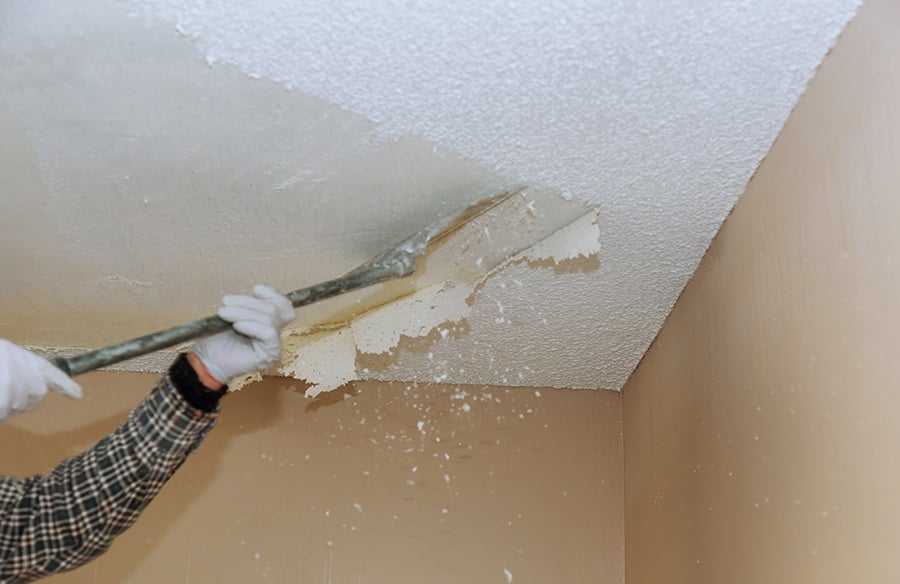
Few renovation jobs deliver as dramatic a payoff with as little structural disruption as removing a popcorn ceiling. The bumpy, cottage-cheese texture sprayed onto ceilings across North America from roughly the 1950s into the 1980s hid imperfections and softened sound, but today it mostly hides light. Take it away and a room reads as taller, brighter and a decade or two younger.
In Toronto, plenty of homeowners are still looking up at one. City of Toronto census figures show close to 334,000 households living in dwellings built between 1961 and 1980, the peak years for textured ceilings, and that is before counting the many older homes refinished during that era.
The texture itself comes off fairly easily. What catches people out is the dust. Here is why, and what a clean job actually looks like.
Start with a test, not a scraper
Before anyone touches the ceiling, find out what it’s made of. Some older textured ceilings contain asbestos, and as the Canadian Centre for Occupational Health and Safety explains, you cannot tell whether a product contains asbestos by looking at it; only a laboratory test can confirm it. Canada banned the import, sale and use of asbestos products in December 2018, but the federal regulations do not apply to asbestos already built into structures before then, so the ban does nothing for a ceiling sprayed in 1974.
Sampling is quick and inexpensive compared with the cost of getting it wrong. If the result is positive, the job becomes asbestos abatement and belongs with a qualified abatement company, not a general contractor or a weekend DIYer. If it comes back clean, you can move ahead with confidence.
Where the mess really comes from
Most homeowners picture scraping as the messy stage, and it is untidy: wet clumps of texture falling onto plastic sheeting. But softened texture is heavy and tends to drop rather than float. The fine, airborne dust that ends up on bookshelves two rooms away usually comes later.
Once the texture is gone, the ceiling underneath is rarely smooth enough to paint. It needs repairs and one or more skim coats of joint compound, and every coat needs sanding. Joint compound is made from very fine minerals. The U.S. National Institute for Occupational Safety and Health lists ingredients such as talc, calcite, mica, gypsum and silica, and notes that the dust can irritate the eyes, nose, throat and airways. Sanding overhead with a conventional pole sander sends that powder straight into the room’s air, where it settles on every surface and gets drawn into HVAC returns.
The same NIOSH research shows how much the method matters. When engineers compared vacuum-equipped sanding systems with traditional sanding, the extraction tools cut dust exposure by 80% to 97%, and four of the five systems tested reduced it by nearly 95%.
What “dustless” should actually mean
No ceiling job produces literally zero dust, and a contractor who promises that is overselling. A genuinely dust-controlled process is built from several layers working together:
- Containment. Plastic sheeting on walls and floors, zip walls or sealed doorways to isolate the work area, and furniture moved out or fully wrapped.
- Sealed ventilation. Supply and return vents taped off so the HVAC system doesn’t carry dust through the rest of the home.
- Wet scraping. Lightly misting the texture so it comes away in heavy sheets rather than powder, without soaking the drywall behind it.
- Extraction sanding. Sanders connected to HEPA-filtered vacuums that capture dust at the sanding head.
- HEPA clean-up. A final vacuum of every surface, not just a sweep.
When comparing quotes, ask each contractor to walk you through these steps. A reputable dustless popcorn ceiling removal service should be able to explain how it contains the work area, what equipment it sands with and how it leaves the room, without you having to pry.
Other questions worth asking
How many skim coats are included? A single thin coat over a heavily scarred ceiling will show every flaw once it’s painted, especially under pot lights or beside a large window. Is priming and painting part of the price, or will you need a painter afterwards? What happens if the drywall underneath turns out to have water damage or popped screws? And how long will the room be out of use? A typical bedroom can often be finished in a day or two, but drying time between coats is not something to rush.
If you live in a condo, check your building’s renovation rules before booking. Many condo corporations limit noisy work to set hours and require elevator reservations, and in buildings with shared ventilation, good containment protects your neighbours as much as your own furniture.
Worth doing right
A smooth ceiling is one of those upgrades people notice without quite knowing why; the room simply feels cleaner and more open. Getting there safely comes down to two decisions made before work begins: test for asbestos, and choose a process that treats dust control as part of the job rather than something to clean up afterwards.