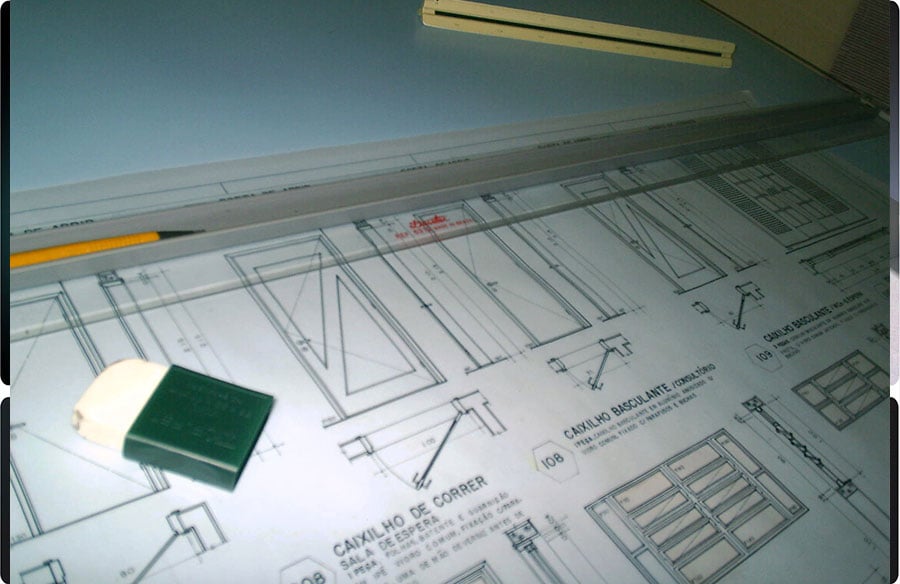
Architecture has spent more than a century arguing about honesty. The argument is usually about buildings: whether concrete should be left board-marked and bare, whether steel should be expressed or clad, whether a timber beam should look like timber or be wrapped in plasterboard. Far less attention goes to the people having the argument, and to what they wear while they have it.
That gap is worth closing. A design studio is a place where material decisions are made all day, and the clothes worn there are the materials designers live with most closely. If a practice believes that materials should be legible, durable and allowed to age in public, it is fair to ask whether the same principle reaches the studio wardrobe. For a growing number of designers, the answer begins with a quiet, unglamorous fabric: linen.
The Principle Behind the Fabric
Material honesty, as taught in most design schools, comes down to a few ideas. A material should be used in a way that suits its nature. Its structure should be visible rather than disguised. And the marks of use and time should be treated as part of its character rather than as damage to be hidden.
Read that list again with fabric in mind and linen fits almost every point. It is made from the stalks of the flax plant, a crop that needs relatively little water to grow. Its weave is visible to the naked eye, with slight irregularities in the yarn that give the cloth a living texture. It creases readily, and it does not pretend otherwise. It softens with every wash rather than wearing thin. In short, linen behaves the way designers ask concrete, brick and oak to behave: openly, and with a record of its own history.
Synthetic performance fabrics take the opposite position. They are engineered to look identical on the first day and the five-hundredth, to resist wrinkles, to imitate other fibers. There is nothing wrong with that for a mountain jacket. But in a studio that lectures clients on authenticity, a wardrobe built entirely on imitation sits a little awkwardly.
A Uniform Shaped by the Work
The idea of a studio uniform is not new. Designers have long gravitated toward a narrow palette of clothing so that attention stays on the work rather than on the morning decision of what to wear. What has changed is the reasoning behind the choice. Where it was once about image, it is now more about how a garment performs over a long day of drawing, site visits and client meetings.
Studio work is physical in ways outsiders rarely see. It involves bending over drafting tables and plotters, crouching to inspect a foundation, carrying sample boards across a city, and sitting through long reviews. Clothing for that rhythm needs to move, breathe and recover. Linen is breathable and quick-drying, which matters in a model shop with a hot-wire cutter running or on a summer site walk with no shade. It also takes a crease and loses it again without fuss, which suits a day that moves from the workbench to the boardroom.
Trousers carry most of that load. They are the garment that bends, kneels and sits the most, and the one most likely to be judged by how it holds up at six in the evening. That is why so many designers who experiment with linen start with a well-cut pair of linen pants before anything else. A relaxed, straight leg in a natural tone reads as considered without being precious, and it sits comfortably beside a sketchbook, a hard hat or a tray of physical models.
Patina as a Design Value
One of the more interesting shifts in contemporary practice is a renewed respect for patina. Projects that reuse existing structures, expose old brickwork or leave traces of earlier uses visible are now widely admired. Writing on materials and construction returns again and again to weathering, repair and the value of material that carries a history.
Clothing can follow the same logic. A linen garment worn for several seasons looks different from a new one. The color softens, the hand becomes more supple, and the creases settle into patterns that reflect the wearer’s habits. Rather than signaling neglect, that change can be read in the same way as a timber floor worn pale along its most-used routes. It is evidence of use, and use is the point.
 Consistency Between Practice and Person
There is a professional argument here as well as an aesthetic one. Clients increasingly ask designers about embodied carbon, sourcing and the life cycle of materials. Many studios have adopted sustainability frameworks for their projects, and the wider discussion of sustainable architecture shows how central those questions have become to the discipline.
A designer who speaks fluently about low-impact materials but dresses entirely in fast fashion is not being hypocritical in any serious sense. Clothing is a personal matter, and the scale of a wardrobe is tiny next to a building. Still, consistency has its own value. It suggests that the principles discussed in meetings are genuinely held rather than adopted for a pitch. Choosing natural fibers, buying fewer pieces and wearing them longer is a small, visible way of practicing what the studio preaches.
The Limits of the Argument
None of this means linen is beyond criticism, and an honest essay on material honesty should say so. Linen wrinkles, and some workplaces still read wrinkles as carelessness. It can feel crisp or even stiff before it has been washed a few times. Like any fiber, its environmental credentials depend on how it is processed, dyed and finished, not only on how the flax is grown. And no fabric is a substitute for simply owning less.
The useful lesson is not that every designer should switch to linen. It is that the criteria designers already apply to buildings, such as legibility, durability, appropriate use and graceful aging, can be applied to clothing too. Linen happens to meet those criteria unusually well, which is why it keeps appearing in studios where those values are taken seriously.
Designing the Everyday
Designers often say that the best architecture improves ordinary life rather than only special occasions. The same can be said of a wardrobe. The studio uniform is worn on ordinary days, through deadlines and site visits and late-night pin-ups. Choosing it with the same care given to a facade or a floor finish is not vanity. It is a continuation of the design mindset into the most personal scale there is.
A well-worn pair of linen trousers, creased at the knee and softened by years of washing, may never appear in a portfolio. But it says something quietly accurate about how its owner thinks: that materials should be what they appear to be, that time should be allowed to leave its mark, and that the honest choice is usually the one that lasts.