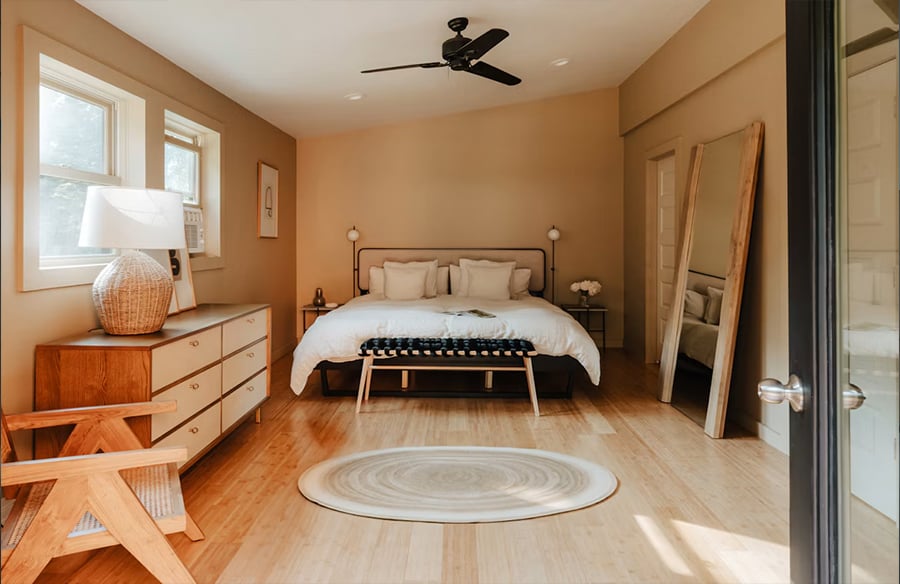
The bedroom looked spacious until the fan arrived. Now its cord crosses the route to the closet, and the air purifier has been pushed behind a chair. Both appliances technically fit, but neither has a comfortable place to work.
This is a layout problem worth solving before replacing furniture. A fan and an air purifier need different positions because they do different jobs. The fan directs moving air toward people; the purifier draws room air through its filters. Give each a useful location, then check that the bedroom still works around them.
Start with the routes you use every day
Walk from the doorway to the bed, then to the closet, window, and dresser. Do this with drawers open and the laundry basket in its usual spot. Those paths tell you where equipment is likely to become an obstacle.
Measure the available floor area, including baseboards and furniture overhangs. Note outlets without assuming that every reachable socket offers a sensible placement. A cord stretched across a walkway is an inconvenience you will encounter daily.
Mark possible equipment positions with paper or removable tape. Include the space needed to operate controls, lift the appliance safely, and access removable parts. Follow the manual’s clearances around inlets and outlets; the physical footprint alone does not describe the space the machine needs.
If two people share the room, test the routes from both sides of the bed. A convenient position for one person can block the other person’s nighttime path.
Aim the fan where you need the breeze
Start from the place you sit or sleep rather than the most discreet corner. A quiet tower fan can be useful beside a clear section of wall when its airflow reaches the occupied part of the room without being blocked by bedding or furniture.
Try the available speeds and oscillation settings while lying or sitting in your normal position. A breeze that feels pleasant when standing may be distracting close to your face in bed. Move the fan or adjust its direction before assuming you need a stronger setting.
Keep curtains and loose fabrics away from the appliance, and place it on the stable surface specified by the manufacturer. Do not wedge it between a dresser and a curtain simply because the gap is narrow.
A room fan circulates indoor air. It does not introduce outdoor air by itself or replace air conditioning during dangerous heat. Use it for the comfort it can provide, and turn it off when nobody needs the breeze.
Give the purifier room to draw in air
An air purifier is easily treated like a side table, especially when floor space is tight. Avoid putting objects on it unless the manufacturer explicitly permits that use. Its airflow paths need to remain open.
When comparing Levoit home air purifiers, check the specific model’s inlet and outlet locations, room-size guidance, and cleaning access. Different designs require different arrangements; there is no universal rule that every purifier belongs in the same corner.
Choose a place where room air can reach the unit without a cabinet, chair, or heavy curtain directly obstructing it. Follow the required clearance rather than guessing a distance that looks tidy.
Also check filter removal. If replacing a filter means dragging several pieces of furniture aside, maintenance is likely to become a neglected chore. Leave enough room to do the job without dismantling the bedroom.
Filtration supplements cleaning and appropriate ventilation. It does not remove the need to address a damp patch, a persistent pollution source, or a ventilation problem.
Test the pair together
Once each appliance has a candidate position, use both in the room as you normally would. Check whether the fan’s breeze is comfortable and whether either unit rattles against furniture.
Keep the appliances’ airflow paths unobstructed. Do not assume that pointing the fan directly at the purifier improves filtration; choose placement according to each manual and the room’s actual use.
Listen from the pillow at the settings you intend to use. Low sound levels matter only if the equipment still performs the job you need. A purifier on its quietest mode may have less airflow than on higher settings, so consider room size and operating time alongside sound.
Look for indicator lights visible from the bed. If the model offers a display-off setting, check how it works. Do not cover vents or controls with fabric to block light.
Make the cords and cleaning work
Route cords without pinching them under furniture or running them beneath rugs. Keep them clear of water, door swings, and places where pets or children can pull them. Avoid improvised power arrangements.
Leave a way to vacuum around the bases. A device that blocks cleaning can create a neglected patch of dust just where it is meant to help manage the room’s air.
Keep manuals and maintenance reminders accessible. Record the model and filter type somewhere useful so replacements do not require another search behind the furniture.
After several nights, make one adjustment at a time. Shift the fan slightly, move an occasional chair, or relocate a basket that crowds the purifier. The best arrangement is usually the one that keeps equipment useful while leaving ordinary movements through the bedroom easy.