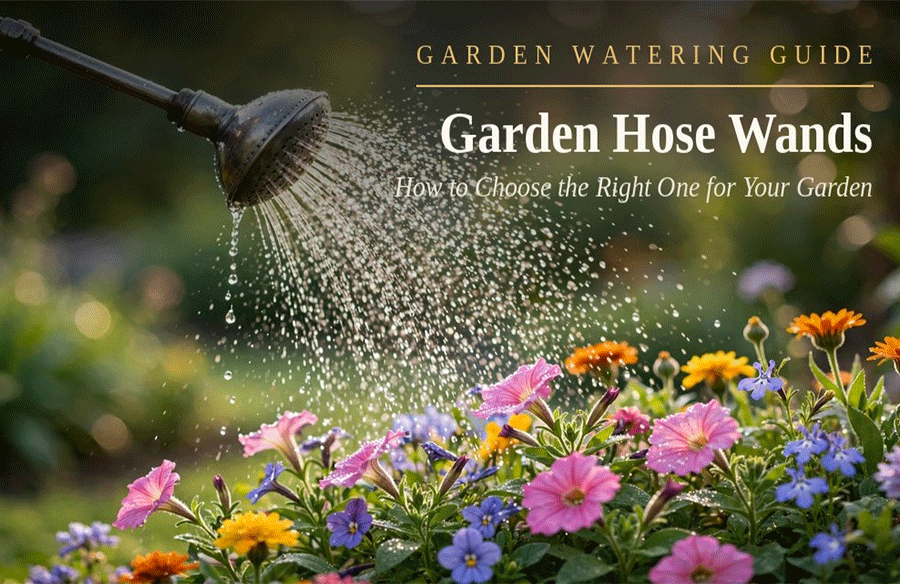
Watering a garden by hand seems simple enough until you have to do it day after day. Then you start to appreciate what a difference a few feet can make. A standard hose nozzle blasts water instead of spraying it. That’s why the average garden hose deserves an upgrade to a watering wand. It gives you more control and a better reach while also being gentler on your plants.
Not everyone appreciates the value of working smarter instead of harder, but after a while, most can agree a purchase is worthwhile. This guide covers what you need to know to pick the one that will help you garden for years to come.
What a Garden Hose Wand Actually Does
A watering wand is a hose attachment with a long handle. The extra length lets you water hard to reach places without having to stretch or bend. Like a shower head, the head on a watering wand disperses water in a spray instead of a solid stream. This helps to soak the soil without eroding the top layer like a strong stream can do. Seedlings are especially susceptible to damage from soil erosion and appreciate gentle watering.
Depending on the model, the head can tilt or rotate. Both forms of adjustability help water hard to reach places without requiring you to change your position. Since garden watering is very hard on your back, a garden hose wand is bound to make a difference within a week of continuous use.
Wand Length: Matching the Tool to Your Garden
The length of your wand depends on what you spend the most time watering. Short wands are ideal for containers or beds you have to bend down to water. Long wands are needed for deep beds you can’t reach from ground level. A long wand is easier to manage, you can always adjust it so it’s shorter if needed.
| Wand length | Best for |
| Short (16–18 in) | Containers, small beds, seedlings |
| Medium (24–36 in) | Flower beds, vegetable rows |
| Long / telescoping (36–60 in) | Hanging baskets, deep borders, shrubs |
Spray Patterns Worth Having
Seedlings don’t need much water and a fine mist can actually flatten them. A wide spray is the best pattern for watering beds. A focused stream is a good pattern for a deep watering and can be sprayed at the base of a plant. A fine mist suits seedlings best, with a broader shower once they grow.
A good wand is versatile, has multiple spray patterns, and can be used for cleaning. The head can be rotated to change patterns. A good wand can cover a large area.
Flow Control Types
How you control the water matters as much as the spray. Thumb-control wands use a sliding lever you nudge with your thumb for gradual adjustment. Trigger models work like a spray gun: squeeze for water, release to stop, with a lock for continuous flow. Rear-trigger designs suit larger hands, while thumb sliders suit smaller ones. Try both styles in your hand if you can; comfort is personal.
What to Check Before You Buy
In addition to length and patterns, there are other details to consider when comparing wands that will last and those that will leak by August. See that the fitting matches your hose thread. Most wands are 3/4-inch standard. See if there is a comfortable grip. You will grip it for long stretches at a time. An adjustable head that can tilt 180 degrees will help you water under leaves without having to crouch.
- Adjustable head angle for watering under leaves
- Rubberized grip that provides a good grip when wet
- Leak proof seals at all joints
- Balanced weight so your arm doesn’t get tired
Metal vs. Plastic: What Lasts Longer
Plastic wands are less expensive and lighter weight, so they are suitable for occasional watering. For daily watering, a metal wand, usually a zinc alloy with an enamel or other coating, will last a long time and won’t rust or correfsers corrosion. The sun and frost will get plastic, but metal will shrug them off. Check the seals, too; even a metal wand can leak with cheap washers. A daily metal wand pays for itself.
Everyday Watering Tips
Using the right tool for the task is only part of the battle. Water in the morning so the leaves don’t stay wet all day. Water the soil and not the leaves; leaves stay dry and it helps prevent disease. A deep watering once in a while is better than a daily light watering because it gives the roots a chance to really drink. Give the soil a chance to soak the water by using mulch. A good wand makes it easy to do all of this.
Conclusion
There are many things to consider when purchasing a wand. The most important is choosing a length that suits your garden. It’s a small purchase that has a big impact. Each morning your plants will notice the difference. Start with what you water most. Choose the wand that fits that job, and let it prove itself all season. Then enjoy the simplest upgrade a garden can get.