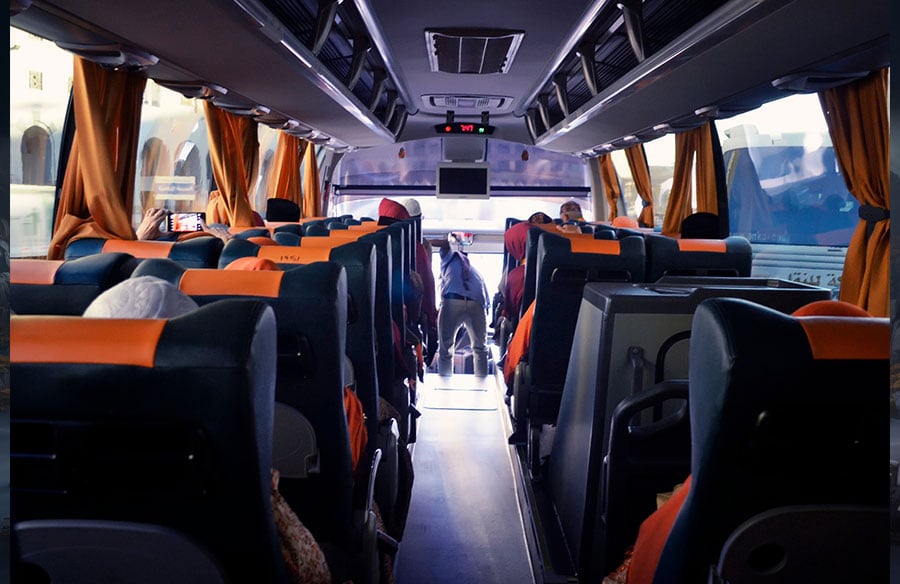
Most booking advice focuses on the paperwork: quotes, deposits, and contracts. Those matter, but experienced trip leaders know that a great ride also depends on something simpler, which is how the group uses the space inside the coach. Where people sit, where bags go, and how everyone interacts with the driver shape the mood of the whole trip.
This guide offers practical tips for booking a 40-passenger coach, then walks through the vehicle zone by zone, from the front rows to the luggage compartment, so your group gets the most from every seat.
What Should You Confirm When Booking?
Before thinking about seating, lock in the basics. Confirm the exact seat count, since 40-passenger coaches vary slightly by model and some layouts lose a row or two to a restroom. Ask whether the vehicle has a restroom, Wi-Fi, charging outlets, and reclining seats, and get those details in writing.
Luggage is the next question. Many mid-size coaches rely on overhead bins and a modest rear or side compartment rather than the deep underfloor bays of a full-size bus. Tell the provider exactly what your group is bringing so they can confirm the space. If anyone uses a wheelchair, request a lift-equipped vehicle at this stage.
Finally, ask for the operator’s USDOT number and proof of insurance. Federal rules require for-hire carriers running vehicles designed for 16 or more people to hold at least $5 million in liability coverage, and a reputable company will share both without hesitation.
Who Should Sit at the Front?
The front rows are the steadiest part of the coach and the easiest to reach, which makes them ideal for a few specific passengers.
Seat anyone prone to motion sickness here, where the ride feels smoothest and the view ahead helps. Older travelers or anyone with limited mobility will also appreciate the short walk from the door. The trip leader should sit near the front too, close enough to speak with the driver at stops without shouting down the aisle. If a guide is traveling with you, the front seat nearest the microphone is the natural spot.
One rule applies to everyone. Federal rules require passengers to stay behind the marked standee line near the front of the bus while it is moving, so the area beside the driver must stay clear.
How Should You Use the Middle Rows?
The middle of the coach is the social heart of the trip. For school and youth groups, this is where chaperones do the most good. Spreading adults through the middle rows keeps noise down, speeds up headcounts, and puts help within reach of every passenger.
For corporate groups, the middle rows suit colleagues who want to talk or work together. If the coach has charging outlets and Wi-Fi, this is a natural place for anyone who plans to use a laptop. Assigning rows by team, class, or department also makes headcounts faster at every stop.
How Should You Handle Bags and Storage?
Storage is where planning pays off most on a mid-size coach. Ask passengers to bring one larger bag and one small personal item. Larger bags go in the luggage compartment, loaded in the order they will come off. Overhead bins take jackets, backpacks, and snacks.
The aisle should always stay clear. Federal bus safety rules require baggage to be stowed so that every passenger has unobstructed access to the exits and so that nothing can fall and injure anyone. Groups traveling with lots of gear should share a detailed luggage list at the booking stage, and if the provider suggests a larger coach, it is usually worth listening. Reviewing the vehicle details for renting a 40 passenger coach for a group before booking also helps you picture how much storage the bus offers and plan packing rules around it.
What Works Best at the Back?
The rear rows are often the quietest seats, which makes them good for people who want to rest. On longer trips, some groups reserve the back for anyone planning to sleep. Ask passengers there to keep volume low, since sound carries forward easily in a smaller cabin.
If the coach has a restroom, it is usually at the rear. Seat passengers who may need it frequently nearby, and remind everyone that it is best used for short stops, with planned breaks every two to three hours on longer routes.
On a 40-seat coach, the back row can also hold overflow items such as sports bags or coolers if the storage compartment is full, as long as they are secured and the aisle stays clear.
How Should Everyone Treat the Driver’s Area?
The driver is responsible for everyone’s safety, so their space deserves respect. Route questions and changes through the trip leader, ideally at stops rather than while the bus is moving. Keep the front steps clear, and let the driver open and close the doors. Share the full itinerary with the driver at the start of the day, including any venue drop-off instructions.
A friendly greeting at the start and a thank you at the end go a long way. If gratuity is not included in your contract, have it ready at the final stop.
What Should Happen at Each Stop?
Stops are where groups lose the most time, so give each one a clear rhythm. Announce the return time twice as people step off, and keep most breaks to about 15 minutes. When everyone is back, row captains or chaperones count their section before the doors close. At the final stop, ask each row to check seats and overhead bins for phones, jackets, and water bottles before leaving the coach.
How Do the Zones Compare?
| Coach Zone | Best Suited For | Why It Works |
| Front rows | Trip leader, motion-sensitive and older passengers | Smoothest ride and easy access to the door |
| Middle rows | Chaperones, colleagues, laptop users | Central position and easy conversation |
| Rear rows | Passengers who want to rest | Quieter seats, often near the restroom |
| Overhead bins | Jackets, backpacks, snacks | Keeps small items close and the aisle clear |
| Luggage compartment | Suitcases and larger gear | Frees cabin space for people |
Frequently Asked Questions
How many people can a 40-passenger coach really carry?
Up to about 40, depending on the model and layout. For comfort and flexibility, aim to fill 34 to 38 seats and keep a few spare for late additions and small bags.
Do 40-passenger coaches have restrooms?
Some do, but restrooms are less common than on full-size coaches. Confirm with the provider if your trip is longer than two or three hours.
How far ahead should we book?
One to two weeks may be enough for ordinary dates. Book several weeks ahead for weekends, holidays, and peak event seasons.
One Last Tip
A 40-passenger coach works best when the group uses its space with purpose, from the front seats to the luggage compartment.
Before your next trip, share your headcount, route, and luggage list to request a free quote, then sketch a simple seating plan so everyone boards knowing exactly where to go.