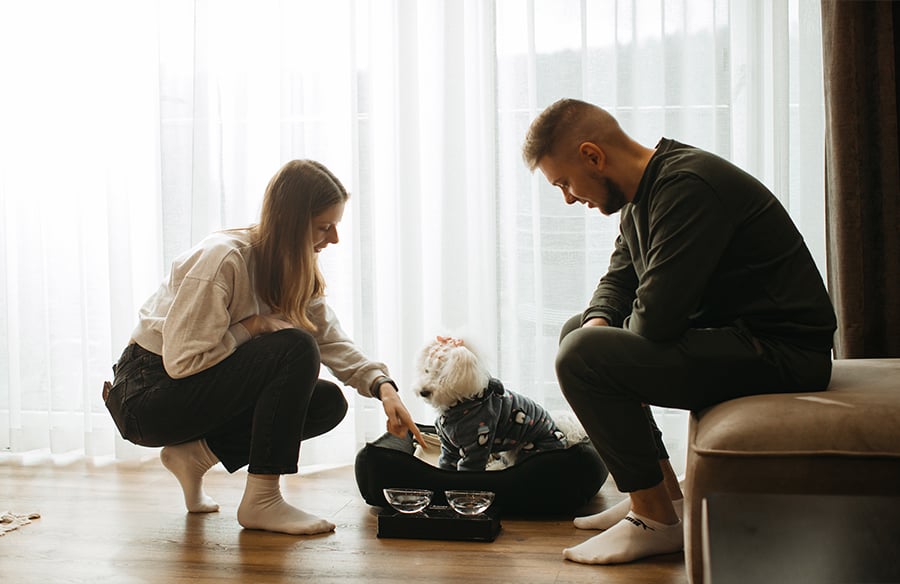
Pets are usually considered members of the family, and it can be emotionally complicated and difficult when deciding where any pets that a divorcing couple had shared will go. Contributing to this is that even though there is normally a close emotional connection with pets, legally, they are normally defined as personal property. That means that they are legally treated similarly to couches, televisions and jewelry.
In any case, a potential complication to keep in mind is that it is possible for one or more pets to go to one divorcing party and the rest to go to the other.
Mutual Agreement Is Preferred
The best option and one that judges prefer is to have the divorcing partners agree about where pets will go. Family mediation can often help with this decision process.
Considerations When Mutually Deciding What Happens to Pets
There are a number of considerations that the two who are divorcing should make when deciding what should happen with their pets.
Generally, co-ownership is not recommended as repeatedly moving cats, dogs and other pets between homes can cause a tremendous amount of confusion, anxiety and behavioral problems. Also, if this route is taken, how will you decide who pays for veterinary bills, and what happens if one moves far from the other?
But if this is the decision that is judged to be for the best, it can be done. Just be clear about who handles what financially, when pets will be at which house and what should happen if one person moves a long distance away from the other.
If you jointly feel that having the pet live with just one of you following the divorce is preferred, consider a few factors.
Emotional attachment should play a pivotal role in your decision-making process. For example, if one of you had the animal before you two met, perhaps that is who it should stay with. However, if you two got, for example, a cat after your marriage started and are equally attached to it, that makes the situation more complicated.
Also, if you have a dog that should receive daily walks, consider which of you would be more likely to be able to and want to take it out on those. In a more general sense, who is more willing to attend to the pet’s needs?
If you have children, of course, what is best for those children should be at the forefront of your minds as well.
Remember that even if you need to have a court decide where pets go and other elements of this process, the divorcing parties can still mutually agree on certain aspects of the proceedings beyond that point, such as in relation to visitation and time-sharing arrangements.
Legal Considerations
When divorcing spouses cannot mutually decide where pets should go and what should otherwise happen with them, that is when a court may get involved to make that determination for you.
If one person brought pets into the marriage, it is likely that that is who the court will award post-divorce ownership to. However, local laws and other circumstances play roles in that determination as well, so pre-marriage ownership does not make it a clear-cut decision. For example, if one person had a dog when the two parties met, but the second was the one who mostly took care of it throughout their marriage, the ruling could be to award the pet to the second party, again depending on local laws and other circumstances.
In any case, keep in mind that you may need documentation to prove that the pets belonged to one party before the marriage started. That can include adoption, purchase, veterinary or licensing records.
Another factor that courts will sometimes consider is children. If it is clear that one or more animals staying with the children is in the latter’s best interests, the ruling is much more likely going to be in the favor of the person who receives custody of those children.
What is in the best interests of the pet itself is also increasingly being taken into account although this being possible depends on the applicable local laws.
Note that the awarding of visitation rights for those who are not given ownership of the pets is rare, but it does happen on occasion.
Prenuptial Agreements
Couples can engage in prenuptial agreements that detail who gets the pets and under what circumstances should the two divorce or otherwise legally separate. As long as there has been no fraud, hiding of assets or other issues legally complicating the situation, courts will often adhere to the agreement spelled out in that prenup.
Financial Balancing
Since pets are viewed as personal property in the eyes of the law, that means that they can also be utilized as part of the financial balancing process that the courts take into account when deciding who gets what. So, pets going to one person may be counterbalanced by personal property like paintings or a car being awarded to the other.
Also, if an animal is especially valuable from a monetary perspective, such as can be the case for a show or breeding animal, that can play a role in this financial balancing.
Third Party Actually Owns the Animal
Another consideration is that in some cases, a third party actually owns the animal and may look to ensure that neither of the divorcing parties receives it in any sort of settlement and that it instead goes to that other person. This can cause significant complications.
Conclusion
Determining what happens to pets following a divorce can be an emotionally intense process despite them being viewed legally as personal property, but there are ways to make sense of this process. One option that may help is consulting the services of an experienced divorce lawyer like the attorneys at Davis & Associates, particularly if applicable laws are not clear or there is no agreement about where the pets should go. In any case, mediation can assist with this process as well.