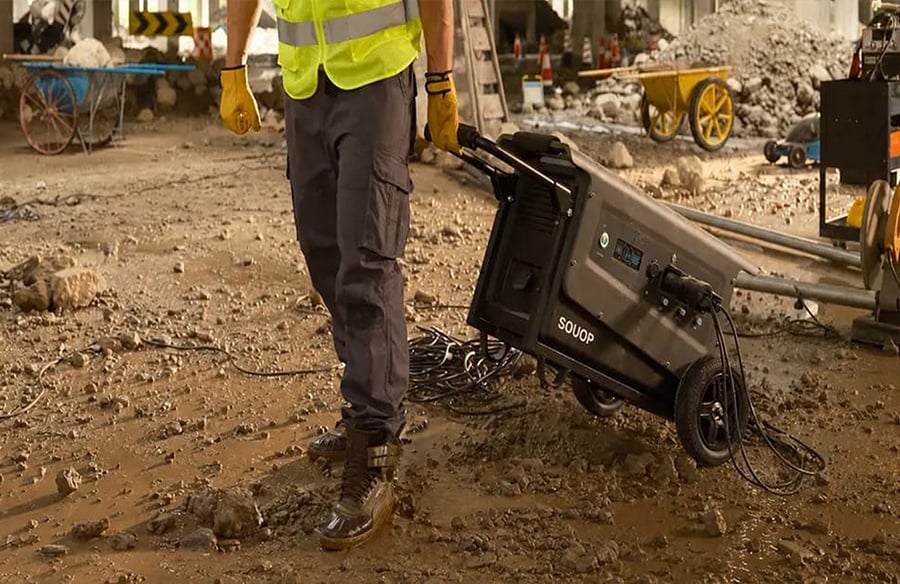
For many remote workers including contractors, surveyors, farmers, and outdoor crews, a dependable power source is an absolute necessity. Consider the potential challenges of putting up a fence in the middle of a rural area, repairing a cell tower on a remote mountain peak, or installing solar panels on a remote and isolated property. In each scenario, the worker’s cordless tools will quickly prove to be as useful as one’s ability to complete the job. When far, far away from an electrical outlet, the question of how your cordless equipment will be powered may well be more important than the job at hand.
Why Grid-Free Power Is Now a Practical Choice
For decades, gas-powered generators have been relied upon for providing electricity in remote settings. However, for all their benefit, generators are loud, polluting, require fuel transportation, and maintenance. They also demand proper installation in order to provide safe operation, and cannot always be used in environmentally sensitive or noise-sensitive areas. Fuel has to be brought to the worksite, and any hiccup in the fuel supply or a clogged carburetor can bring work to a standstill.
Using batteries to power worksites is a viable substitute that allows jobs to run more efficiently while being a much cleaner and safer option. With the development of lithium iron phosphate technology, efficient inverters, and affordable solar panels, battery-powered jobs are a reality. Jobs that require large-scale equipment can be powered without emitting harmful byproducts or unwanted noise that can impede on the surrounding environment. Electricity is available the moment the battery is turned on and there is no need to pull a cord or bring fuel to the job site, and no waiting for the machine to warm up. Jobs that require large-scale equipment can benefit tremendously from using a battery as their primary power source.
Start With the Equipment You Actually Use
Before buying any equipment, you should draw a list of all the tools that you are planning to use. For each tool, you need to know its wattage and how many hours per day you are going to use it. A drill’s charger can have a wattage below 100W, but a circular saw, an angle grinder, or an air compressor can require a power source of 1500W or more. It is crucial to remember that the motor will require a current two or three times higher than the marked wattage for a short time during starting.
Once you know your numbers, a power station becomes much easier to choose. Brands such SOUOP Power offer portable units sized for everything from light battery charging to heavy-duty tool use. Operated by Shenzhen Kerui Power Storage Co., Ltd., SOUOP focuses on portable power stations, home backup power products, solar generators, and related power solutions. Matching a unit to your real workload, rather than guessing, prevents both overspending and mid-job shutdowns.
Calculate Capacity and Output Separately
When choosing power stations, there are two primary parameters to focus on: capacity and output. The former is measured in watt-hours (Wh) and denotes how much energy the station can store. The latter is measured in watts (W) and represents the amount of power the station can supply. Basically, a power station with high capacity but low output cannot supply a power tool with a surge of energy, spiking its needs. Instead, it will keep a light bulb lit for a sufficiently long time.
To size your power station, you should know how many watts each device you intend to use with it consumes and for how many hours per day you will use it. For each device, multiply its wattage by the number of hours you will use it, add up all the results, and add a thirty percent “safety margin” to get the final value. With the information at hand, you can now pick a power station with a slightly higher rating than your calculated value. Take the example below:
If your device consumes 1,200 W and you use it for two hours, then your capacity will be 2,400 W. Adding a thirty percent safety margin brings the result to 3,120. Under these circumstances, a 3,000 W battery should suffice, but make sure that the continuous and surge power ratings of the power station are higher than the wattage of your largest power tool.
Build for Real Site Conditions
Job sites are harsh places for electronics. Between the dust, vibrations, rain, muck, and fluctuating temperatures, delicate electronics made for controlled environments are not often suited for the outdoors. This is why durability ratings are so important. An Industrial Waterproof Power Station has reinforced connections and casings which allow it to better withstand the elements and random spills that could damage a consumer grade device. When the skies open up while on the roof, you want your power station to outlast the storm, rather than be caught in one.
Make sure to note the ingress protection rating, operating temperature range, and overall sturdiness of the handles and body of the unit. Cold batteries have less power, and very hot temperatures can cause electronics to automatically power down. The station you choose should have a temperature range that falls within the normal range of your work site. Positioning on a work site matters as well, placing the unit on a pallet, or on an elevated surface beneath a shelter can help it last much longer.
Recharge Smartly With Solar
A battery only has value if you can then recharge it. Modern generators can be recharged in a number of different ways, it can be plugged in at home, charged through the journey in the 12V sockets of the car or even harnessed using solar panels on the spot. Solar energy is the thing which makes it possible to work off the grid for a number of days. A pair of collapsible 200 watt panels can generate between 600 to 1,000 WH depending on the time of year and angle of the sun.
To make sure you get the maximum efficiency out of your solar panels, make sure that they are positioned correctly in relation to the sun, don’t gather dust or are shielded by other structures. Many teams charge batteries while they are working and let the panels do their work during breaks, finishing charging in the evening.
Use Power Efficiently
- Even the best system benefits from good habits. With a few tweaks, you can dramatically extend the runtime:
- Charging multiple packs simultaneously can take advantage of the sun’s maximum power.
- Select efficient tools. Brushless motors consume less energy for equivalent work.
- Several inverters have a standby power demand.
- Use the DC ports when able. D.C. charging will have lower losses since the power won’t have to go through the inverter.
- Use short, thick extension cords. A long, thin cord wastes energy to heat.
- Spread the effort of heavy loads. Don’t operate two large motors simultaneously.
Prioritize Safety and Maintenance
Although the battery power is more eco-friendly than fuel, it still needs care. Make sure that the station is placed on dry ground in cases of humid weather and never connect broken wires or plugs. Also, check the rating of the extension cords and grounds to make sure they suit the electrical tools you are going to use. The device must be kept away from all direct heat sources and flammable materials and should not be left in a hot car for a long time. Performing some simple maintenance tasks will ensure that the device is in perfect working order. Clean vents and ports, as well as checking wires before the first use to make sure that everything is fine.
Plan for Redundancy
A clever team always has a backup. When everything is essential, it should carry the extra power pack, portable charger, and a small power bank to ensure that the critical devices such as phones, radios, and lights have some backup power. Some crews combine their primary power device with a light one so that one malfunction does not stop everything. Knowing the power capacities of different devices and having a load plan written make troubleshooting easy.
Final Thoughts
Using the power tools without the use of grid power is no longer a compromise because if you have enough power and a good enough design, then you can get a battery which can do the job of a lot of generators without having to have the noise and emissions that they produce. Just make sure you calculate your load, choose your equipment based on site needs, and establish a charging plan before you drive your work truck out of your garage.