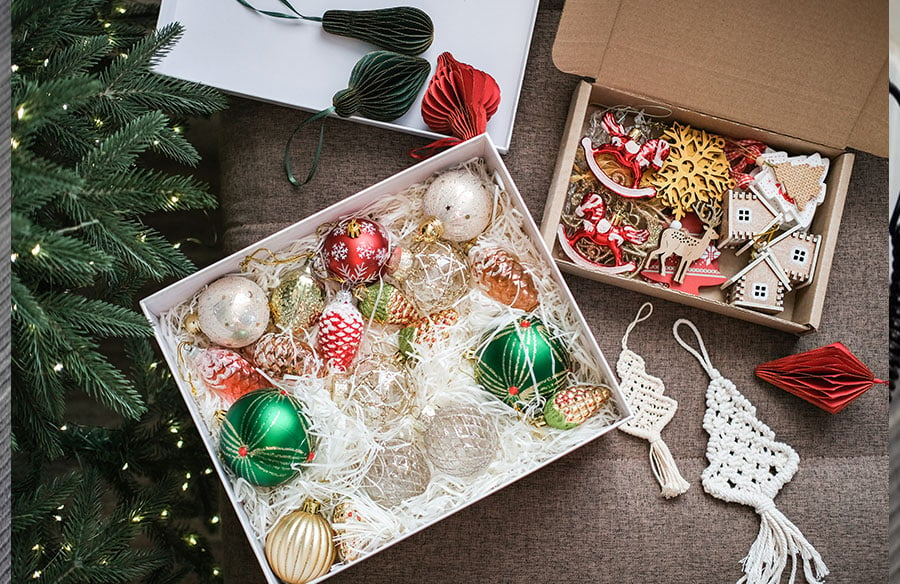
Taking care of retro holiday heirlooms means you need to keep them from changing because of chemicals. To do this, store these items in the right spot. Use boxes or covers that do not have chemicals in them. Many people make things worse by putting their stuff in the basement where the temperature is not steady. Some also use tissue paper that has chemicals in it.
Original Angle: The conventional wisdom on vintage decorations sees them all as glass beads. But the real danger to 1950s collectibles is cross-contamination via off-gassing of the early plastics (cellulose acetate) and their destruction of adjacent mercury glass and spun cotton pieces.
Identifying Christmas Ornaments
To see if mid-century holiday decor is real, you have to feel and touch it, not just look at it. Old glass baubles from Germany, Poland, and post-war Japan have some signs. You can spot clear pontil scars on them. The glass is thin and made with soda-lime. They also have stamped caps, and these are made of metal—all key markers when authenticating vintage christmas ornaments.
[Visual Assessment] ──> [Weight & Cap Stamp Check] ──> [Material Segregation]
The Canadian Conservation Institute (CCI) says that when you touch old things with your bare hands, skin oils and salt can hurt them. This can make marks on the silver or painted parts that will not go away.
| Material Type | Production Era | Key Identification Traits | Primary Degradation Risk |
| Mercury Glass / Radko | 1840s–Present | Silver nitrate interior coating, metal crown caps | Moisture oxidation, flaking paint |
| Spun Cotton | 1880s–1950s | Wire armature wrapped in raw cotton, starch glaze | Moisture absorption, pest attraction |
| Cellulose Acetate Plastic | 1940s–1960s | Lightweight, semi-rigid, molded seam lines | Off-gassing (“vinegar syndrome”), warping |
| Dresden Paper | 1870s–1920s | Embossed gilded cardboard, intricate relief | Acidification, fiber embrittlement |
Care for Delicate Holiday Decorations
While cleaning the old Christmas decorations, one has to be extremely careful while doing so. Never apply anything that is in liquid form, whether it be liquid detergent, glass cleaner, or even water, because the liquid inside the product will penetrate through the minuscule cracks in the surface, causing the underlying layer of silver to flake off.
- Wear safety equipment: Non-powdered nitrile gloves will protect the silver plate from coming into contact with your oils.
- Dust removal using soft brushes: You can remove the dust from the carved glass and spun cotton with the help of dry brushes made of horse or goat hair.
- Caps should be cleaned separately: Remove the loose accumulation on the caps with the help of a dry microfiber cloth before replacing them.
If you like to collect and set up big displays for the holidays, you may want to check out special items like Christopher Radko Christmas Collections. You will see how the mouth-blown glass methods they use now come from old European ways.
Storage for Antique Christmas Decorations
Storing vintage Christmas ornaments needs conditions that determine the length of life. Uncontrolled attic and basement spaces should be avoided, since temperature fluctuations can lead to glass fractures due to expansion, and high moisture content causes mold growth on organic materials.
Archival Storage Setup
[Rigid Acid-Free Box]
├── [Unbuffered Tissue Lining]
├── [Individual Cell Dividers]
└── [Relative Humidity: 45–50% | Temp: 65–70°F]
According to the Museum Handbook, published by the United States National Park Service (NPS), mixed media collections should be stored in non-acidic and lignin-free containers.
| Material | Safe Storage Medium | Relative Humidity Target |
| Glass & Painted Baubles | Unbuffered acid-free tissue, rigid divided box | 45%–50% |
| Cellulose Acetate / Early Plastics | Ventilated acid-free box (isolated) | 40%–50% |
| Textiles & Spun Cotton | Washed unbleached muslin or unbuffered tissue | 45%–55% |
Safe Display and Lighting Methods
Showing old glass and paper needs steps to keep them safe from harm. You have to keep these things away from stuff that can break them. Prevent exposure to bright light as well. Exposure to direct sunlight or any lights that produce a lot of heat results in the loss of their original colors and may affect the adhesives.
- Use UV-resistant LED lights: Use high-quality LED lights with a warmth around 2700K. These lights produce no heat or UV radiation.
- Secure display trees properly: Place display trees on robust cast-iron supports. Add padding made of foam at the bottom of the display trees. This will ensure that items that fall will be caught by the padding.
- Use glass domes: Protect paper and spun cotton heirlooms from dirt using glass domes. You will not need any special equipment for cleaning them.
FAQ
Could you clean your old glass ornament with water?
No. The water penetrates the fine cracks in the paint and cap openings, destroying the silver nitrate coating inside – use only dry and soft-bristled dusting.
Why should the early plastic ornaments be kept separate?
The early plastics, such as cellulose acetate, release acidic vapors (known as “vinegar syndrome”), which will damage the metal pieces, flake the paint, and cloud the glass kept with them.
What is the distinction between buffered and unbuffered tissue paper?
Buffered tissue paper is made up of calcium carbonate, which will neutralize acid, while the unbuffered tissue does not contain any additives.
How do I fix the cap on the glass ball?
The legs of the cap need to be pushed inwards gently before inserting, or an unbuffered tissue paper circle needs to be wrapped around the legs.