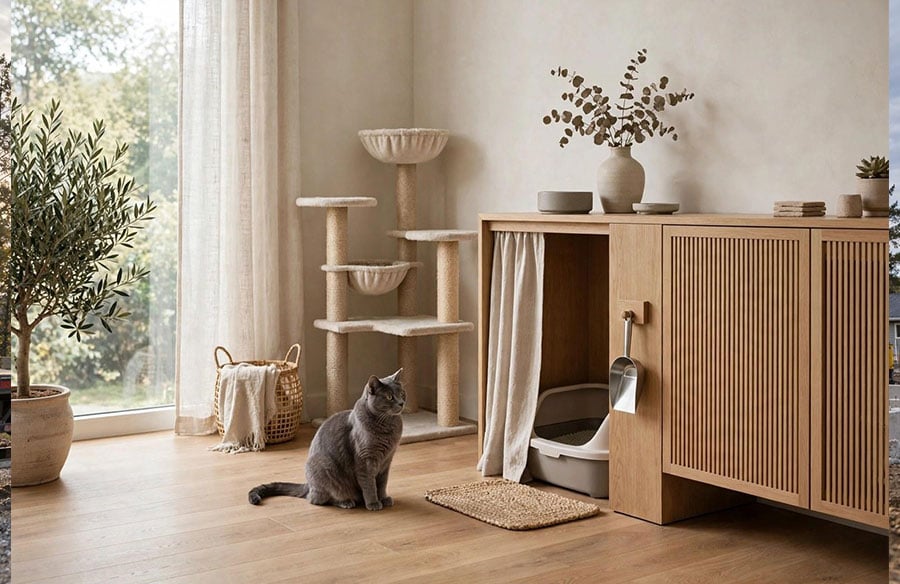
Every cat owner knows the compromise. You curate the living room, the sofa, the light, the rug. And then there’s the litter box, shoved behind a door like an apology. It doesn’t have to be that way. A cat-friendly home gives the cat’s needs the same care as everything else.
Think of the litter zone as a room within a room. It’s got users, a function, traffic patterns, maintenance needs. Treat it like any designed space, placement, air, surfaces, and it stops being an eyesore. It just becomes another well-resolved corner.
1. Space: give the litter zone a real footprint
Start with placement. Honestly, placement fixes half the problems people blame on the box. Cats want what we all want from a bathroom: a little privacy, a clear way in, and, critically, a clear way out. Shove the box into a dead-end corner behind the washing machine and you’ve built a trap, not a toilet. In multi-cat homes especially, a box with one approach becomes territory. One cat guards it, the other avoids it.
Think about how bodies move through the space. A laundry room works. So does a ventilated hallway nook, or part of a mudroom. Anywhere with two directions of approach and floor space for a mat and a scoop. Measure the real footprint, not just the box: the unit, plus landing space, plus room for you to service it without doing yoga. A zone too tight to clean won’t get cleaned. That’s where the design fails.
2. Airflow: design for the nose, not just the eyes
Here’s the thing most interiors get wrong. A litter zone is an olfactory space first. No amount of styling compensates for air that doesn’t move. Shut the door and odor concentrates, no matter how beautiful the tile. Give the zone passive ventilation where you can. A cracked window, a vent, a cat flap. At minimum, don’t seal the thing inside airtight cabinetry.
Materials matter as much as airflow. Smooth, non-porous surfaces do the heavy lifting here. Sealed floors, wipeable walls, a washable mat, and scatter or spills become a thirty-second wipe. Skip the heavy fragrances though. Cats smell far more intensely than we do, and a perfumed corner can put a cat off the box completely. Design the smell out with air and surfaces. Not cover-ups.
3. The box itself: choose a silhouette that belongs
This is where the object itself matters. A litter box is furniture, like it or not. It sits in your visual space every single day. The newer automatic boxes finally seem to get that, with cleaner lines than the plastic tubs of the past.
If the box sits somewhere visible or semi-visible, an open-top format earns its place on looks alone. No bulky hood dominating the corner. Sightlines stay open. The whole thing reads as a low, simple object instead of an appliance. A PetPivot automatic litter box follows exactly that logic, an open-top automatic design that separates clumped waste on its own and stores it in a sealed drawer. No app, no Wi-Fi, no subscription to manage. The automatic cycle keeps the litter bed presentable between your own maintenance passes, and that’s half the visual battle right there. A box that looks clean gets treated like part of the room. Not an embarrassment hidden behind a screen.
4. Open or enclosed: let the cat and the floor plan decide
The open vs. enclosed debate is one of the oldest in litter-box design, and it’s worth settling with evidence instead of habit. A small controlled study of 28 cats found no significant group preference between covered and uncovered boxes. 20 showed no preference at all, while 4 preferred covered and 4 preferred uncovered (Grigg et al., 2013). Small sample, sure. But it lines up with what feline behaviorists keep saying: there’s no universally correct box. There’s only the one your particular cat will actually use. So the takeaway isn’t that style doesn’t matter. It’s that individual fit beats any universal rule.
What this means in practice is simple: stop shopping by category, start shopping by measurement. Bring a tape measure to the decision, like you would for a sofa. Check the entrance height, the turning radius inside, how the cat’s tail clears the back wall. Compare the usable interior, not the exterior shell. Motors and walls eat into automatic models more than you’d think. Then watch your cat use the current box. Does it walk all the way in? Turn around comfortably? Hesitate at the entrance? In a multi-pet home, think about exit security too. One enclosed opening becomes a choke point fast if another animal decides to guard it. And before you commit, reading up on open and enclosed litter box designs helps frame the trade-offs honestly. Open tops give you visibility and airflow. Enclosed shells contain scatter. Neither one excuses a cramped interior or a bad location.
Final Thoughts
A cat-friendly home never asks you to pick between your cat and your interiors. Design the litter zone like you’d design anything else, space, air, materials, daily rituals, and the most functional corner becomes the most invisible one. Honestly, that’s the highest compliment a design can earn.