Step outside a well-designed home or hotel, and the architecture doesn’t stop. Terraces and pool courts carry the interior out into open air, exposed to sun and rain year-round with nothing overhead to buffer it.
The materials you choose help determine how long that space holds up over time. They shape your repair budget too, and how the design still looks a decade from now.
The stakes rise during pool renovation and restoration. It’s a chance to plan ahead, whether you’re fixing what’s there or reworking the space for the years ahead.
The Foundations of Outdoor Longevity
Outdoor materials live in a demanding microclimate, where repeated exposure gradually drives wear.
- UV radiation is one factor. Sunlight can degrade some polymers, coatings, sealants, and pigments over time. The rate depends on the material, formulation, color, and level of exposure.
- Moisture adds another source of stress. Water seeps into porous surfaces, and in colder regions it can freeze and expand. Repeated freeze-thaw exposure can contribute to cracking, scaling, and other deterioration when materials are not suited to the climate.
- Chemical exposure becomes another consideration around pools. Chlorinated or saltwater splash-out can repeatedly wet nearby paving, and some porous or chemically sensitive stones and metals may discolor or deteriorate without appropriate material selection, detailing, and maintenance.
The first cost can mislead you. A lower-cost material can become more expensive over its service life if it needs frequent sealing, repairs, or early replacement. A higher-performing option may cost more upfront but require less intervention over time.
Lifecycle cost often gives a more useful comparison than the sticker price alone. It accounts for purchase, installation, maintenance, and eventual replacement over the material’s service life.
A Comparative Guide to Outdoor Materials
Each material family responds to sun and water in its own way. Here is how the common choices hold up.
Natural Stone and Engineered Concrete Pavers
Stone and concrete pavers are common choices for pool surrounds and terraces because they can handle regular foot traffic and outdoor exposure when the specific product is appropriate for the site and installed correctly.
Natural stone
Quarried rather than manufactured, natural stone carries a texture and color variation that can be difficult to replicate with manufactured materials.
- Pros: Brings a depth and variation manufactured products rarely match. Dense stones such as many granites and quartzites can offer strong wear resistance and durability e when appropriately specified.
- Cons: Performance varies significantly by stone type. Some stones are relatively porous or sensitive to salts, chemicals, staining, or freeze-thaw exposure and may require periodic sealing or other maintenance.
Engineered concrete pavers
These pavers are built to consistent specifications, so size, shape, color, and published performance characteristics can be easier to compare across a product line. They can also provide a cost-effective alternative to some natural stones.
- Pros: Consistent sizing and a broad range of load ratings, finishes, and installation patterns. Individual units can often be replaced if one becomes damaged, and properly designed segmental paving systems can accommodate limited movement without the same continuous cracking pattern seen in a monolithic slab.
- Cons: They don’t have the natural depth and variation you get from quarried stone, and color, surface texture, and long-term appearance vary by manufacturer and product.
Stone suits projects where natural variation and premium material character are priorities; pavers suit high-traffic walkways and transitions between house and garden where repeatability, modular replacement, and design flexibility matter.
Wood and Composite Decking
Decking feels warm and visually softer than many forms of hard paving. Wood and composite ask very different things of you over time, though.
Natural Wood (Ipe, Cedar)
Real timber gives a deck a natural grain and warmth that ages with the property.
- Pros: Hard to replicate that look with anything else. Ipe is extremely dense and naturally resists decay and insect attack. Cedar is less dense but is also valued for its natural decay resistance and relatively low weight.
- Cons: Maintenance requirements depend on the species, finish, climate, and desired appearance. Exterior wood will naturally weather, and coatings or penetrating finishes generally require periodic renewal if you want to preserve a particular color or surface appearance. Improper detailing, trapped moisture, and neglected maintenance can contribute to checking, splitting, decay, or dimensional movement.
High-end composites
Blended from wood fiber and polymer, many composite decking products are designed to reduce the maintenance demands associated with natural timber.
- Pros: High-quality composites are engineered to resist moisture, splitting, insect damage, and significant fading with less routine maintenance than natural timber. Many current products also carry long-term warranties against specific forms of structural deterioration, staining, or fading.
- Cons: Composite decking still requires periodic cleaning, and heat buildup, scratching, expansion, appearance, recyclability, and warranty terms vary by product. End-of-life options also depend on the manufacturer and local recycling infrastructure.
Hardwood or other durable natural wood species can suit projects where the appearance of real timber justifies the added upkeep. High-quality composites can make sense for larger decks, boardwalks, hospitality spaces, and other applications where reducing routine refinishing is a priority.
Structural Metals and Performance Coatings
Pergolas, railings, and pool fencing lean on metal framing, and the metal you pick along with its finish and detailing determines how well it survives near water.
Aluminum
Corrosion-resistant aluminum alloys are widely used for railings, pergolas, fencing, and other architectural elements because they combine relatively low weight with good outdoor corrosion resistance.
- Pros: Aluminum forms its own protective oxide layer, does not rust like carbon steel, and stays light for pool-adjacent structures. Appropriate alloys and finishes can perform well in humid, coastal, and pool environments.
- Cons: Aluminum has different structural properties from steel, so member size, alloy, connections, and engineering become important where long spans or high structural loads are involved. Not every aluminum alloy or finish offers the same corrosion resistance.
Galvanized steel
Steel with a zinc coating, this option combines steel’s structural strength with sacrificial corrosion protection from the zinc layer.
- Pros: Carries more load across longer spans with relatively compact structural sections when properly engineered.
- Cons: Its zinc coating shields the steel, but chloride-rich and persistently wet environments can accelerate corrosion. Cut edges, welds, damaged coatings, drainage details, and ongoing maintenance all influence service life.
Protective finishes can extend service life further. Powder coating can provide an additional barrier on properly prepared aluminum or galvanized steel, while anodizing is used on aluminum to thicken its protective oxide layer and improve corrosion and wear resistance. The appropriate system depends on the substrate, exposure, fabrication process, and maintenance expectations.
Sustainability and Innovation in Outdoor Materials
Choosing a sustainable material does not necessarily mean sacrificing performance, but environmental benefits still need to be evaluated alongside durability, sourcing, maintenance, and end-of-life options.
- Permeable paving systems let rainwater pass through openings or joints into an engineered aggregate base and, where site conditions allow, the underlying soil. Properly designed and maintained systems can reduce stormwater runoff and lessen demand on conventional drainage infrastructure.
- Recycled plastic lumber is used in applications such as decking, boardwalks, site furnishings, and other outdoor components. Its suitability for structural applications depends on the specific product and engineering requirements.
- Lower-carbon concrete mixtures can reduce the amount of portland cement by incorporating supplementary cementitious materials such as slag cement, fly ash, or other approved materials. Depending on the mixture and exposure, these materials can also improve properties such as permeability and resistance to certain forms of chemical attack. Performance should still be verified for the specific application rather than assumed from cement replacement alone.
Coatings are advancing alongside the materials themselves.
- Water-repellent and hydrophobic treatments can reduce liquid-water absorption in some porous masonry and stone surfaces. Their effectiveness, vapor permeability, compatibility, appearance, and reapplication requirements vary by product and substrate, so they should be specified for the particular material rather than treated as a universal solution.
- Photocatalytic coatings, often based on titanium dioxide, can use light-driven chemical reactions to break down certain organic contaminants on a surface. They are being studied and used for self-cleaning and pollution-reducing building applications, but performance depends on the coating formulation, available light, substrate, contaminants, and long-term weathering.
Integrating Materials and Expertise in Pool Renovation and Restoration
Material compatibility can play a major role in preventing premature deterioration in a pool project. Coping, decking, and interior finish work together as one system around the water.
Pool Surrounds and Coping
Start with slip resistance. There is no single universal “R11 or higher” requirement that applies to every residential pool deck. The appropriate test method and performance criteria depend on the material, jurisdiction, project type, slope, drainage, footwear or barefoot use, and applicable building or pool code.
For U.S. projects, hard-surface products may be evaluated under standards such as ANSI A326.3, which includes product-use classifications for wet and exterior conditions. European projects may use different systems, including barefoot classifications under EN 16165. Rather than comparing unrelated ratings, specify a surface that has been tested and recommended for the actual wet, barefoot, or exterior conditions of the project.
Surface temperature comes next. Lighter-colored materials generally tend to absorb less solar radiation than comparable darker materials, but color alone does not determine how hot a pool deck becomes. Texture, composition, thickness, thermal properties, airflow, shading, and site exposure also affect surface temperature.
Check chemical resistance. Material performance around chlorinated or saltwater pools varies considerably. Dense porcelain, concrete products, and appropriate natural stones can all perform well when the selected product, finish, installation system, and maintenance routine are suited to pool exposure. Some natural stones may need sealing, while certain sealers themselves may require periodic renewal.
Surfacing Trends
Inside the pool, finishes are moving beyond traditional white plaster. Exposed aggregate blends pebbles or quartz into the cement matrix to change the finish’s appearance, texture, and performance characteristics. Glass bead finishes go a different route, adding shimmer and a distinctive surface texture.
Premium quartz, pebble, and other aggregate finishes are often selected for greater durability than basic white plaster, but no finish is immune to staining, scaling, etching, cracking, or improper water chemistry.
Service life varies substantially with the product, installation quality, pool structure, water chemistry, startup procedure, climate, and maintenance. Some quality aggregate finishes can remain serviceable for well over a decade, but a blanket 15-year lifespan should not be treated as a guarantee.
Bringing Pool Expertise Onto the Project
Expansive clay soils, sloped lots, and coastal air. All three change how materials perform around a pool, and not always in obvious ways. When professional pool services are part of the project from the start, site conditions, pool-system requirements, drainage, access, water chemistry, and long-term maintenance can be considered alongside the architectural design.
Materials get matched to the site before anything is ordered. Installation requirements matter for warranties, too. Manufacturers may condition warranty coverage on approved applications, substrate preparation, installation methods, qualified installers, maintenance, or other product-specific requirements, so specifications should be checked before construction begins.
Long-Term Asset Value and Architectural Integrity
Every outdoor space reveals its material choices as the years pass. Well-chosen surfaces can weather gracefully, while poor material compatibility or detailing often becomes more visible with time. The objective is not to find a material that never changes, but to choose one whose aging, maintenance requirements, and expected service life support the architecture.
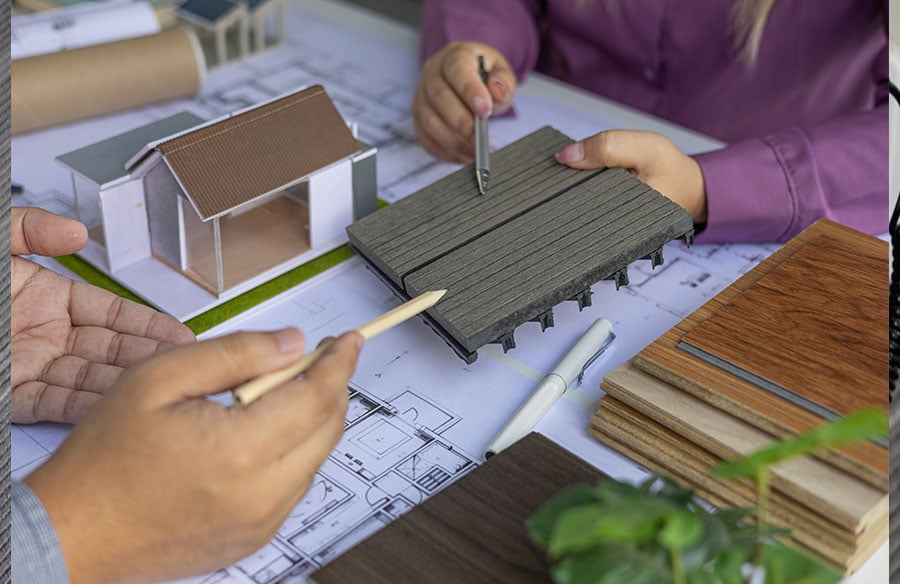
Compare options on lifecycle cost alongside the price tag, and bring specialists into the conversation during the blueprint phase, when changes cost the least. Material selection, detailing, installation, and maintenance all influence whether an outdoor space retains its architectural character for years or requires an early redesign.
Plan for those factors from the beginning, and durability becomes part of the architecture rather than an afterthought.