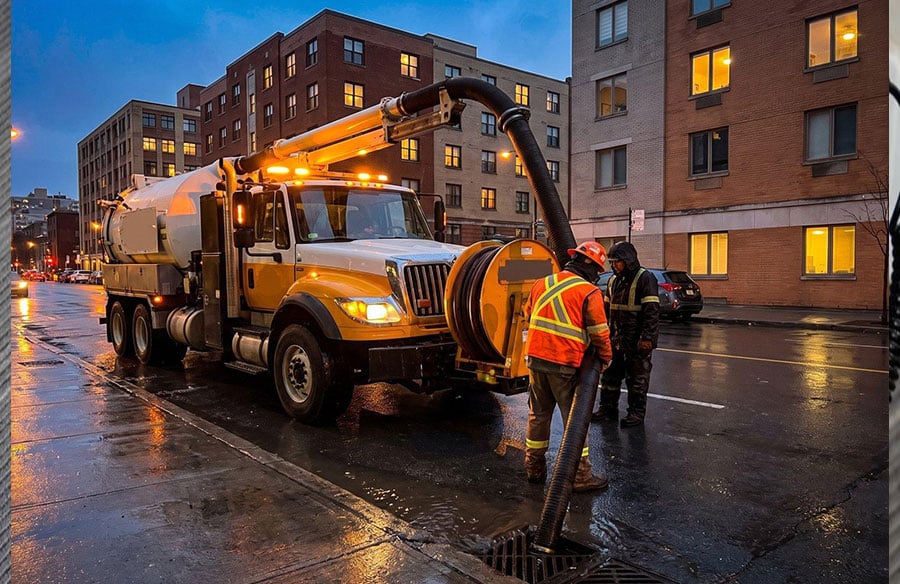
A vacuum truck clearing a storm drain on a city street at dusk with mid-rise buildings in the background
Architects draw sewers, drains and service trenches in every section, then move on to the next sheet. Rarely do they see who keeps those lines working ten years later. That gap matters, because a design is only as good as the upkeep it allows. Pipes silt up, catch basins fill with debris, and buried cables sit exactly where the next excavation is planned. This article looks at the machines and routines behind that upkeep: how cities clear drainage, how crews dig safely around live utilities, and how sanitation works on sites and in places the sewer grid never reached. It also covers what designers can decide on the drawing board to make all of it easier.
The crews that keep sewers and drains working
Picture a mid-sized city in the weeks before monsoon season. Residents have been reporting standing water at a low junction, and the project team behind a nearby mixed-use building has noticed silt in its stormwater outlet. A maintenance crew arrives before dawn. Within hours, the municipal vacuum trucks are pulling sediment, sludge and packed leaves out of the catch basins and sewer lines, so the first heavy rain has somewhere to go.
The basic principle is simple. A vacuum truck uses a powerful pump and a sealed tank to suck up liquids, slurry and solids that a person couldn’t reach safely. Combination units add a high-pressure water jet that breaks up blockages first, then the vacuum removes what the jet loosens. Neither tool is glamorous. Both decide whether a drain works on the day it’s needed.
Why aging pipes make this work harder
Most cities now rely on systems built decades ago. The American Society of Civil Engineers gave US wastewater a D+ and stormwater a D in its 2025 Infrastructure Report Card, even as the country’s overall grade rose to a C, its highest ever. The overall climb is real. The sewer and drain grades show that the underground part hasn’t caught up.
Old pipes crack, roots intrude, and grease and sediment build up faster than most budgets assume. Cleaning is cheaper than replacement, which is why regular vacuum and jet work remains the first line of defense in many cities.
Cities have always struggled with this. Public health reforms of the nineteenth century grew out of sewage problems, and the story of how urban planning and public health developed together is worth a read if you haven’t followed it before.
Digging around buried utilities without breaking them
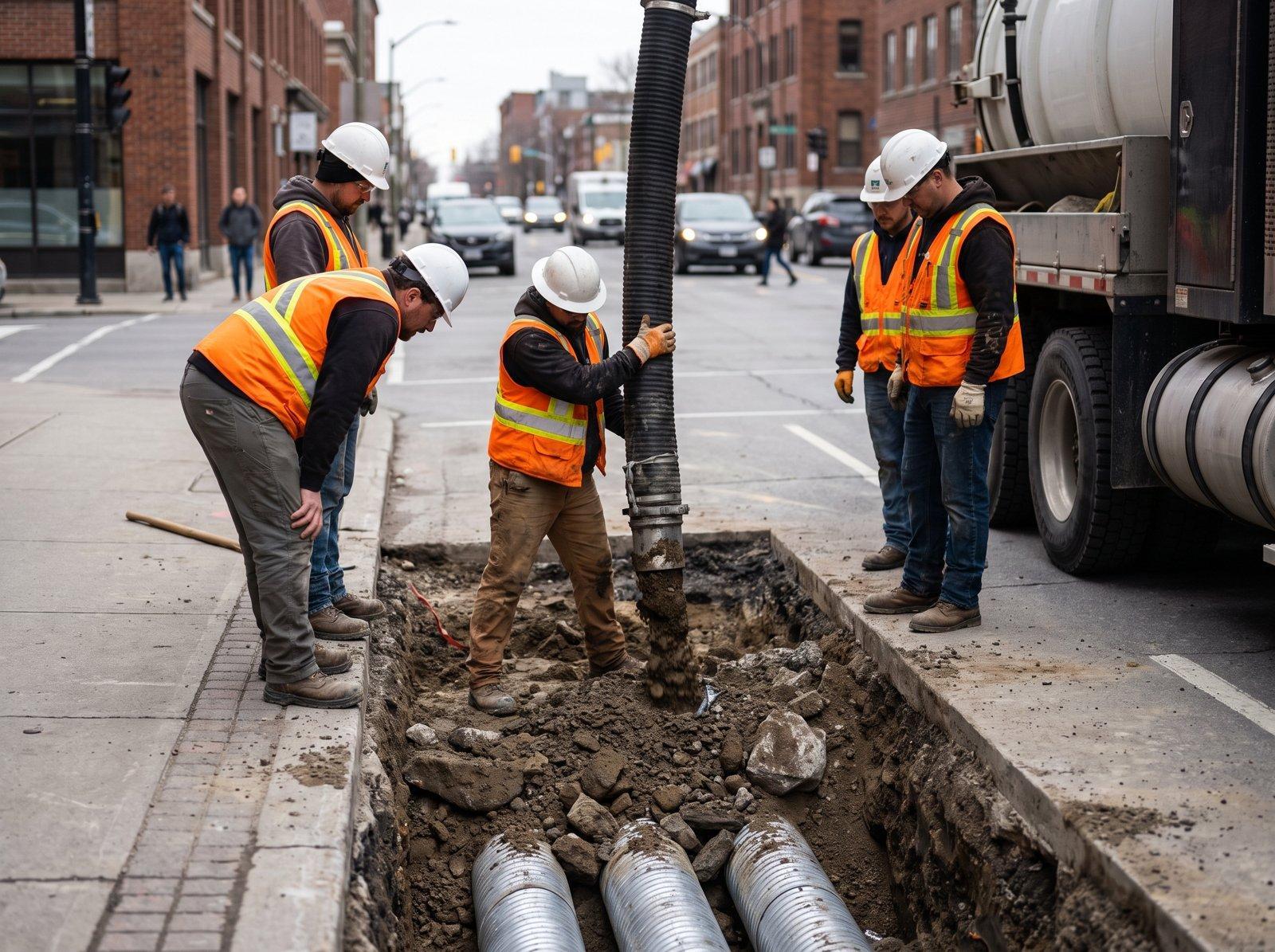 Construction crew in hi-vis vests using a vacuum excavation unit to expose pipes in an open utility trench
Every site has a layer nobody can see. Before a mechanical excavator goes in, careful crews often use vacuum excavation to expose pipes and cables, a process called potholing or daylighting. Water or air loosens the soil and the vacuum removes it, so the utility is revealed without a bucket tooth hitting it.
The data explains why this matters. The Common Ground Alliance analysed 196,977 damage reports for its 2024 DIRT Report, published in 2025. Its damage index rose from 94.0 in 2023 to 96.7 in 2024, the wrong direction. Failing to notify 811, the US call-before-you-dig line, accounted for 24.54% of damages, and water and sewer work was the most common type of work involved.
The design takeaway is blunt. Order a utility survey early, and write potholing into the specification where the drawings show congested ground. A few hours of vacuum excavation costs far less than a severed fiber line or a ruptured water main.
Sanitation beyond the sewer grid
Not every building connects to a city sewer. The US Environmental Protection Agency reports that more than one in five American households rely on septic or small cluster systems. Those tanks don’t maintain themselves. They need pumping on a schedule, and the waste has to be hauled away by truck.
The same logic applies to holding tanks, rural clinics, peri-urban housing and temporary event sites. Decentralized sanitation can be a sound choice, but only when someone plans for servicing. A tank placed behind a boundary wall, with no access for a hose or a truck, becomes a maintenance problem by year three.
Our article on wastewater management in sustainable architecture covers how treatment and reuse fit into design. Servicing is the other half of that picture, and it rarely appears on the drawings.
Cleaner, safer construction sites
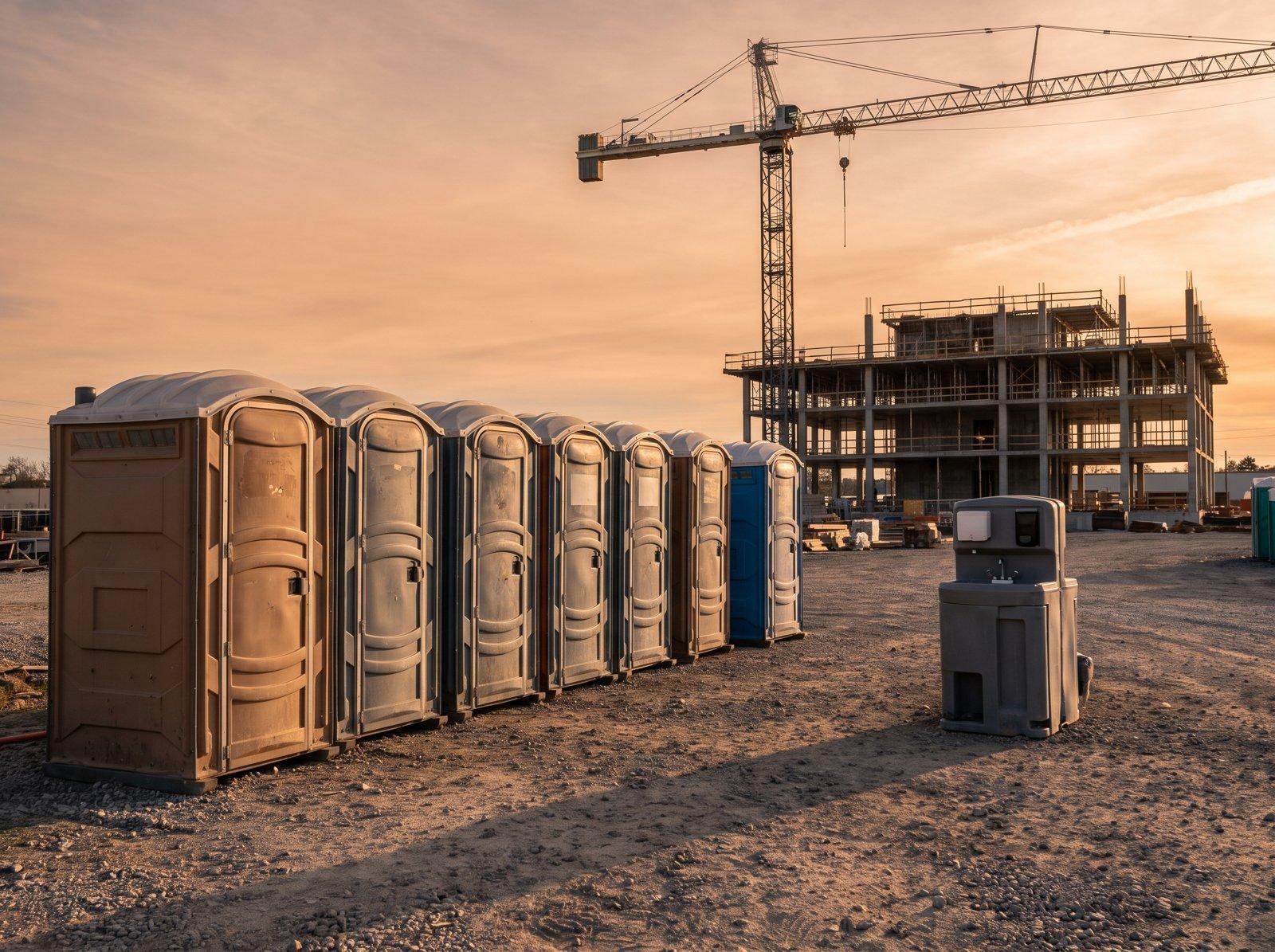 Portable restrooms and a handwashing station on a building plot with a tower crane in the background
Construction sites generate their own sanitation demand. Under OSHA’s construction sanitation standard, a site without a sanitary sewer must provide privies, chemical, recirculating or combustion toilets, with at least one toilet for 20 or fewer workers. Larger crews need more, and the units need regular emptying to stay usable. Equipment manufacturers such as Satellite Industries build both portable restrooms and the pump-out equipment used to service them, which shows how closely the two are tied.
Vacuum equipment helps with the rest of the site too. Washout water, slurry and sediment have to be removed before they reach storm drains, and crews can collect them from sumps and settling pits instead of letting them run off. That protects the same drainage systems discussed above.
For teams planning greener sites, the principles in our guide to sustainable measures at the construction level fit naturally with a properly planned servicing routine.
What designers can do
Maintenance access is a design decision. It isn’t something to leave for the contractor or the city to solve later. A few practical moves make a real difference:
- Leave truck access and turning room near manholes, wet wells and septic tanks.
- Mark buried services clearly, and specify potholing where utilities are dense or poorly mapped.
- Include temporary sanitation and servicing in the site logistics plan from the first week.
- Budget for lifecycle maintenance, not only for installation.
None of this adds much cost on the drawing board. Retrofitting access after a building is occupied costs far more, and sometimes can’t be done at all.
Planning for the day after handover
A city’s resilience shows up in unglamorous places, such as a drain that clears before the storm or a trench opened without a single cut cable. Good design brings these outcomes closer by leaving room for the machines and crews who do the work. Ask one question at the next design review: where will the truck park when this system needs servicing?