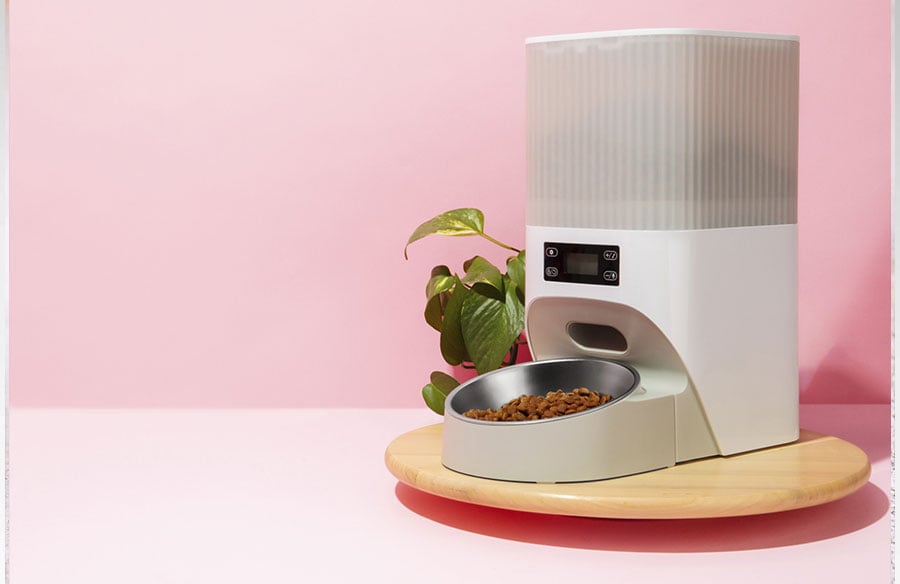
A feeding device can solve two very different problems. One helps make sure food appears at the right time. The other helps a pet parent understand what is happening when the dog eats or drinks. A smart dog bowl is generally designed to add information to an ordinary feeding or drinking routine through sensors, connected software, or pattern analysis. An automatic feeder is primarily designed to store and dispense food according to a schedule or portion setting. Some newer products combine both functions, but the underlying jobs remain different.
For pet parents comparing connected pet care products, the useful question is what problem the technology is actually solving.
Key Takeaways
- A smart dog bowl is primarily designed to provide information about eating or drinking patterns, while an automatic feeder is built to dispense food on a schedule.
- The most useful connected pet care products are those that solve a clear household need, whether that is meal delivery, portion consistency, intake visibility, or multi-pet management.
- Neither a smart bowl nor an automatic feeder replaces veterinary assessment. Changes in appetite or drinking are useful context, not a diagnosis.
What is a Smart Dog Bowl?
A conventional bowl holds food or water. Once the dog has used it, the owner usually has to reconstruct what happened from memory. Was the meal finished? Was water intake different from usual? Has that change happened once, or has it continued for several days?
A connected bowl can add data to that routine. Depending on the product, that may include information about food or water consumption, meal history, weight, or changes relative to an established baseline.
This is a different proposition from automated feeding. The value is not necessarily that the bowl does something for the dog. It may instead help the owner understand what the dog has already done.
Hoomanely’s EverBowl is one example of this category direction. The company positions it around learning a dog’s normal eating and drinking patterns rather than dispensing meals automatically.
What is an Automatic Feeder?
An automatic feeder has a clearer mechanical purpose: it dispenses food.
Most models store food in a reservoir or enclosed compartment and release a defined portion at selected times. Connected versions may allow owners to adjust meal schedules through an app, feed remotely, receive low-food alerts, or review dispensing history.
That makes automatic feeders useful when consistency and access are the main problems. A commuter who cannot be home for a midday meal, for example, may care more about reliable dispensing than about longitudinal eating data.
Smart Dog Bowl vs. Automatic Feeder
| Smart dog bowl | Automatic feeder | |
| Primary purpose | Understand feeding or drinking behavior | Deliver food automatically |
| Dispenses food | Not necessarily | Yes |
| Scheduled meals | Not a defining feature | Core feature |
| Intake information | May be a central function | Varies by model |
| Useful when | You want better visibility into everyday patterns | You need reliable meal timing and portion delivery |
| Health role | Provides observational context, depending on device | Primarily feeding management |
| Replaces veterinary assessment | No | No |
What Was Offered vs. What Was Consumed
Automatic feeders are good at controlling what is dispensed. That is not always the same as knowing what was eaten.
This becomes important in real households. Food may remain in the bowl. One dog may steal another dog’s meal. A pet may approach food but eat less than usual. A scheduled feeder can report that a portion was released correctly without necessarily establishing what happened afterward.
Consider how the design of a home’s pet feeding station, or even the overall layout of rooms, can influence these interactions. Architects and interior designers often integrate pet-friendly features, from dedicated feeding zones to materials that withstand pet activity, ensuring both functionality and aesthetic coherence within the living space.
Manufacturers are increasingly addressing this gap. Some automatic-feeder systems now use built-in scales or cameras to estimate what was dispensed, consumed, or left behind.
A smart dog bowl that is designed primarily around observation starts from the other side of the problem. It is less concerned with delivering a meal and more concerned with creating a record around the dog’s interaction with food or water.
A veterinarian asking whether appetite has changed is usually interested in the dog’s actual intake and the timeline of that change, not whether the feeder motor operated at 7:00 a.m.
The Health Value of a Smart Dog Bowl
Reduced food intake can accompany gastrointestinal illness, dental pain, stress, infection, medication effects, systemic disease, or something as simple as a disrupted routine. Increased drinking can occur after exercise or during hot weather, but sustained changes can also accompany conditions such as diabetes or kidney disease.
A bowl cannot determine the cause from intake data alone.
The responsible use of such a device is therefore not:
A change happened, so the device has identified a disease.
It is:
A measurable pattern changed. That information can now be considered alongside symptoms, examination findings, and veterinary testing.
This is especially important for acute emergencies. A dog that is repeatedly retching, collapsing, struggling to breathe, vomiting continuously, or showing other severe signs needs direct veterinary assessment. Waiting for a connected device to accumulate more data would add no value.
How to Choose the Best Device
1. Multiple dogs
In a multi-dog household, attribution matters. A bowl may show that food disappeared without proving which dog ate it. Automatic feeders with microchip, RFID, or camera-based pet recognition are increasingly used to control individual access. AAHA specifically mentions feeders that identify pets by collar tag or microchip as one option when animals compete for food.
For any connected bowl, owners should ask the same question: Can the system reliably associate the data with the correct dog?
2. Wet food vs. dry food
Hopper-style automatic feeders are commonly designed for kibble, while refrigerated or compartment-based products may support wet food.
A bowl-based system may have different restrictions. Diet compatibility should therefore be checked before treating any connected product as interchangeable.
3. Cleaning
A device that produces interesting data but is difficult to clean creates an obvious practical problem. Food-contact surfaces should be easy to remove and wash, and electronics should not make routine hygiene cumbersome.
This emphasis on material science and ergonomic design for hygiene mirrors principles critical in kitchen and bathroom design, where ease of cleaning and durability of surfaces are paramount. Thoughtful product design ensures that pet care solutions not only perform their primary function but also integrate seamlessly and hygienically into the home environment.
4. Connectivity and failure modes
For an automatic feeder, ask what happens if Wi-Fi fails, power is interrupted, food jams, or the hopper empties.
For a smart dog bowl, ask what happens to data when connectivity is unavailable and whether normal feeding can continue without the connected functions.
Conclusion
Automatic feeders are built around delivery: when food appears and how much is dispensed. Smart bowls are built around information: what happens at the bowl and how that behavior changes over time. Some products now combine the two, which makes labels less useful than understanding the underlying function.
For pet parents, that distinction creates a better buying test. Decide whether the real problem is meal scheduling, portion delivery, individual food access, visibility into intake patterns, or some combination of those needs. Then evaluate the device against that problem, including its limitations, cleaning requirements, data practices, and fit with veterinary care.
FAQs
1. What does a smart dog bowl actually do?
A connected bowl adds digital or sensor-based information to feeding or drinking. Depending on the device, it may provide intake records, weight information, meal history, or pattern data. Features vary significantly between products.
2. Is a smart dog bowl the same as an automatic feeder?
No. An automatic feeder’s defining function is dispensing food according to a programmed schedule or command. This type of device may collect information about eating or drinking without dispensing food at all.
3. Can a smart dog bowl tell if my dog is sick?
Not by itself. Changes in appetite or drinking can provide useful health context, but many different medical and nonmedical factors can cause them. Diagnosis requires veterinary assessment when illness is suspected.