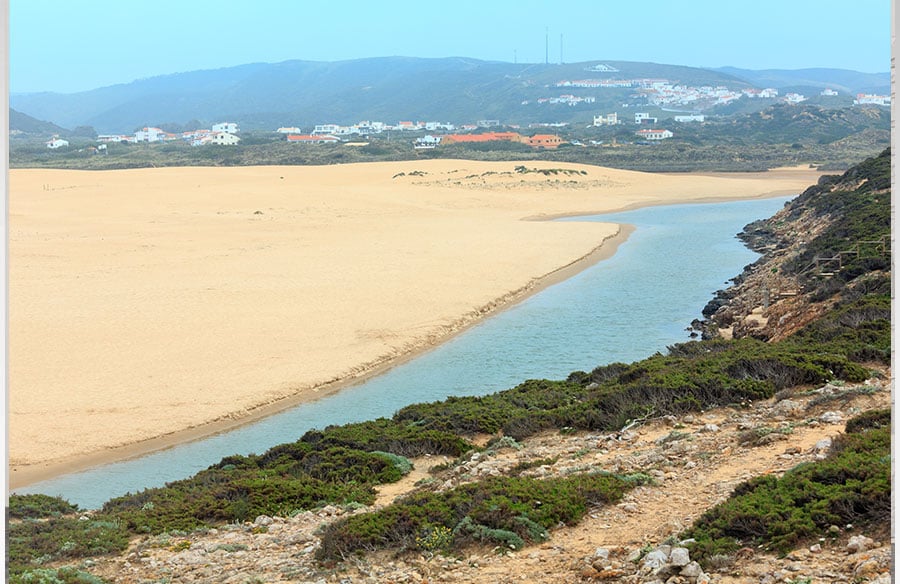
Anyone who’s flown into Faro and looked down at the patchwork of lagoons and sandbanks stretching along the coast has seen the Ria Formosa without necessarily knowing its name or understanding just how much authority it has over local construction. This protected natural park runs along much of the eastern Algarve, and its conservation status has become one of the biggest, quietest factors shaping what can and can’t be built near towns researching Algarve real estate for sale in this part of the region.
What the Park Actually Protects
The Ria Formosa is a system of barrier islands, salt marshes, and tidal lagoons that supports genuinely significant biodiversity, migratory birds, fish nurseries, and one of the last places in Europe where traditional salt harvesting still happens at any meaningful scale. Its ecological importance is well documented and not remotely controversial among scientists, which is part of why the protections around it have real teeth rather than being a symbolic gesture that gets waived whenever a developer complains loudly enough.
How This Plays Out for Actual Construction Projects
Development within or immediately adjacent to the park boundary faces environmental impact assessments that go considerably beyond a standard planning application, covering water drainage, light pollution effects on nesting birds, and even noise during construction phases at certain times of year. Projects that would sail through approval elsewhere in the Algarve can take years longer here, and some proposals get rejected outright regardless of how much money is behind them, which frustrates developers but is precisely the point of the protection existing at all.
The Buildings That Predate the Rules
A fair number of older structures, some going back generations, sit within areas that would never get approved for new construction today. These often belong to traditional salt pan operators or small scale fishing families, and the legal status of these buildings is a genuinely complicated area of Portuguese planning law, generally allowed to remain and sometimes be maintained, but rarely permitted to expand significantly, which creates an odd situation where the historic character of the area is preserved partly by accident of timing rather than deliberate design.
Why This Actually Benefits the Property Market Long Term
It would be easy to frame these restrictions purely as an obstacle, and plenty of frustrated developers do exactly that. But the Ria Formosa’s protected status is also precisely why the eastern Algarve has avoided the kind of dense overdevelopment that reshaped some western coastal towns during earlier tourism booms. Property here retains a genuine sense of open landscape and quiet that buyers increasingly value, and that scarcity of unrestricted coastal land has, if anything, supported values in the towns bordering the park rather than undermining them.
What Buyers Actually Need to Check
Anyone considering a property near the park boundary should request the specific zoning classification and any environmental restrictions attached to the land before assuming future extension or new construction will be straightforward. A plot that looks buildable on a map can turn out to sit within a buffer zone with meaningfully tighter rules than a similar plot a few hundred metres further inland. It’s a slower way to research a purchase, and it’s the only way to avoid an unpleasant surprise a year or two down the line.